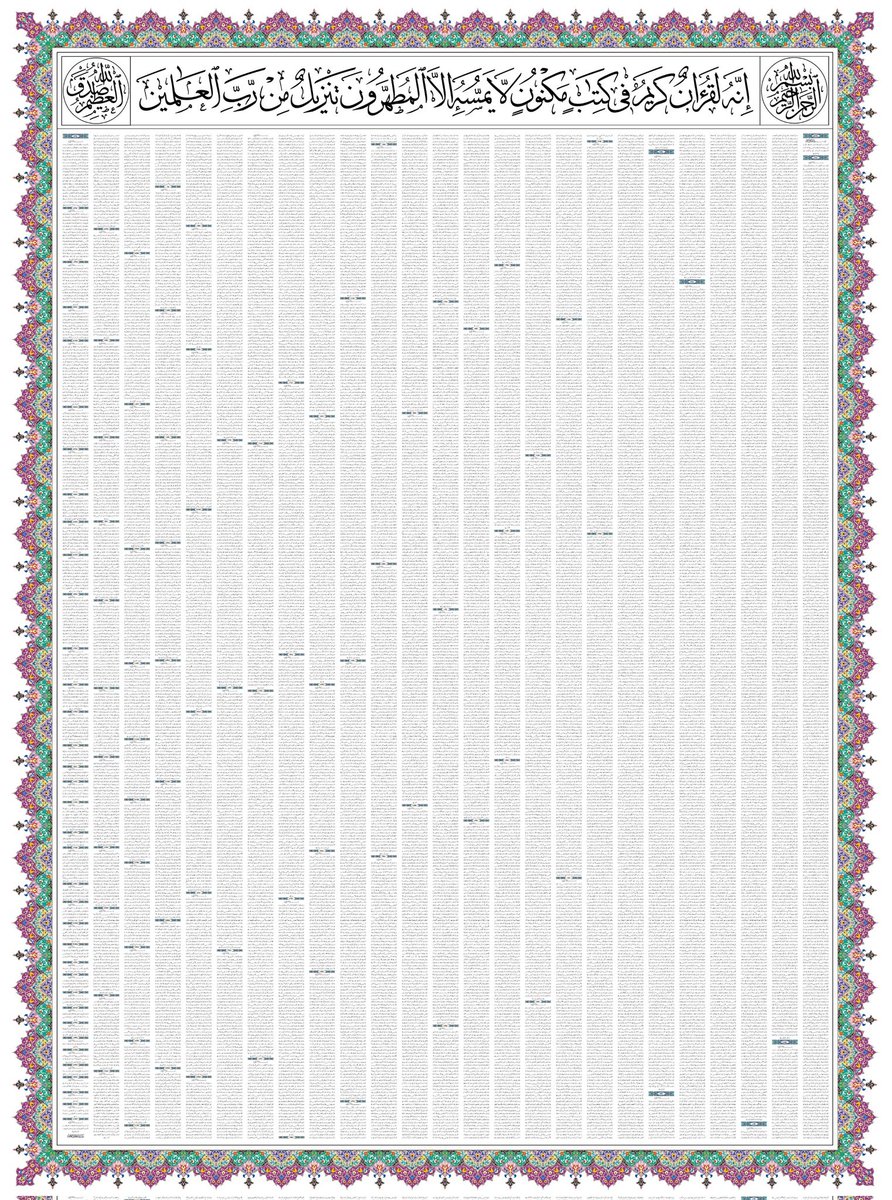
The Quran is the holy book of the Islamic world. Collected over a 23-year period during the 7th Century CE, the Quran is said to consist of Allah's revelations to the Prophet Muhammad, transmitted through the angel Gabriel. Those revelations were written down by scribes as Prophet Muhammad pronounced them during his ministry, and his followers continued to recite them after his death. At the behest of the Caliph Abu Bakr, the chapters and verses were collected into a book in 632 CE; that version of the book, written in Arabic, has been the holy book of Islam for over 13 Centuries.
Islam is an Abrahamic religion, meaning that, like Christianity and Judaism, it reveres the biblical patriarch Abraham and his descendants and followers.
The Quran is divided into 114 chapters of different topics and lengths, known as surah. Each surah is made up of verses, known as ayat (or ayah). The shortest surah is Al-Kawthar, made up of only three verses; the longest is Al-Baqara, with 286 verses. The chapters are classified as Meccan or Medinan, based on whether they were written before Muhammad's pilgrimage to Mecca (Medinan), or afterward (Meccan). The 28 Medinan chapters are mainly concerned with the social life and growth of the Muslim community; the 86 Meccan deal with faith and the afterlife.
The Quran is also broken into 30 equal sections, or juz'. These sections are organized so that the reader can study the Quran over the course of a month. During the month of Ramadan, Muslims are recommended to complete at least one full reading of the Quran from cover to cover. The ajiza (plural of juz') serve as a guide to accomplish that task.
Themes of the Quran are interwoven throughout the chapters, rather than presented in chronological or thematic order. Readers may utilize a concordance, an index that lists each usage of every word in the Quran to look for particular themes or topics.
- Subscribe for Detailed Post -
#archaeohistories
@IslamicIns70668 Cliffe finds no problem with educating others on Christianity and the Bible in public, but as soon as a reasonable Muslim has a convocation with Cliffe, and makes good points, Cliffe shuts them down, saying they're not listening to him even though Cliffe wasn't the one speaking.