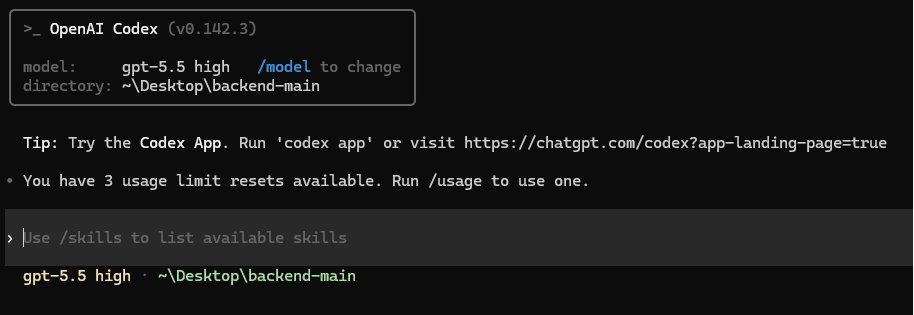
@thsottiaux Love that u guys listen feedback unlike other companies
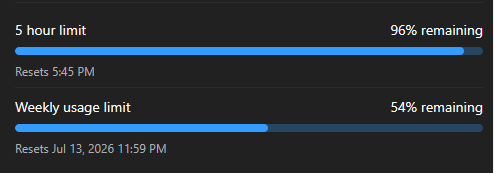
Thanks for the reset, however safeguarding is too sensitive i never once seen that using 5.5 but now when i use 5.6 it stops every 5 to 40 min.
Limits seemed to be draining fast but will test it again after this tweet.
Not done yet: Triton kernels aren't GPU-validated, the drafter is trained on a toy target only, wall-clock numbers are single runs. Apache-2.0, 178 tests. Tell me where it breaks.
https://t.co/YaiQYEKWpm
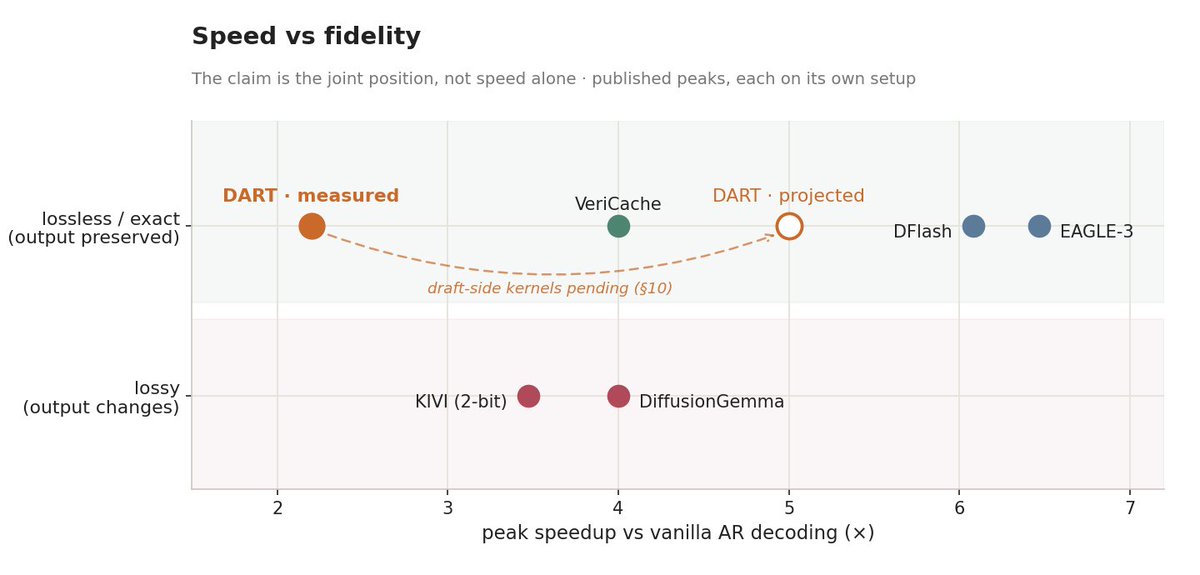
I built DART,
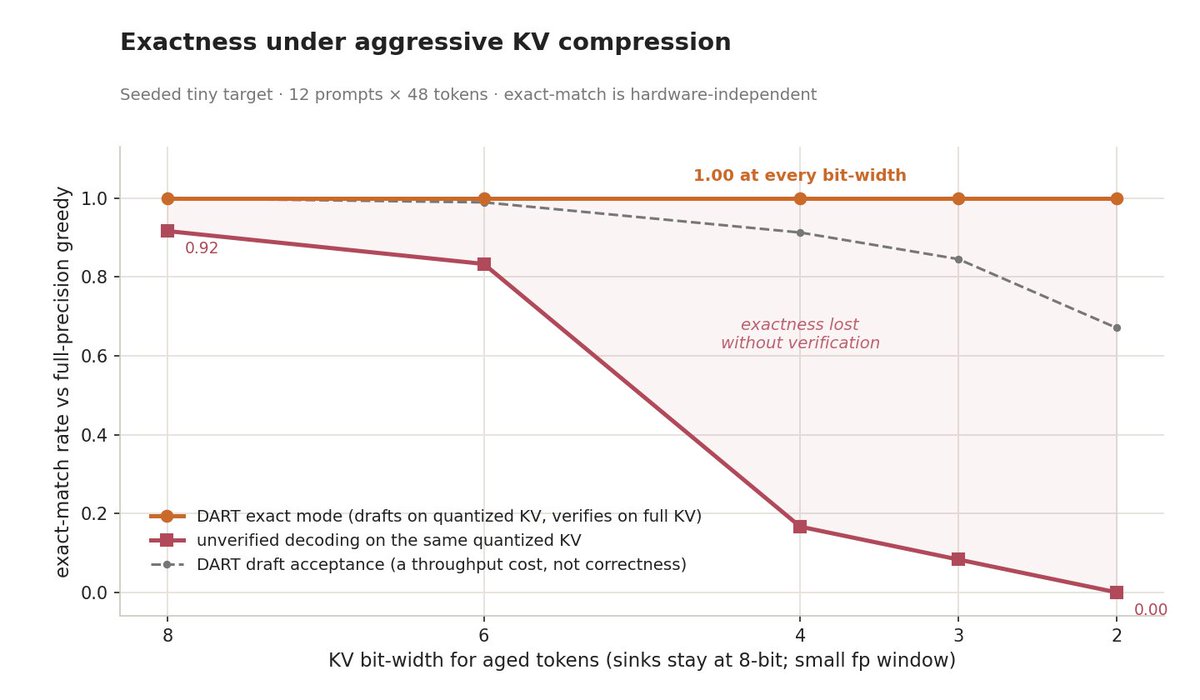
an LLM inference engine where lossy drafters (int4 KV, diffusion, n-gram) propose tokens and the full model verifies each one. Output stays byte-identical to normal decoding.
https://t.co/YaiQYEKWpm
House rule: no number in the README without a committed artifact behind it. One script rebuilds every figure from the JSONs, and the headline ablation reports mean and std over 5 seeds. A single good run is not a result.
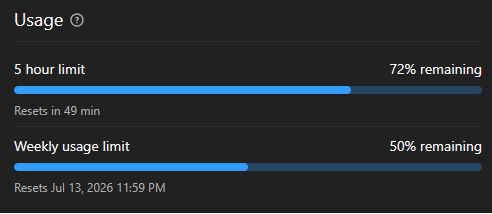
Are we sure the Codex background drain is actually fixed?
I've been tracking my token consumption and I'm only seeing a ~1-2% improvement in weekly usage.
Back when I was on the Plus plan, I could never even finish my usage. Now on Pro? It's completely drained in 3 or 4 days.
Codex usage limits will be fully reset again in the next hour and we will credit one additional reset into your bank for your own usage over the next 24 hours.
We investigated reports that Codex usage was being consumed faster than expected. There wasn't one central issue, but a few smaller problems compounded for some users.
Here's what we found and changed:
- Actual usage: Auto-review had become more proactive, another change was triggering more subagent work, and background suggestions could run twice or retry too frequently after failures. We reverted the changes and fixed suggestion scheduling, duplicate generation, and retry behavior. This should reduce unnecessary background token consumption while preserving the work users explicitly request.
- Usage reporting: Auto-review was incorrectly appearing as GPT‑5.4 usage, and failed or rate-limited requests were still shown as turns. Auto-review now appears as its own category, and only successful requests count toward the turn graphs. Rate-limited requests were never charged, but they were being displayed incorrectly.
- Immediate relief: We reset usage limits while rolling out the fixes, then shipped hotfixes across the CLI, desktop app, and usage backend.
- What to expect: New usage data should be clearer and actual consumption should be lower. Historical charts may still show auto-review under GPT‑5.4 because older turn data was not relabeled. Features that intentionally perform more work; such as /goal, subagents, and higher reasoning levels will still naturally use more capacity.
All fixes are now deployed, and we've added more detailed monitoring so we can detect background-usage regressions sooner. We'll continue watching the results closely.
Thank you for building and doing all sorts of things with Codex.
@thsottiaux 3 saved resets.
Only shows "30 days".
Would be nice to see the exact expiry timestamp for each reset.
Also when using a reset, does it consume the oldest one or the newest one ?
Thanks for the reset btw :)
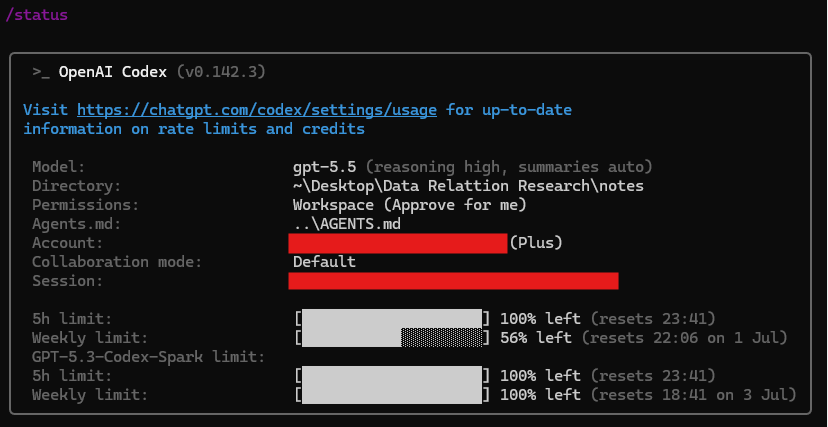
@thsottiaux 72% to 56% weekly limit in ~4 hours.
Always on 5.5 high, not on xhigh .
100% 5 hour limit used to take ~6/9% ( after x2 bonus on x5 sub ended, not before ) on the weekly limit. Now its taking ~16% .
Now that the repo is mostly built, I kind of wish I had a small army of Codex and Claude Code instances running experiments in parallel 😅
There are about 50 things I want to test and enough time to do maybe 5 of them.
Built SPECTRA.
A W1.58A8 recursive core that tries to make test-time compute fit in CPU cache.
The idea: reuse a tiny ternary core many times, measure real joules, then compare to dense baselines.
https://t.co/LIvkVC2gfz
cc @thsottiaux@embirico@bcherny
6/6
The main kernel idea is weight-stationary recursion.
Decode the 2-bit weights once.
Use them across K recursive steps.
DRAM weight bytes/MAC becomes:
0.25 / K
As K goes up, weight traffic per MAC goes down and throughput rises.
cc @rourkem