𝐖𝐡𝐲 𝐝𝐨 𝐈 𝐤𝐞𝐞𝐩 𝐭𝐚𝐤𝐢𝐧𝐠 𝐭𝐡𝐞 𝐫𝐢𝐬𝐤—𝐩𝐞𝐫𝐬𝐨𝐧𝐚𝐥 𝐚𝐧𝐝 𝐩𝐫𝐨𝐟𝐞𝐬𝐬𝐢𝐨𝐧𝐚𝐥—𝐭𝐨 𝐬𝐩𝐞𝐚𝐤 𝐭𝐫𝐮𝐭𝐡 𝐨𝐧 𝐡𝐞𝐫𝐞?
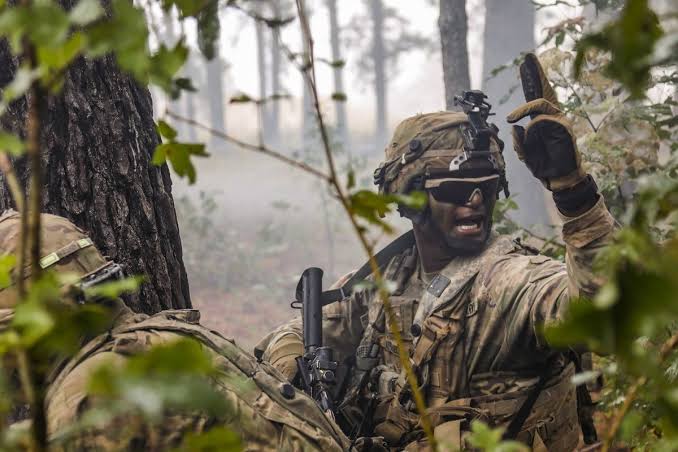
As one of the few senior officers still active on X, I’ve been attacked, downgraded, and hit with whisper campaigns meant to soften what I’ve seen and said from the front seat of command.
I do it because I care. Deeply. Because I’m committed to authenticity and relentless about truth. Not for clicks or applause, but for one purpose: to build the lethality and warfighting edge our Army will need if the balloon goes up. And more importantly, to strengthen deterrence—so we never have to fight.
Peace comes through real, credible strength. Not dog-and-pony shows.
I’ve been “informed” my authenticity upsets people. Damn right it does. That’s the job. Our profession demands abrasiveness when softness gets Soldiers killed.
I’ve written the professional articles, recorded the podcasts, spoken at the symposiums. Observations from 55 NTC rotations, Blackhorse command, and hard lessons from the modern battlefield. They get filed away like every other rotational AAR—only for us to repeat the same mistakes and ignore the same gaps.
𝐗 𝐢𝐬 𝐝𝐢𝐟𝐟𝐞𝐫𝐞𝐧𝐭. 𝐈𝐭 𝐜𝐫𝐞𝐚𝐭𝐞𝐬 𝐭𝐡𝐞 𝐭𝐫𝐚𝐟𝐟𝐢𝐜, 𝐭𝐡𝐞 𝐟𝐫𝐢𝐜𝐭𝐢𝐨𝐧, 𝐭𝐡𝐞 𝐜𝐨𝐧𝐯𝐞𝐫𝐬𝐚𝐭𝐢𝐨𝐧𝐬 𝐭𝐡𝐚𝐭 𝐚𝐜𝐭𝐮𝐚𝐥𝐥𝐲 𝐦𝐨𝐯𝐞 𝐭𝐡𝐞 𝐧𝐞𝐞𝐝𝐥𝐞.
That’s why I stay in the fight here.
Our Army deserves leaders who prioritize winning over comfort. I’m all in on that mission.
#Blackhorse #Lethality #MissionCommand
The year is 1949.
The Nobel Prize in Medicine has just gone to the man who invented the lobotomy. Your doctor suggests one for your sister, who has not been herself since the baby came. It is the most celebrated advance in psychiatry of the age, and he is simply current. By the time the prize curdles into an embarrassment, close to twenty thousand Americans have had the operation, and proportionally more here in Britain.
The year is 1956.
Lay the baby down on his front, the doctor says. So does the most trusted childcare book ever written, the one on every new mother's shelf. On his back he might choke, the reasoning goes. Millions obey. The advice holds for nearly thirty years, long after the evidence has quietly turned, and a generation of cot deaths is counted before anyone thinks to roll the babies over.
The year is 1966.
A bestselling book informs your wife that menopause is a disease, that she is, in the author's word, a castrate, and that a small daily pill will keep her youthful and tolerable to live with. Her doctor agrees. The drug becomes one of the most prescribed in the country. Nobody mentions that the author sat on the payroll of the company that made it. That detail surfaces decades later, in the same year the landmark trial is halted early for raising rates of breast cancer, stroke and clots.
The year is 1979.
Your ulcer is caused by stress and sharp food, the doctor explains. Calm down, drink milk, take the antacid that happens to be the best-selling medicine on earth. Two Australians are about to prove that most ulcers are caused by a bacterium and cured by a fortnight of antibiotics. The profession laughs. One of them eventually drinks a beaker of the stuff to settle the matter. The establishment takes the better part of twenty years to stop laughing. The Nobel lands in 2005.
The year is 1985.
Butter is dangerous, the doctor says. Switch to margarine, it is modern, it is heart-healthy, the experts are united. The spread he nudges you toward is loaded with trans fats, which the next decade will identify as the genuinely dangerous one, and which will eventually be banned outright. The butter goes quietly back in the fridge. No correction is ever printed at the volume of the original warning.
The year is 1992.
There is a pyramid on the surgery wall, and the very same one in your grandchild's classroom. Bread, cereal, rice and pasta form the broad virtuous base, up to eleven servings a day. Fat is exiled to the tiny tip. The chart was reportedly held back a year while the relevant industries had their say. It is wrong at the bottom and wrong at the top.
Now it is today.
Your doctor has new guidelines, new studies, a fresh consensus, delivered with precisely the steady confidence of every guideline above. He believes it, and he has good reason to. So did every doctor in this thread. None of them were villains. Each was sincere, most were kind, and all were certain, reading from a map that somebody else had drawn and handed them. That is the part worth sitting with.
So when the man in the white coat tells you what to eat, what to fear, and what to swallow every morning for the rest of your life, you are allowed to ask. Who paid for the study. What the evidence says beneath the headline. What he was just as certain about thirty years ago, and where that advice sits now.
Then make up your own mind. Call it scepticism, or call it whatever your grandmother called it when she ignored the advert, kept the butter where it was, and lived to ninety-one.
It has outlasted every consensus on this list. It will outlast this one too.
“I wish it need not have happened in my time," said Frodo.
"So do I," said Gandalf, "and so do all who live to see such times. But that is not for them to decide. All we have to decide is what to do with the time that is given us.”
@DrSuneelDhand Read The Fourth Turning.
I think we’re in the transition from the third turning (unraveling) into the fourth (crisis).
Western Civilization tracks these turnings like clockwork
A doctor at the hospital the CDC used to launch remdesivir filed an affidavit Fox covered. The hospital's leaders openly discriminated against unvaccinated patients and refused them medical care.
Every American needs to see what happened.
https://t.co/wrMtgZyfvO
82 years ago today, nearly 160,000 Allied troops stormed the beaches of Normandy on D-Day, launching the liberation of Europe.
We are free because they were brave. 🇺🇸
Eighty-two years ago today, freedom stood on the edge of extinction, and Allied forces stormed into hell to help save the world.
We will never forget the courage, the sacrifice, and the blood spilled on that fateful day.
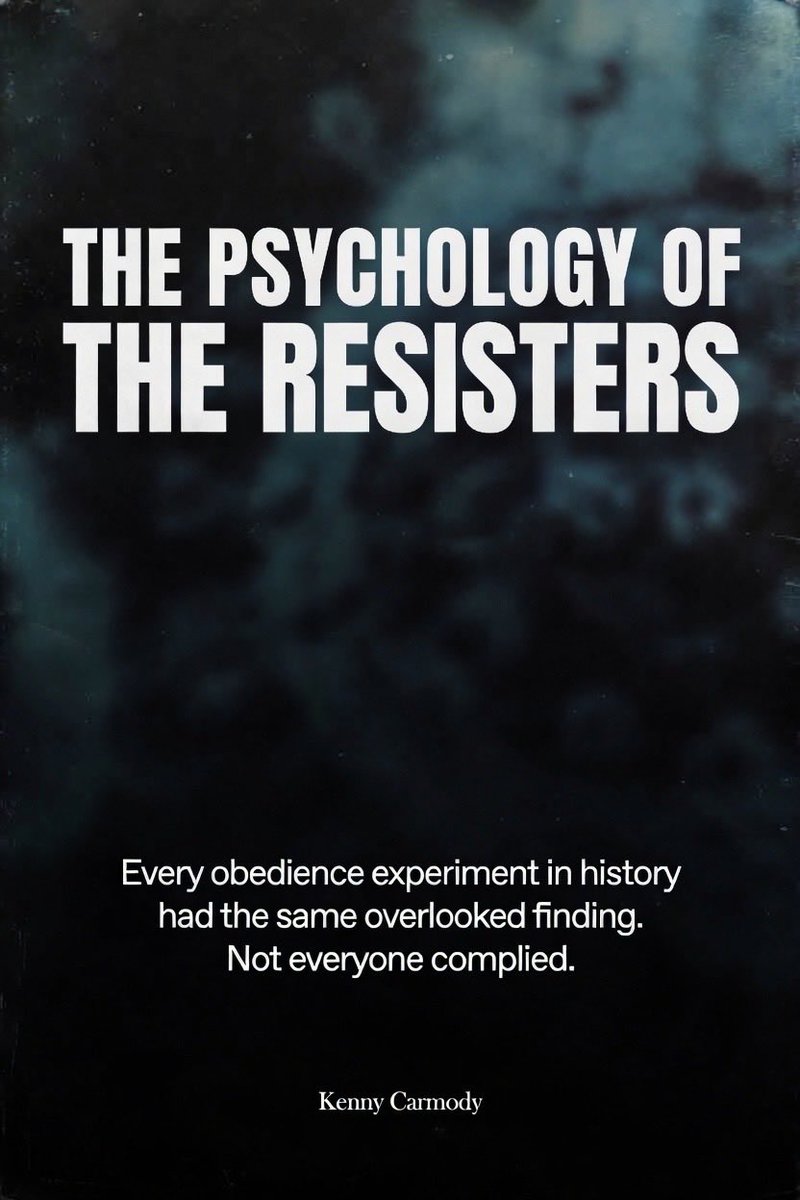
Every obedience experiment in history had the same overlooked finding.
Not everyone complied.
In Milgram’s lab, 35% refused to deliver the final shock. In Asch’s line experiments, 25% never conformed, not once, across any trial. In Zimbardo’s prison, at least one guard refused to dehumanize. One prisoner demanded a lawyer instead of a doctor and broke the psychological frame entirely.
We spent decades studying the ones who obeyed.
We barely asked what made the others different.
That question matters more now than it ever has.
The resisters in the COVID era were not difficult to find. Physicians who filed exemptions and lost their licenses. Nurses who walked away from careers rather than mandate patients into decisions they hadn’t genuinely chosen. Scientists who published contrary data knowing what it would cost them. Parents who stood alone at school board meetings. Ordinary people who simply said, quietly, without drama , no.
What made them different?
Research consistently identifies a cluster of factors. Not personality traits you either have or don’t. Situational and cognitive patterns that can be cultivated.
First: prior reflection on authority. The resisters had usually thought, before the crisis, about the limits of institutional trust. They weren’t cynics. They were people who had already asked the question “under what conditions would I refuse?” before anyone was asking them to comply.
Second: a concrete reference point outside the consensus. A value, a principle, an oath, a relationship that existed independently of the institutional structure demanding compliance. Something the system couldn’t reach.
Third: at least one other person. Milgram found that a single dissenting confederate reduced compliance dramatically. The resisters rarely stood entirely alone. They found each other. Sustained each other. Gave each other permission.
Fourth: the willingness to tolerate social pain. Not immunity to it. Tolerance of it. They felt the pressure. They felt the exclusion. They chose the discomfort of integrity over the comfort of belonging.
None of this is innate. All of it is learnable.
The most important thing Milgram, Asch, and Zimbardo taught us is not how fragile conscience is.
It’s that conscience can hold, if you’ve trained it, named its limits, and found even one other person willing to hold theirs beside you.
Build that now. Because the experiment is always running.
Until then stay humble.
For nearly seven years, Melina Salazar worked at a small diner in Texas where she regularly served an elderly World War II veteran named Walter “Buck” Swords. He was known for being difficult, constantly complaining, rarely smiling, and almost never leaving tips. Many employees avoided waiting on him whenever they could.
But Melina continued treating him with patience, kindness, and respect every single time he walked through the door. She never mocked him, never ignored him, and never let his attitude change the way she treated him.
Then one day, he suddenly stopped coming to the diner.
Not long after, Melina received a call from a lawyer and learned that Walter had passed away. What she heard next completely shocked her. In his will, he had left her $50,000 and his Buick car.
He also shared that her kindness over the years had meant more to him than she probably ever knew.
AMERICA HAS FORGOTTEN:
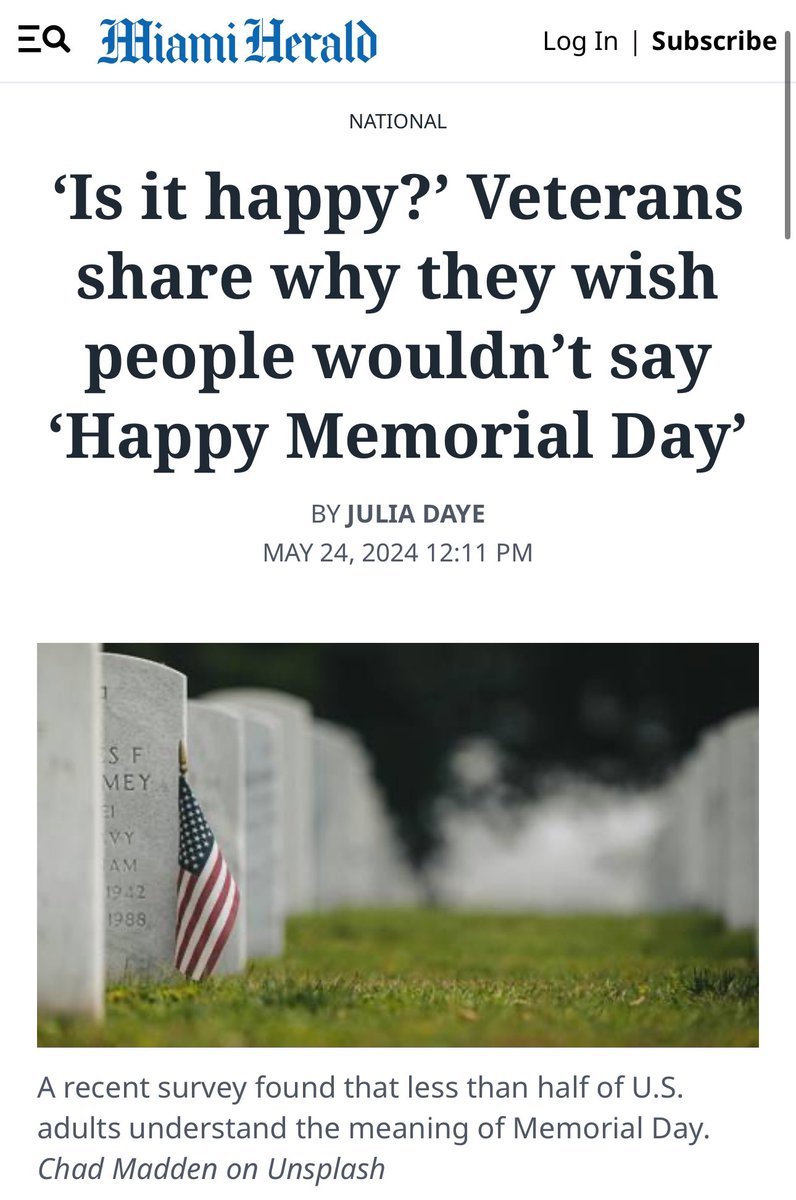
#MemorialDay has become two separate days. For the average American it has been commercialized for decades like every other meaningful date on the calendar. Picnics, pool
openings, BBQ, a day off work / school- it's spring in all its glory.
However most don't truly realize
it has been terribly disrespectfully warped. It is a completely different day for those affected by war.
It is intended to be a day set aside to remember those Warfighters who have given their lives in service of our country.
Many times seeing it celebrated in the this commercialized way causes the Warfighter Community anguish as they remember their brothers and sisters in arms who sacrificed their lives, sometimes literally physically having been right beside them. Those memories never leave them.
War has created empty seats at tables across our country day after day, year after year. It's painful. Memories flow.
It's meant to be a time of solemn reflection of those who left our lives in the violence of war. Those who have given the ultimate sacrifice for all of us, for our comfort and safety. Their last breath committed to the oath they took as guardians of our country.
Spouses, children, parents, siblings, friends reflecting on those they lost. The wounds still painful for the absence of their loved one.
Respectfully honoring our fallen matters. Being respectful of our veterans and their personal losses and memories matter. Remembering so many have lost a loved one in service to our country as this day dawns year after year matters.
It should be who we are, now it's who used to be.
We have lost our way in the commercialization as a country in so many ways. This is one of them. Do you think it's accidental?
(Team BC)
https://t.co/RbD47uNM7p
In June 1775, the British military governor of Massachusetts offered a full pardon to every American rebel who would lay down arms.
He named two exceptions. Samuel Adams was one of them.
By that point Adams had spent over a decade engineering the destruction of British rule in America, and the Crown wanted him hanged for treason. He was 52 years old, broke, often dressed in clothes his friends had quietly bought him, and shook with a tremor so bad he could barely sign his name.
He was also the most dangerous man in the empire.
Sam Adams was born in Boston in 1722, thirteen years before his more famous cousin John. He entered Harvard at 14 and wrote his master's thesis on whether it was lawful to resist the supreme magistrate "if the commonwealth cannot otherwise be preserved." He argued yes. He was 20. He would spend the rest of his life proving it.
He was terrible at business. He inherited his father's malt house and ran it into the ground. He tried merchant trading and failed. The town of Boston eventually made him tax collector, possibly as charity, and he proceeded to not collect taxes from people who couldn't afford them. He ended up personally owing the town thousands of pounds, an enormous debt for the time. Boston never made him pay it back.
Voters loved him for it.
In 1764, when Parliament passed the Sugar Act, Adams wrote one of the first major American arguments that taxation without representation was unconstitutional. When the Stamp Act followed in 1765, he organized the Boston resistance, helped grow the Sons of Liberty, and pioneered something new in politics: he turned the Boston town meeting into a weapon, a place where ordinary tradesmen voted on questions of empire.
He wrote constantly. Under more than 25 different pseudonyms, Vindex, Candidus, Determinatus, Populus, and on and on, he flooded Boston newspapers with essays attacking British policy. Loyalists complained that fishermen and dockworkers were now debating constitutional theory in taverns. That was Sam Adams's doing.
After the Boston Massacre in 1770, he stood in front of the royal lieutenant governor and demanded every British soldier be removed from Boston. Not some. All. The governor caved. The troops left. His younger cousin John then defended those same soldiers in court, and Sam never held it against him. They were running the same revolution from opposite ends.
In 1772, Sam Adams invented the system that made the Revolution possible: the Committees of Correspondence. He organized a network of patriot writers in every Massachusetts town who exchanged letters, news, and grievances. Other colonies copied it. Within two years, an unofficial shadow government stretched from New Hampshire to Georgia, faster and better informed than the British administration trying to govern it. It was, in effect, the internet of the American Revolution, and one man designed it.
Then came the tea.
On December 16, 1773, after a final mass meeting at the Old South Meeting House, Sam Adams reportedly stood and said, "This meeting can do nothing more to save the country." It is widely believed to have been the signal. Within minutes, men disguised as Mohawks marched to Griffin's Wharf and threw 342 chests of British tea into Boston Harbor. Adams did not put on a costume or board the ships. He didn't need to. He had built the crowd that did.
Britain responded with the Coercive Acts, shutting down the port of Boston and rewriting the Massachusetts charter. Adams used the crisis to summon the First Continental Congress.
On the night of April 18, 1775, British troops marched out of Boston with two missions: seize the patriot weapons stockpiled at Concord, and capture Samuel Adams and John Hancock, who were hiding in a parsonage in Lexington. Paul Revere rode ahead to warn them. They slipped into the woods minutes before the redcoats arrived. As the first shots of the Revolutionary War cracked behind him on Lexington Green, Adams is said to have turned to Hancock and exclaimed, "What a glorious morning for America."
He signed the Declaration of Independence the next year. He helped write the Massachusetts Constitution of 1780, the oldest functioning written constitution in the world, still in force today.
After the war, the firebrand became an elder statesman. He opposed the new U.S. Constitution at first because it had no Bill of Rights, then supported ratification once one was promised. He served as Lieutenant Governor under John Hancock, then as Governor of Massachusetts from 1794 to 1797. He watched his younger cousin John serve as the second President of the United States while he ran the state where the whole story had started.
By the end, the tremor in his hands was so severe his wife Betsy had to write his letters for him. He spent his last years quietly in Boston, in the same plain coat, in the same plain house, talking about scripture and republics.
He died on October 2, 1803, in genteel poverty. His funeral procession was the largest Boston had ever seen.
The brewery wasn't his. The beer is just a name. The country is the monument.
I CRIED WHEN I READ THIS
A parent’s home will always remain open for their children…
even after arguments, distance, disappointment, or years apart.
But many parents quietly realize that once their children grow up,
they slowly stop having a place in their children’s busy lives.
Parents spend their whole life saving money for their children’s future…
while many children grow up counting every expense spent on their parents.
A mother will stay awake all night if her child is sick…
but many parents silently stare at their phones waiting for a simple call that never comes.
Parents forgive their children again and again without keeping score.
But as they grow older, they often fear becoming a burden to the very people they once carried in their arms.
The painful truth is:
when we are young, our parents feel permanent.
So we delay the visits.
The hugs.
The conversations.
The appreciation.
Until one day…
the chair they used to sit in stays empty forever.
And suddenly, all the busy days that felt “important” no longer matter at all.
Love your parents gently while you still can.
Call them more.
Sit with them longer.
Listen to their stories patiently.
Because one day, you will realize:
no one in this world will ever love you
as quietly, deeply, and selflessly as they did.
✨🙌🏾💫