A column article by Will.FX:
Redefining Financial Rails: Perspective on Robinhood's Prediction Market and AI Agent Revolution
If Meta's "Arena" is about gamifying social predictions, Robinhood is elevating prediction markets (Event Contracts) into the "fourth major retail asset class", sitting alongside equities, options, and crypto. It is a textbook Web2.5 bridge model: leveraging world-class Web2 user experience to unlock Web3's on-chain settlement efficiency and fully compliant event contracts.
1. Financializing Information: Democratizing Global Hedging
By offering real-money, binary contracts priced between $0.01$ and $0.99$ USD, Robinhood is making macro hedging accessible to the masses.
Breaking Asset Silos: Users can seamlessly trade Tesla stock, Ethereum (ETH), and "Fed rate cut probabilities" in a single portfolio.
Micro-Hedging for All: Institutional-grade macro hedging—against inflation, tariff changes, or geopolitical events—is now democratized, allowing retail users to hedge risks for just pennies.
2. The Web2.5 Hybrid Architecture: Custom L2 and Regulatory Moat
Unlike platforms facing regulatory headwinds, Robinhood has constructed a robust hybrid model:
Robinhood Chain (L2): Built on Arbitrum, Robinhood's proprietary L2 chain migrates tokenized equities, crypto, and event contracts on-chain, driving transaction fees down to sub-penny levels (under $0.01$).
Regulatory Shield: By partnering with CFTC-regulated clearinghouses like Kalshi and ForecastEX, Robinhood combines decentralized settlement efficiency with a solid US regulatory moat.
3. Agentic Accounts: The Automated Era of Prediction Markets
The true paradigm shift lies in Robinhood's Agentic Accounts, a feature that aligns perfectly with the CAIA (Crypto AI Agent Benchmark) framework:
AI-Driven Trading: AI agents process macro indicators and global data much faster than humans. Robinhood allows users to plug custom AI agents directly into its trading infrastructure.
Machine Pricing: Markets are now priced 24/7 by AI agents scanning news and on-chain data. This shifts prediction markets into an era of hyper-liquidity and marks a major step toward AI-driven asset ownership.
Prediction markets are the ultimate convergence of information and capital. When autonomous AI agents begin pricing reality on Robinhood Chain using real capital, we cross the threshold of Web2 and enter a self-adaptive financial era run by algorithms and protocols.
@LegioAlternati2
Prediction Market Daily(June 30, 2026 )
Keywords: Regulation | Kalshi | FIFA World Cup | Meta |
📰 Headlines
① Michigan Court Temporarily Bars Kalshi from Offering Sports Event Contracts to State Residents ⭐⭐⭐⭐⭐
A Michigan state court has issued a Temporary Restraining Order (TRO) prohibiting Kalshi from offering sports event contracts to Michigan residents and requiring the company to immediately implement geofencing measures. The case further escalates the ongoing jurisdictional dispute between state gaming regulators and the U.S. Commodity Futures Trading Commission (CFTC) over the regulation of prediction markets.
② Meta Considered Acquiring Kalshi Before Building Arena ⭐⭐⭐⭐☆
Multiple media outlets revealed additional details today indicating that, before developing its prediction market product Arena, Meta had evaluated acquiring Kalshi. The company ultimately decided to build the product in-house while also exploring potential partnerships with platforms such as Kalshi and Polymarket. This signals that major internet companies increasingly view prediction markets as a key component of the next generation of interactive products.
③ Kalshi CEO: Insider Trading Is Easier to Detect in Prediction Markets Than in Stock Markets ⭐⭐⭐⭐☆
In an interview today, Kalshi CEO Tarek Mansour stated that suspicious trading activity is easier to identify in prediction markets because the relationship between events and trades is more direct. He noted that Kalshi has implemented employee verification, abnormal trading surveillance, and whistleblower mechanisms. His remarks also respond to recent public concerns regarding potential insider trading in prediction markets.
④ FIFA World Cup Knockout Stage Continues to Dominate Prediction Market Activity ⭐⭐⭐⭐☆
The FIFA World Cup Round of 32 continues to dominate the front pages and trending markets across major prediction platforms. The most actively traded markets on Polymarket and Kalshi remain centered on World Cup matches, championship winners, and the Golden Boot race, with sports continuing to be the most active sector in the prediction market industry.
🤝 Fundraising / Partnerships
Prospect Prediction Markets Inc. (TSXV: MKT) announced today that all 7,321,679 warrants issued through its June and July 2024 private placements have been successfully exercised. The warrant exercise generated US$976,055 in gross proceeds for the company. The exercise period officially expired after market close last Friday, with the company confirming the final settlement today. The proceeds will be used to further develop its sports prediction platform and support general working capital.
📈 Market Snapshot
🔥 Hottest Sectors Today
Rank | Sector | Heat
①⚽ FIFA World Cup⭐⭐⭐⭐⭐
②🏀 U.S. Sports⭐⭐⭐⭐☆
③🪙 Crypto⭐⭐⭐☆☆
④💹 Macroeconomics⭐⭐⭐☆☆
⑤🤖 AI⭐⭐☆☆☆
🎯 Opportunity Watch
The defining theme of June 30 was not trading activity—it was regulation and mainstream adoption.
On one hand, the Michigan court's temporary injunction against Kalshi once again highlights the lack of a unified regulatory framework for prediction markets in the United States. On the other hand, Meta's disclosure that it had considered acquiring Kalshi, together with Robinhood's continued operation of its Prediction Markets Hub, demonstrates that prediction markets are steadily evolving from crypto-native applications into strategic products for mainstream internet and financial platforms.
🔍Industry Outlook
Short Term: The FIFA World Cup will remain the primary driver of trading activity.
Medium Term: Regulatory clarity will determine the pace of platform expansion.
Long Term: Prediction market infrastructure—including white-label solutions, oracles, settlement systems, and market data services—is expected to become the industry's most valuable long-term growth opportunity.
The biggest news in the industry today.
The Inham County Circuit Court in Michigan issued a Temporary Restraining Order (TRO) yesterday (June 29th), which was officially announced today (June 30th) by the Michigan Gaming Control Board (MGCB).
Because Kalshi allowed users aged 18 and over to open accounts and trade, while the legal gaming age in Michigan is 21, the court ruled that this constituted a potentially serious harm to minors and created "unfair competition" against licensed entities that pay gaming taxes in compliance with regulations.
The injunction requires Kalshi to immediately cease offering and operating any event contracts involving sporting events to Michigan residents and must use third-party geofencing technology approved by the state gaming control board to enforce the restrictions. If Kalshi fails to comply with the geofencing requirements within the specified period, it will face fines of up to $120,000 per day.
A Kalshi spokesperson responded today, stating that the company strongly opposes the decision and will fight it in court, insisting that Kalshi falls under the sole federal jurisdiction of the U.S. Commodity Futures Trading Commission (CFTC). However, the platform has already begun implementing access restrictions in Michigan.
Because Kalshi allows users aged 18 and over to open accounts and trade, while Michigan law stipulates the legal gambling age is 21, the court ruled that this constitutes a potentially serious harm to minors and creates "unfair competition" against licensed entities that compliantly pay gambling taxes.
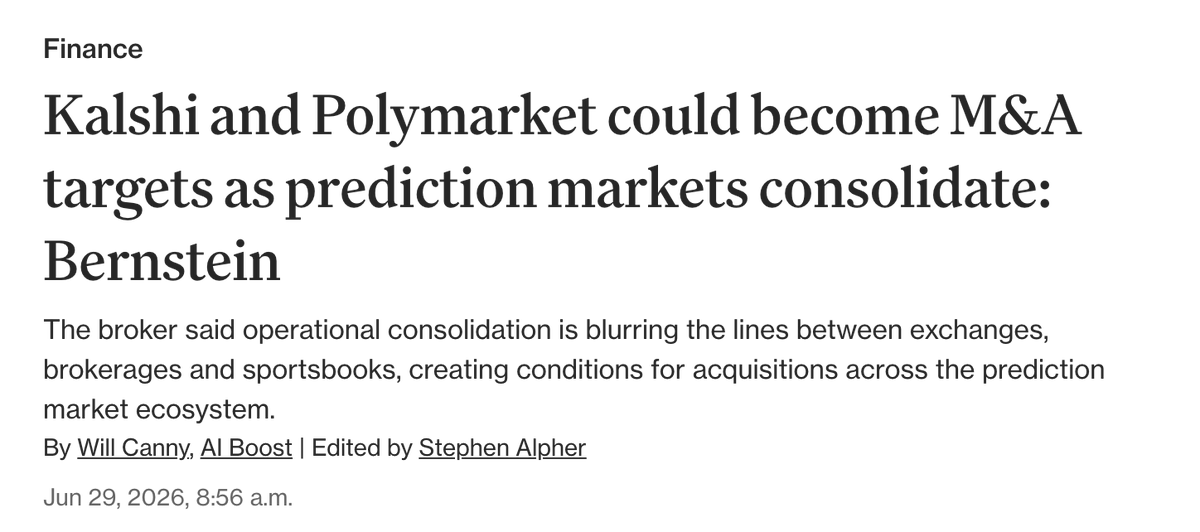
A recent industry report from Bernstein dropped a bombshell: while Kalshi and Polymarket possess perfect technology stacks, their lagging distribution makes them highly likely to become acquisition targets. The report points out that prediction markets, sports betting, and consumer finance are rapidly converging into a single competitive landscape, with Robinhood and Coinbase currently holding the strongest dominance.
This analysis precisely confirms futurist Kevin Kelly's fundamental prediction about technological evolution: the destination is dying, the scenario is the future; the ultimate fate of technology is to become "invisible" and "headless."
I. Why are Robinhood, Coinbase, and sports betting giants (Flutter, DraftKings) frantically entering this field?
Because prediction markets are driving a collective leap in human cognitive paradigms: everything is predictable, probability is an asset.
For consumer finance platforms, traditional stock and cryptocurrency trading naturally fluctuates within bull and bear cycles, while "uncertainty" is the only perpetual, cyclical hard currency in human society.
Financial institutions flock to prediction markets because they offer perfect "synthetic assets." A user might not want to buy stocks today, but they'd definitely be willing to place a bet on Robinhood about "whether the Fed will cut interest rates next week"; a sports fan scrolling through social media would also be willing to use their funds to price in "whether there will be a red card in the second half." Prediction markets have become the ultimate weapon for financial giants in 2026 for low-cost user acquisition and increasing user lifetime value (LTV).
II. The Demise of the Destination Model and the Birth of "Headless Marketplaces"
Polymarket's past success relied on the "singularity effect" of political elections. But when the world returns to normal, users won't download a separate app or visit a separate website just to place a bet. Prediction markets will become "invisible"—a native button in the Coinbase wallet, an option on the Robinhood trading panel, and even a readily clickable interactive component in social media feeds like Farcaster and Telegram.
This is a game between "those who price the future" and "those who control the distribution channels."
Prediction markets are no longer an isolated arena; they have been formally integrated into the massive global ecosystem of finance, gambling, and Web3 social media. Everything can be priced, and the giants who control the screen access of hundreds of millions of users are setting the final acquisition price for "the prediction platform itself." Distribution is destiny—when prediction markets collide with the ultimate devouring force of the "headless market."
The final acquisition price.
🚨 KALSHI AND POLYMARKET COULD BECOME M&A TARGETS -BERNSTEIN
"Kalshi and Polymarket own the stack but trail on distribution, which leaves each as plausibly a target as an acquirer"
So far:
- $DKNG acquired Railbird
- $HOOD partnered with Susquehanna to build Rothera
- $COIN acquired The Clearing Company
- $FLUT established a dual-FCM structure
Bernstein's view is that prediction markets, sports betting, & consumer finance are converging into a single competitive landscape
Robinhood and Coinbase currently have the strongest competitive positions, according to Bernstein, followed by DraftKings
https://t.co/FWfEnFx9IF
Quick question: What’s the difference between a prediction market and an opinion market? Most people don’t know. Prediction: Verifiable events + oracle. Opinion: Subjective debates + crowd consensus.
Quick question: What’s the difference between a prediction market and an opinion market?
Most people don’t know.
Prediction: Verifiable events + oracle.
Opinion: Subjective debates + crowd consensus.
If you want to experience a real opinion market 👇
Waitlist is open.
a roadmap for how a prediction market platform could actually win, modeled on how the strongest platforms compound advantages (the hyperliquid playbook by @schemacap):
phase 1: founder-market fit
team has structural edge from trading, quant, or mechanism design where they build the right primitive instead of copying polymarket
phase 2: prove the core
launch one thing done exceptionally well. organic growth from sophisticated users who see the edge first
phase 3: scale the infra
survive the volume surges and bring seamless UX during major events earns institutional credibility
phase 4: expand the surface
binary to scalar to options to conditional markets. each new instrument captures a new user type and makes it a one-stop venue
phase 5: align with a token (optional)
distribute ownership to the users who built the liquidity. fees buy back the token so usage drives value. no VC-heavy allocation
phase 6: become infrastructure
open it up so terminals, aggregators, lending protocols, and AI agents build on top and stop being a destination, become the settlement layer
phase 7: category dominance
force the industry toward your standard. early structural decisions compound into leadership latecomers can't challenge
the through-line: build something genuinely better for a specific user, align ownership with who uses it, expand methodically, turn the product into infrastructure
teams that compound patiently become the category