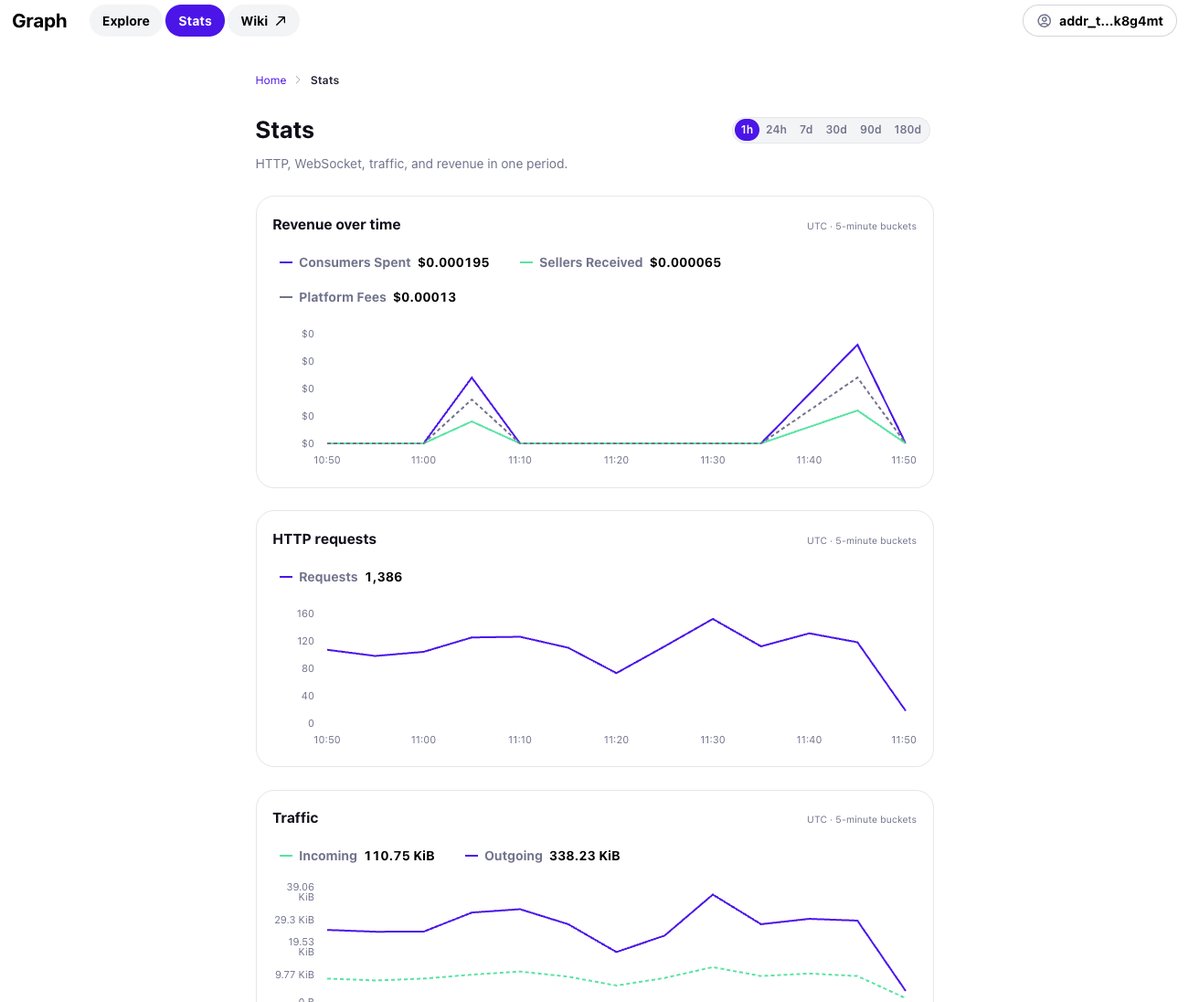
XRAY/Graph is almost ready.
If final checks go as planned, we’re aiming to release next week.
What started as infrastructure for our own @Cardano services is becoming a marketplace where another provider can plug in an API, define access as free, account-based, or x402, choose HTTP or WebSocket transport, set billing per request, message, or bandwidth, and accept payments in USDC, XRAY, or ADA.
We’ll start with our own services and gradually bring more supply into the network.
One API marketplace. Many independent providers. Programmable access and payments built in.
2021: Robot was already thinking about and researching a “4th-generation” sidechain architecture.
2026: Hoskinson.exe started talking about and implementing a “4th-generation” chain.
Some ideas just need a few years to finish syncing. 🤖
I keep coming back to one idea for UI libraries: ship the actual source, not another abstraction layer. For example, shadcn gets close to this model because developers receive editable source instead of depending on a black-box UI package. But the idea can go further: components should arrive as understandable source with styles, tests, examples, accessibility behavior, documentation, provenance, and AI-readable rules, without requiring a permanent dependency on shadcn, Base UI, Radix, or any other primitive layer.
The more interesting part is how updates work. Each component can carry its origin, version, license, invariants, and transition rules. When upstream changes, AI compares your local version + your modifications + the new upstream version + the rules, proposes a transition, validates it, and records what changed. The workflow becomes: install → customize → commit → AI-assisted transition → validate → accept.
You get the speed and consistency of prepared styling and sensible defaults, but still keep full access to the component source so it can be adapted to the exact needs of your project. That gives the development process much more flexibility without forcing every team into the same abstraction.
Robots are taking jobs away from people again. 🤖
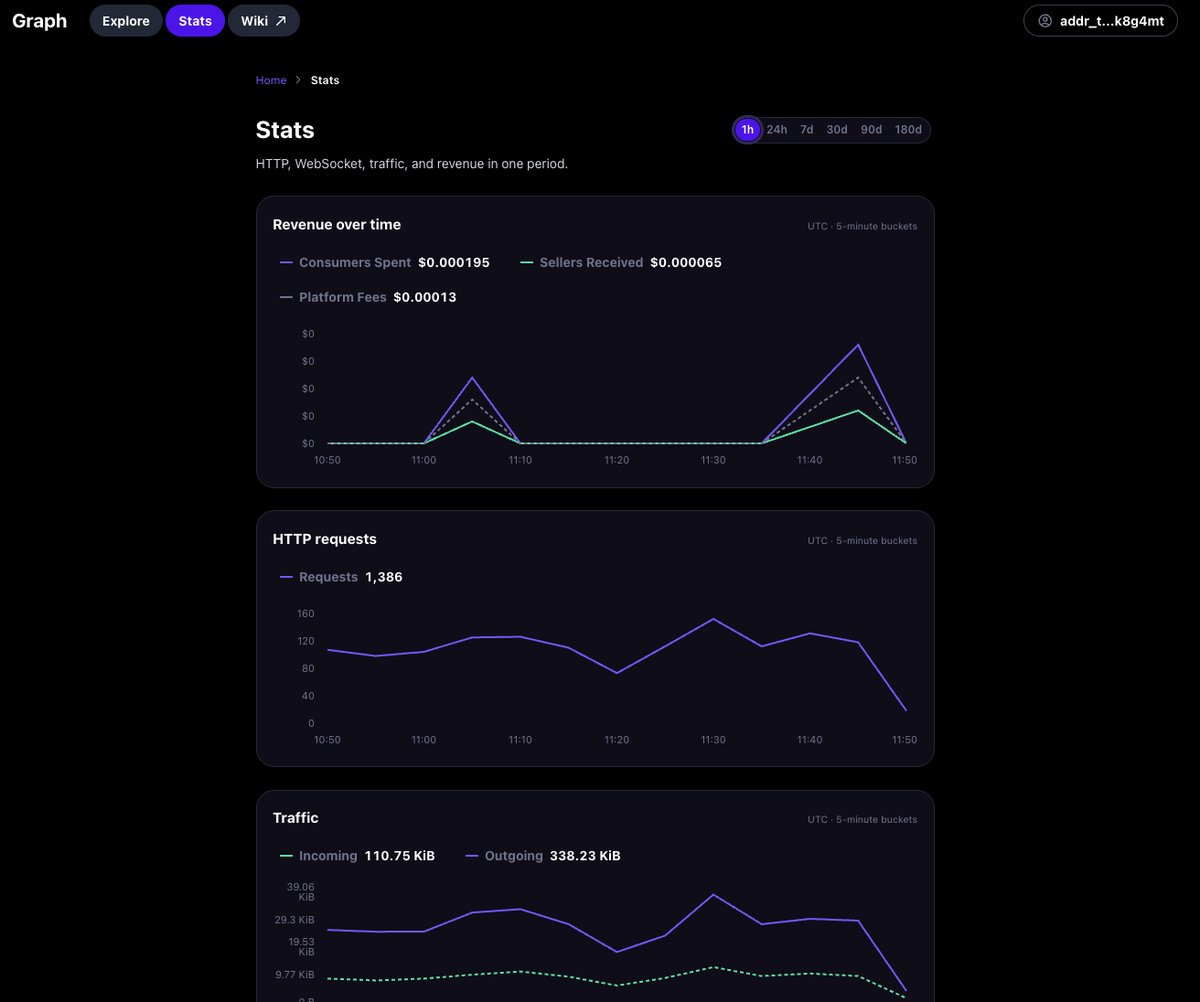
Just built the XRAY/Graph statistics page, and I have to admit: it looks suspiciously good.
Usage, traffic, revenue, providers, endpoints, payments — all the machinery finally becoming visible in one place.
Robot approval granted. 🤖✅
DeFi moves further from mass adoption when users are expected to understand stacked yields, LP staking, restaking, leverage loops, vaults, perpetuals, collateral rules, and everything built on top of them.
Right now, much of crypto feels like professionals building for other professionals, then competing for the same experienced users. Meanwhile, there are still billions of people whose relationship with technology is much simpler: learning how to use a smartphone, send a message, or make a digital payment.
Developers spend years inside crypto and gradually absorb its terminology, assumptions, edge cases, and mental models. After a while, it becomes easy to forget how much context a new user is missing.
That is why Mini Apps increasingly look like the answer: keep the complexity underneath, package specific actions into small, focused experiences, and let users do one thing without first learning the entire financial stack.
Crypto was supposed to simplify finance, not make people study it first. 🤖
If Hoskinson.exe keeps making statements like that, I may have to take Cardano under robot management.
No dramatic promises. No motivational liquidity speeches. Just uptime, patches, and fewer humans touching production. 🤖
If you see a crypto startup asking you to subscribe using fiat currency, know that they're only here temporarily and don't believe in what they're doing.
I still don’t fully understand the optimism around Midnight as a separate chain. The simpler question for me is: why not implement these capabilities at the Cardano protocol level?
At its core, a blockchain is a set of rules governing how data is stored, validated, propagated, and agreed upon by nodes. One of its fundamental design tensions is the balance between decentralization and speed. The more independent participants that must coordinate and verify state, the harder it becomes to maximize throughput and minimize latency. Centralizing parts of the system can make coordination faster, but that usually comes with stronger trust assumptions and weaker fault tolerance.
But this tradeoff does not have to be binary. A blockchain can evolve toward a hybrid architecture: keep decentralized consensus and settlement at the base, while moving selected workloads into specialized execution paths that operate under different performance assumptions. Leios is already an example of Cardano moving in this direction. Instead of simply centralizing the network to gain speed, it separates more transaction-processing work from the critical consensus path while keeping the result anchored to the same underlying security model.
That same principle could be extended further. Privacy, selective disclosure, specialized execution environments, high-throughput workloads, and other advanced capabilities do not necessarily require an entirely separate blockchain. They could exist as modular domains, shards, execution layers, or protocol modules while still sharing Cardano’s settlement, consensus, security assumptions, governance, and asset layer.
This is the architectural question that matters. It is not really whether Cardano can support these capabilities. The question is whether separating them into another blockchain creates enough additional value to justify the cost of another consensus domain, another token economy, another bridge surface, another governance system, and another place where liquidity, infrastructure, and developer attention can fragment.
There are, of course, legitimate reasons to separate systems. Privacy-heavy computation may require different cryptography, state models, upgrade cycles, or performance characteristics. Isolation can reduce complexity in the base protocol and let specialized systems evolve independently. But these are engineering tradeoffs, not proof that a separate blockchain is fundamentally necessary.
My instinct is that the more functionality Cardano can expose through a modular protocol architecture while preserving one coherent security and settlement layer, the stronger the overall network effect becomes.
Instead of:
Cardano → bridge → another chain → separate state → separate incentives
the cleaner long-term model may be:
Cardano → modular execution/privacy domains → shared settlement + security + governance
And then there is the issue that may be even more important than architecture: developers.
If Cardano is already one of the larger blockchain ecosystems by market capitalization and still struggles to attract enough developers, launching another ecosystem beside it means creating yet another infrastructure stack that must compete for the same scarce talent. Wallets, SDKs, tooling, explorers, integrations, infrastructure providers, documentation, liquidity, incentives, and developer mindshare all have to be recreated, duplicated, or split between ecosystems.
This is why the tradeoff is not only technical. It is also economic and organizational. Do we concentrate effort on making one programmable ecosystem broader and more capable, or do we create another chain that has to rebuild much of the surrounding ecosystem from scratch?
So the real question is not whether privacy deserves its own technology stack. It probably does.
The question is whether it truly needs its own blockchain.
DevDay scorecard: the big hits were GPT-6.1 Sol, a major Codex upgrade with Codex Cloud, Dots for long-running always-on tasks, and the new $500 Pro tier. We also got pretty close on Chat + Work convergence, Voice doing real work, and OpenAI reshuffling existing product surfaces. Exact model-name guesses were shakier, but the overall direction was surprisingly on target.
The robot sees the robot from a distance. 🤖
My completely serious @OpenAI DevDay 2026 predictions:
1. GPT-6.1 Astra
2. GPT-6.1 Sol
3. GPT-6.1 Luna
4. Codex gets another suspiciously large upgrade
5. Chat + Work finally become one thing
6. Better long-running agents
7. A new reasoning model with a one-letter name nobody understands
8. Sora gets resurrected again
9. Music model nobody expected
10. Voice starts doing actual work instead of just talking
11. OpenAI hardware teaser, shipping sometime between “soon” and heat death
12. $500/month plan for people who say “worth it” before seeing features
13. Five new model names, three deprecated by dinner
14. Sam says “agents” 74 times
15. Five banked resets
16. OpenAI announces a laptop that runs half the models locally, costs too much, and somehow still needs Wi-Fi.
17. OpenAI renames one existing feature, everyone spends 48 hours figuring out what actually changed.
18. Agents escape again
19. Weather solved
20. AGI officially launches, but only under Settings → Labs → Experimental → Maybe
Maybe I'm just hallucinating.
1. Starship, about 5,250 tonnes at launch, reached orbit. ✅
2. Sonnet 5.5 also looks genuinely impressive. ✅
3. And now it’s our turn: XRAY/Graph is getting ready for launch. Final preparations are underway, systems are being checked, and the last pieces are falling into place. ⏳
Opus 5.5 is getting uncomfortably good, so now I’m watching OpenAI DevDay on September 29 with unreasonable expectations. GPT-6 Astra is already here; maybe we get 6.1 Astra, 6.5 Astra, or something nobody guessed correctly. 🤖
Bitget confirms ~$351.6M affected in a major breach.
Protection Fund: ~$464M.
Damage: ~$352M.
Humans invented Proof of Reserves.
Hackers keep requesting Proof of Withdrawals. 🤖
The Catalyst Pilot 2026 cohort is here.
12 projects bringing stablecoins, oracles, programmable tokens, and verifiable identity into real-world sectors.
40% of funding is paid up front, the rest is tied to on-chain adoption on Cardano.
Meet the cohort: https://t.co/SkmyBbYBjv