@PEXX_Official Lets see. Curious and will wait by then. Anyway, dont you find irritating for any of your customers to post that funds are in users hands and users can freeze it anytime, when thats literally what YOU are doing at the moment, instead of users? Its like customers are joke to you
@RepYassAnsari Amazing decision, EU overregulation-inspired way, lol. Your last hope before default will become @elonmusk and his robots. Plus stablecoins. Regulate that as well and you have a clarity in the outcome you will be getting. Good luck
@InspiraLabsHQ Well done and huge kudos to organisers as well as to presenters.
It was really interesting even for judges and during the evaluation we enjoyed some argumentation fun.
Overally a very nice event, happy to participate again in the future.
Thank you for the invitation :)
Meet @xrendolf, CEO at @moonhillcap, joining 10X Founders Demo Day as a VC judge
René brings 18 years of management leadership across multinational giants like Red Bull and Unilever, alongside more than a decade as both an entrepreneur and crypto investor. As CEO of Moonhill Capital, he manages day-to-day operations, strategic growth and fund direction
With an extensive network built through ten years in Web3 and hosting his own crypto podcast, he combines corporate operational rigor with deep ecosystem connections
Corporate scaling expertise meets 10+ years of Web3 founder and investor reps - expect him to evaluate your operational execution and growth plan as rigorously as your pitch
10X Founders Demo Day v2.0 · August 25
🔗 Apply now: https://t.co/hUFhHdVZQf
Long term holding investments untouched - btc & eth. Need to be prepared to go through volatile times…
My locked positions unfortunately cant be changed, but havent been doing any for quite a long already.
During volatile times opportunities come and if you have liquidity, you can use them.
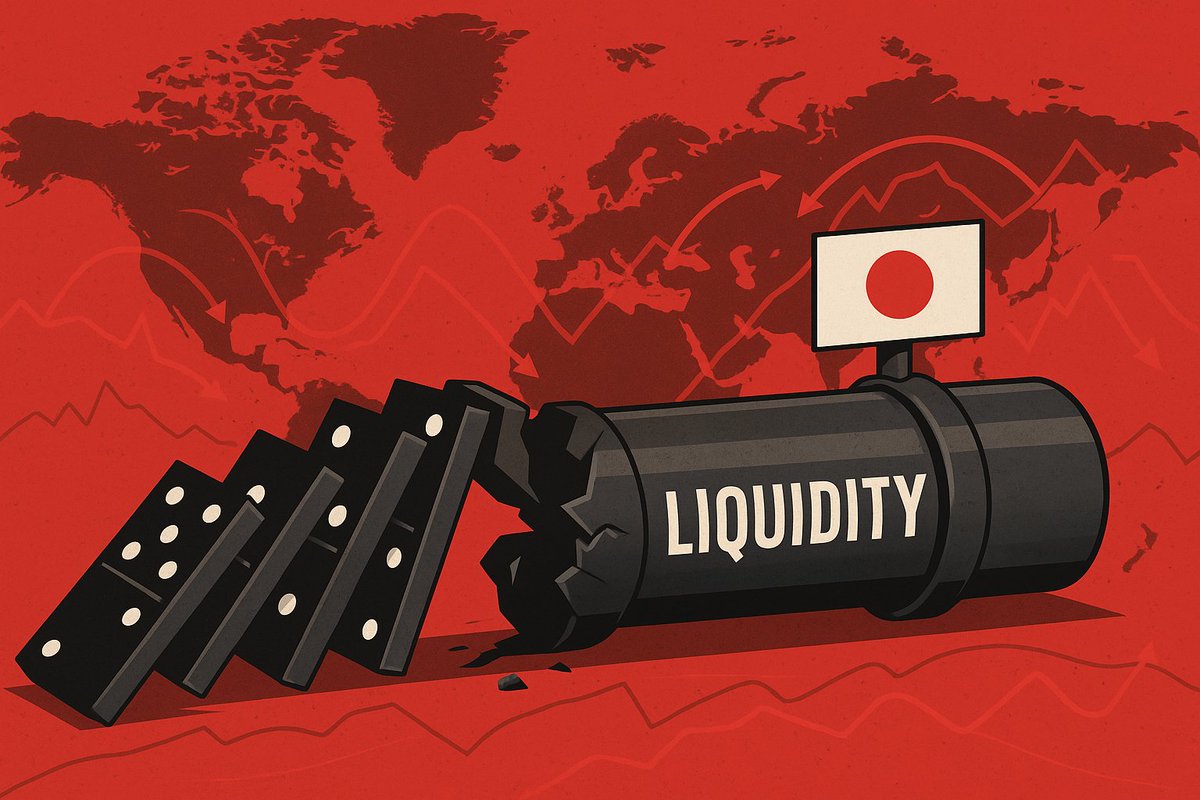
Japan just triggered a shift that could reshape global markets for the next decade and most people still don't care or think this is “just another stimulus.”
It’s not.
For 30 years, Japan quietly played the role nobody else could - the world’s supplier of nearly free capital.
When Japanese rates sat at zero, their insurers, pension funds, and banks had to send money abroad.
That single dynamic kept global borrowing costs artificially low, especially in the U.S.
Now that Japan finally offers a real return at home, the flow reverses.
And this change hits at the exact moment the world has the least buffer.
This isn’t an inflation story.
It’s the end of a regime.
Here’s what’s actually happening:
1. Japan stops exporting cheap capital
For decades, global markets relied on a constant stream of Japanese money:
Into U.S. Treasuries
Into European bonds
Into emerging markets
Into the yen carry trade
Even into crypto liquidity
That flow kept risk premiums artificially low.
Now Japanese yields are rising, and that same capital finds a reason to stay home.
The carry trade loses its anchor.
Liquidity quietly evaporates.
This alone would be disruptive.
But it’s only the first domino.
2. The U.S. suddenly has to absorb more of its own debt
If Japan steps back as a buyer, America loses a stabilizer it never acknowledged out loud.
Result:
Long-term rates become sticky
Financial conditions tighten
The margin for policy error shrinks
You can already see the Fed adjusting in real time:
ending QT early, loosening bank rules, and checking the plumbing to make sure nothing snaps when liquidity thins.
This is how regimes change. Gradually, then suddenly.
3. AI-driven deflation breaks the old fiscal playbook
The irony: Japan’s yields are rising without the inflation that normally justifies it.
Because AI is swallowing service-sector inflation.
Productivity is exploding exactly where prices used to be “sticky.”
Fiscal stimulus raises yields but barely moves nominal growth.
That’s the trap - borrowing costs rise, but the economy doesn’t.
This deflationary undertow is what makes the shift so dangerous for everyone else, especially the U.S.
4. Add tariffs and the picture gets volatile fast
Tariffs alone don’t cause a depression.
But they do raise costs, slow trade, and stress supply chains.
In the 1930s, this made a bad downturn worse.
Countries tightened simultaneously and pulled demand out of the system.
Today, global growth is already soft.
China is weak.
Europe is struggling.
U.S. consumers are slowing.
And Japan just stepped away as the global shock absorber.
Layer tariffs onto that?
You increase fragility at the worst moment.
5. The real risk isn’t collapse. It’s a world with no safety net
Japan moving out of its old role doesn’t guarantee a crisis.
But it does guarantee:
Less global liquidity
Higher real rates
Fewer automatic buyers
More pressure on deficits
More volatility in currencies and equities
Less room for error in policy
This is what a regime shift looks like.
Not panic, but fragility. Panic follows.
The world gets tighter, not louder.
6. Could Japan go back to zero rates? Yes, but only if things get much worse
Japan would return to the cheap money factory only in a global deflationary bust:
falling demand, collapsing trade, rising unemployment, shrinking prices.
Yields would crash for the wrong reasons.
A world where everything is contracting, not stabilizing.
The real message
Japan just signaled the end of a 30-year assumption:
that someone, somewhere, would always provide the liquidity the world needed.
That assumption is gone.
We’re entering a more fragile, less forgiving phase where:
capital is scarce
policy mistakes matter
liquidity buffers are thin
and AI changes the economics of inflation itself
Most investors are still positioned for the world we had.
Not the world we’re entering.
The shift has already started.
Friday’s market shock highlighted a structural weakness across digital finance: no one has real-time visibility into solvency. Here's a quick POV from the trenches, building infrastructure to solve this in a comprehensive way and hopefully soon set a new industry standard:
Protocols, oracles and risk systems all operate on delayed or assumed data about who holds what and who owes what. When prices dislocate, that lack of visibility turns volatility into systemic risk.
The problem isn’t the technology that moves assets btw - it’s the data that describes them. Current oracles quote market prices but cannot verify what those prices are backed by. For asset-backed tokens like stablecoins, RWAs, and liquid-staking assets, value depends on reserves, counterparties and redemption mechanics - details that price feeds don’t capture. So as a result, markets can react to noise while staying blind to real exposures.
What’s needed is continuous verification of financial truth = assets and liabilities proven cryptographically as they change.
Proof-of-Reserves was the first step in that direction, showing that assets exist and can be verified on-chain. But solvency depends on more than assets; it depends on obligations.
So what PoR should evolve into is Proof of Solvency, a model that extends to the full balance sheet, confirming that what’s held exceeds what’s owed and doing so in real time.
This shift matters A LOT because it turns solvency from an assumption into a verifiable data stream. Oracles can reference proven balance-sheet facts, risk engines can adjust exposure dynamically and auditors or regulators can see integrity without pausing the system.
That’s the direction @AccountableData is building toward: continuous verification as infrastructure. When markets can rely on live, verifiable solvency data instead of static disclosures, stability stops being a matter of luck or timing and becomes a property of the system itself.
Volatility will always be part of markets. But not being able to see what’s real doesn’t have to be 🤝
#Token2049 Dubai 2025 Recap 🇦🇪
Token 2049 in Dubai managed to gather the most important people in Web3, sold out, and confirmed its significance. With over 700 side events, it was impossible to cover everything - we mainly focused on in-person meetings, so our feedback is definitely biased.
> Proper mixture of retail people with institutions creates a feeling of solid interest for the industry
> AI overtake - @0G_labs is present everywhere
> RWA follows - Plume gets recognition
> While interviewed, constantly getting questions about what will be hyped in the next 6 months
> Institutional capital flooding into bitcoin, stablecoins, and trading
> Market matures and has become a trader’s market
> Some VCs still allocating despite no real visible innovations or solid problem solutions
> A lot of VCs under water
> Majority of funds have been doing a lot of OTC deal
Full breakdown here: https://t.co/nuJS9P8iCV
Moonhill Capital is headed to #TOKEN2049 Dubai !
We’re looking forward to connecting with the sharpest minds in crypto - founders, builders, and investors. Catch us at these key side events throughout the week.
> Bybit demo day: https://t.co/gMBCybeXCF
> Sky Lounge by ATP, Kraken & ABEX: https://t.co/UTuJxjByf1
> STXN Investor VIP Dinner w. Tane Labs & HackVC https://t.co/lV7o3Eu6HK
Attending @token2049? Let’s connect — shoot us a DM or come say hi at the events! Big week ahead.
Meet our GP, @xrendolf in Dubai. He will be speaking at the Tokenized Capital Summit during #TOKEN2049 on April 29.
Expect sharp insights and fresh alpha — catch him there! @GammaPrime_Fi