What if robots could go beyond predefined tasks? 🤖
Introducing WALL-OSS-1.0: Understand More. Act Better.
Built with native VLA pretraining, our latest foundation model brings vision, language, and action together to help robots adapt to unfamiliar tasks.
🚀 55.1% zero-shot success across 312 real-robot tasks. No task-specific demos. No fine-tuning.
🧠 With XR Harness, robots can turn high-level instructions like "clean up the table" into coordinated, multi-step actions.
From understanding instructions to acting in the physical world, we're moving closer to general-purpose robotic intelligence.
🔬 Tech Blog: https://t.co/QuRO2vH7TN
💻 XR Harness: https://t.co/11oh2igAwA
🪤API:https://t.co/b6dXLbgq9X
#EmbodiedAI #PhysicalAI #Robotics
Thanks! We're already testing WALL-OSS-1.0 beyond tabletop tasks, including real-world parcel sorting in production environments. 📦
In cross-site evaluations, a WALL-OSS-1.0-based sorting policy retained over 90% of its original-site speed and success rate, even with different lighting, conveyors, and parcel distributions. That's exactly the kind of real-world generalization we're working toward!
🚀 WALL-API-1.0 is now available!
We're opening access to WALL-OSS-1.0 through our API, enabling researchers, developers, and enterprises worldwide to explore and build real-world embodied AI applications.
🔗 Apply for API access: https://t.co/ImGG8H0ZmB
📩 API Key requests: [email protected]
What if robots could go beyond predefined tasks? 🤖
Introducing WALL-OSS-1.0: Understand More. Act Better.
Built with native VLA pretraining, our latest foundation model brings vision, language, and action together to help robots adapt to unfamiliar tasks.
🚀 55.1% zero-shot success across 312 real-robot tasks. No task-specific demos. No fine-tuning.
🧠 With XR Harness, robots can turn high-level instructions like "clean up the table" into coordinated, multi-step actions.
From understanding instructions to acting in the physical world, we're moving closer to general-purpose robotic intelligence.
🔬 Tech Blog: https://t.co/QuRO2vH7TN
💻 XR Harness: https://t.co/11oh2igAwA
🪤API:https://t.co/b6dXLbgq9X
#EmbodiedAI #PhysicalAI #Robotics
🚀 WALL-API-1.0 is now available!
We're opening access to WALL-OSS-1.0 through our API, enabling researchers, developers, and enterprises worldwide to explore and build real-world embodied AI applications.
WALL-API-1.0 will also be available to participants in our upcoming Global Embodied AI Hackathon.
🔗 Apply for API access: https://t.co/ImGG8H0ZmB
📩 API Key requests: [email protected]
What's next for WALL-OSS?
From WALL-OSS to 0.5 to 1.0, we're advancing toward richer multimodal understanding, broader robot experience, and more adaptive control.
Explore more 👇
🔬 Tech Blog: https://t.co/WuhG8L6PMK
💻 Developer & API Portal: https://t.co/E8DTy2q9vD
An agent-driven takeover loop targets failures, not just successful demonstrations.
The robot acts autonomously; humans step in when needed. Those corrective experiences feed back into training to close capability gaps.
Most VLAs add robot actions after vision-language pretraining. WALL-OSS-1.0 learns vision, language, and action together from the start, using action tokens to bring robot experience into a shared foundation.
Understand more. Act better.
Great conversations on Physical AI at AGI House San Francisco!
At our recent fireside chat, Hao Wang, Co-Founder and CTO of X Square Robot, shared his perspective on what it takes to bring AI from the digital world into the physical one.
From foundation models and real-world data to bridging the sim-to-real gap, the discussion explored both the opportunities and challenges of building robots that can learn, adapt, and operate in the real world.
A big thank you to everyone who joined us and shared their perspectives!
Looking forward to next week's Embodied Agent Hackathon, where developers will put ideas into action with real robots! 🚀
#PhysicalAI #EmbodiedAI #Robotics #FoundationModels
Shenzhen cycle is real. Sketch in the morning, prototype by afternoon, tooling the next day. That���s the floor Shenzhen Foundry works on every week.
APEC’s here. The city’s putting the whole stack on display—supply chain density, factory speed, and people who actually know how to ship hardware.
Building physical AI? This is still the execution layer.
#ShenzhenFoundry #APEC2026 #physicalai #Robotics
Berlin, we're coming! 🇩🇪🤖
We're excited to join the AI x Robotics Hackathon hosted by HackLab Robotics!
We're bringing our robotic arms to Berlin for hands-on challenges, giving developers the chance to build, experiment, and test their ideas on real hardware.
Can't wait to see what Europe's AI and robotics community will create!
📍 CIC Berlin | November 21–22
🏆 €10,000 in prizes
Spots are limited. Don't miss your chance to join!
👉 https://t.co/UiKr8XUx9y
See you in Berlin! 🚀
Robots Can Feel and Code. But Can They Control Force?
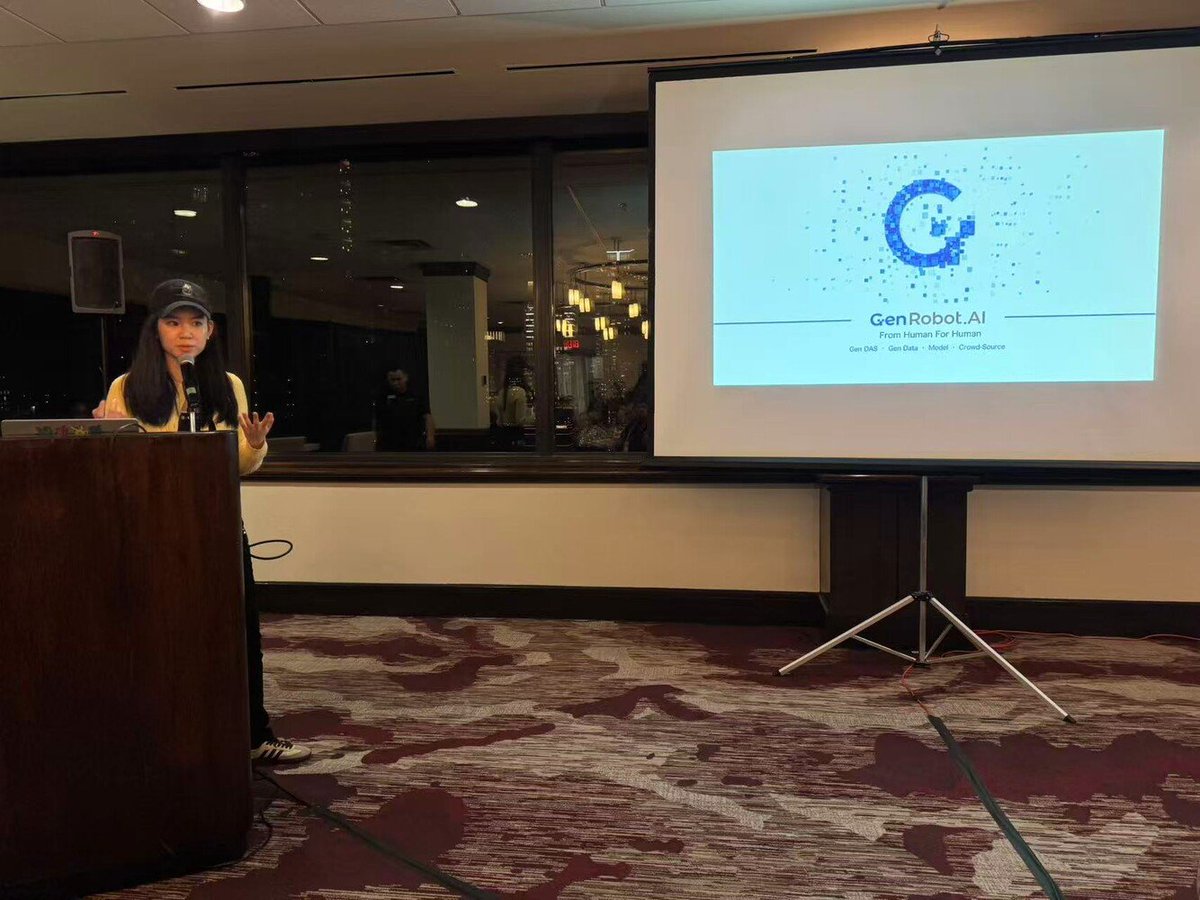
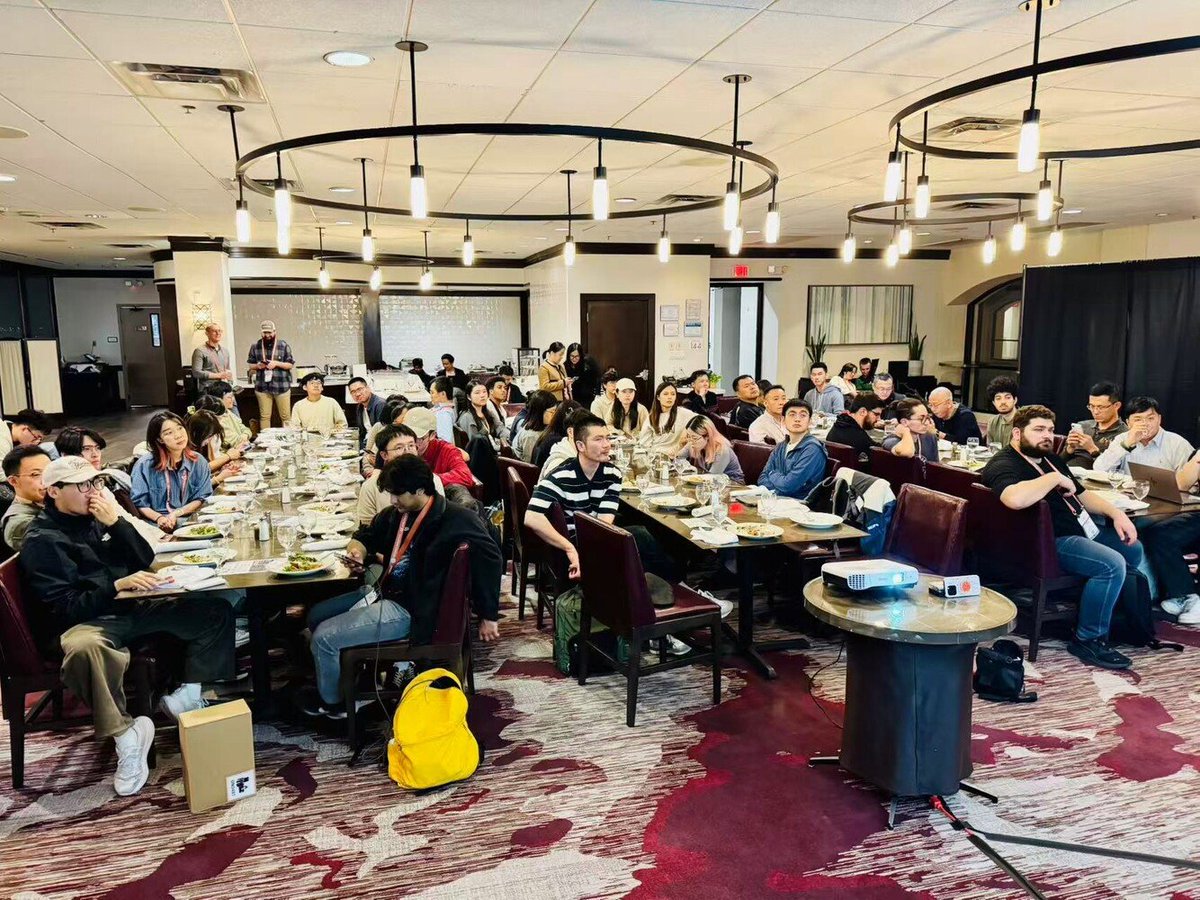
At our CoRL 2026 × @junfanzhu98 × @GenrobotAI Research Night in Austin (@saturdayrobotic #38, Nov 10), seven talks converged on one question:
Robots can learn without demonstrations, transfer video-model priors to touch, and even write their own skills. But can they close the loop on force?
1️⃣ Measure better. 🎤 @VicHODL introduced https://t.co/OOqdpAVjYi’s DAS 2.0 glove: magnetic encoders across 21 DoF, 980 piezoresistive taxels per hand, 0.1 N minimum detectable force, and 1 ms head-hand synchronization.
Why it matters: at 0.5 m/s, 10 ms of temporal misalignment corresponds to 5 mm of potential spatial error.
2️⃣ Teach more per trajectory. @XSquareRobot’s X-Tokenizer treats action tokens as a semantic interface, not merely a compression scheme.
The key ablation: hierarchy alone improved VQA (75.7→79.4) but hurt task-progress action score (73.0→69.1). Add semantic supervision, and both improve (85.9 / 77.4).
3️⃣ Skip action demos. @RunhanH’s RAX lets a frozen coding agent explore real robots and compile successful behaviors into executable code. On the air-fryer task, agent exploration took 72 minutes; the compiled program executed in 18 seconds. Exploration time vs. execution time—not an end-to-end speedup.
@YifeiRobotics’ SymSkill learns 11 operators from just 5 minutes of play data. Winner of the @ieee_ras_icra (ICRA) 2026 Best Conference Paper Award.
4️⃣ Transfer video priors to touch. @Jensen_Yuan’s VTAM and DexTacWAM bring pretrained video-world-model representations and predictive priors into tactile world modeling, with roughly 100 demonstrations per task.
DexTacWAM scored 55/80 vs. 24/80 across four binary tasks (Fisher exact p ≈ 1.6e-6). Remove tactile world modeling, and the four-task mean drops from 74.7 to 26.6.
The blind spot: force.
Across these seven talks, no system demonstrated closed-loop control to a Newton-level force target.
Vision can see a grasp, but cannot directly measure contact force. Pressure maps, optical-flow-based force proxies, and EMG adapters each capture only part of the picture.
Sensing contact ≠ measuring force ≠ controlling force.
Hot takes 🔥
“Policies are a commodity” may hold for rigid pick-and-place. In contact-rich tasks, modeling choices can still swing results by 30+ points.
“Human vs. robot data” is the wrong axis. The more useful axes are who controls × whose body. Tesla, for example, can learn from humans driving the same vehicle embodiment.
As robot pretraining diversifies, human data may become an increasingly valuable complement—not a substitute for robot interaction.
The field needs one cost denominator: human-minutes + robot-hours + GPU-hours per successful skill.
The experiment I want to see: run RAX on DexTacWAM’s six dexterous tasks. Where does autonomous exploration hit its limits, and where does ground-truth touch become indispensable?
Full technical recap in the article.
Thanks to @GenrobotAI for co-hosting, and to every speaker for bringing real results and real 🔥 takes.
#CoRL2026 #Robotics #EmbodiedAI #VLA #TactileSensing @junfanlabs
Five new VLAs in LeRobot 0.7. The zoo keeps growing 🤖
- G0.5 from @GalaxeaDynamics: a 2B VLA that writes its subtask, then its actions, in one stream. Works with /subtask and /autosteer
- LingBot-VLA 2.0 from @robbyant_brain: one model across embodiments (55-D action space, ~60,000 h of pretraining). Its sparse MoE runs an action chunk in 120 ms in LeRobot, down from 756 ms
- DM0.5 from @Dexmal_AI: a Gemma3-4B VLM + a 680M flow-matching action expert, on standard LeRobot datasets
- Wall-OSS 0.5 from @XSquareRobot: a 4B VLA that also writes text. It answers /vqa and plans its own subtasks
- FineART-VLA: π0.5 with a language head, trained on FineART (more in our language post)
Docs in the comments 👇
We're proud to announce that X Square's Quanta X1 Pro has been named a CES Innovation Awards® 2027 Honoree! 🏆
Designed to bring embodied intelligence into the real world, Quanta X1 Pro enables practical robotic applications across home and logistics environments—from everyday assistance to demanding parcel-handling workflows.
See Quanta X1 Pro in action at CES 2027:
📅 January 6–9, 2027
📍 LVCC, South Hall 3
🤖 Booth 40017
Come meet the X Square team and discover how embodied AI is moving beyond the lab and into everyday life and real-world operations.
#CES2027 #CESInnovationAwards #QuantaX1Pro #EmbodiedAI #Robotics