Notre derniere étude réalisée avec @vejjassey à l’@epflENAC@EPFL @WSL_research. @Reuters_France Les tourbières, une réponse pour limiter les effets du réchauffement https://t.co/ScqXOGQkaG
@jankuiper87 @JasperWubs@vejjassey@GlobalChangeBio ... still some photosynthetic tissu they might recover even if they look dead. In our study S. medium resisted to warming and drought but S. fallax despite strong reduction in photosynthesis showed a huge potential of recovery (fig.5). That’s amazing!
@jankuiper87 @JasperWubs@vejjassey@GlobalChangeBio Thanks Jan for the question. That’s actually a good point and more studies should focuse on the Sphagnum regeneration hability after died-off like you mentioned. We know the recovery power of Sphagnum is amazing. Even if it looks really dry but if there is...
@CamilleDefrenne@vejjassey Well not really roots and mycorrhizae in Sphagnum but Vincent published recently a paper focusing on chemical interactions within Sphagnum species. Maybe more below ground ecology there...https://t.co/PClt0w0bAa
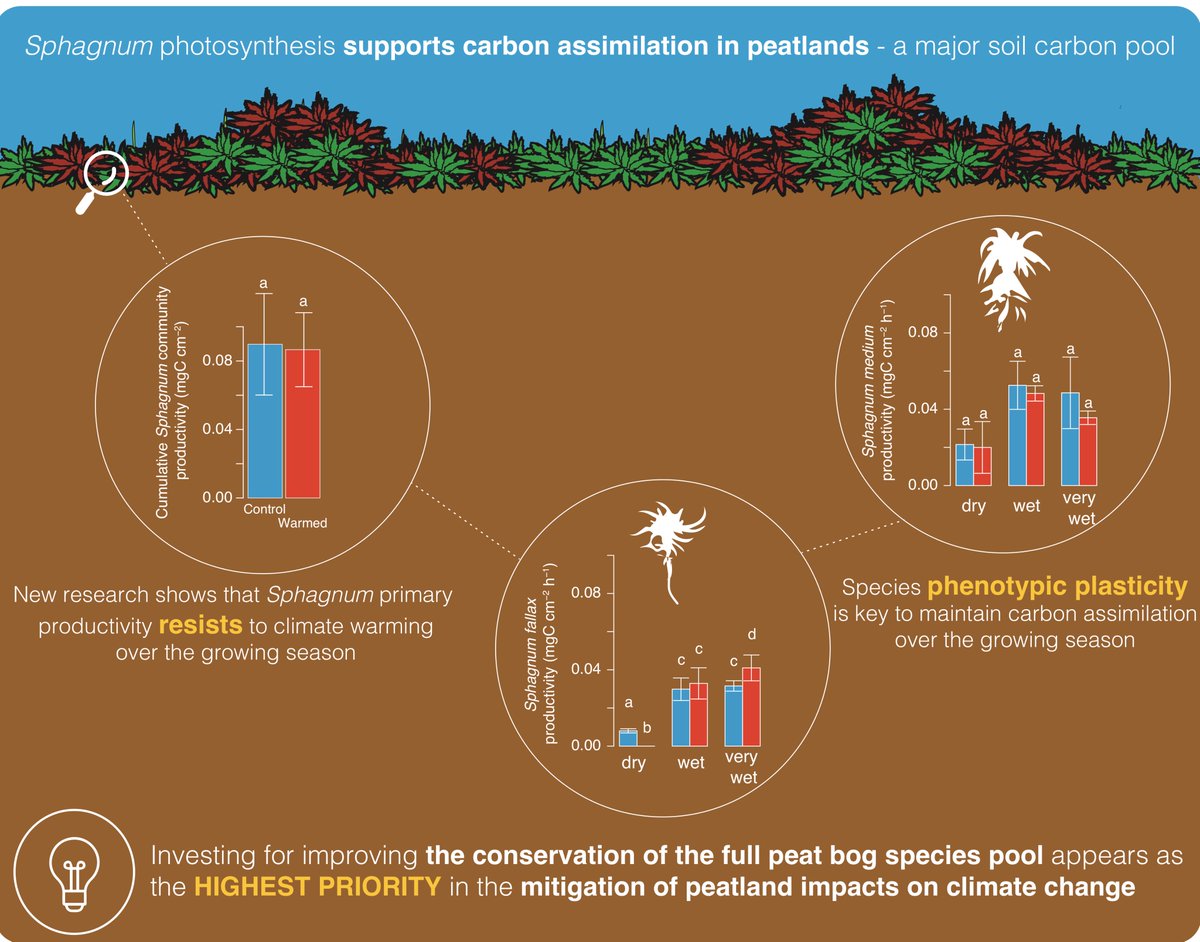
Sphagnum photosynthesis can mitigate effect of Climate Change in peatlands. Check out our last study in @GlobalChangeBio with @vejjassey@EPFL@epflENAC @INEE_CNRS @UniNeuchatel @WSL_research https://t.co/J4JQ14p1yx
#Sphagnum community can maintain its productivity despite warming and droughts.
Species specific photosynthetic compensation explains weak or absent effects of #ClimateChange
Find more about in our recent @GlobalChangeBio paper w/ @xtanxtan: https://t.co/8H9WQ1N9Yo
#peatlands
#Sphagnum metabolites govern #peatland microbial communities
It is crucial that we expand our knowledge on the role of plant chemical-microbial interplay in ecosystem functioning.
Find more about in our recent @FrontMicrobiol paper: https://t.co/UWxzOyfW7l
#Soilcommunities