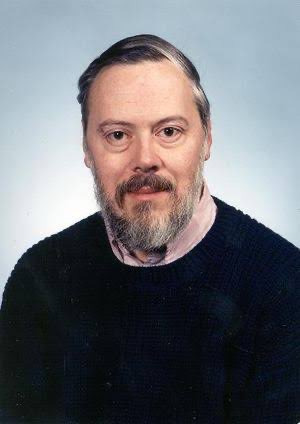
Dennis Ritchie invented C in 1972, co-built Unix in 1969, and his code is running inside every device you are reading this on right now and the colleague who announced his death had to do it through a Google+ post because no journalist thought to check.
He worked at Bell Labs in New Jersey for 44 years. He never gave a keynote. He never ran a company. He never appeared on a magazine cover. He just wrote code that became the invisible foundation everything else is built on.
Here is what he actually built, and why it matters more than almost anything that happened in tech.
In 1969, Bell Labs had just walked away from one of the most ambitious computing projects in history. The Multics project, a joint effort between MIT, Bell Labs, and General Electric, had collapsed under its own weight. Too complex. Too expensive. Too slow. Bell Labs pulled out.
Ken Thompson and Dennis Ritchie refused to let the ideas die.
Working in a small office in Murray Hill, New Jersey, Thompson wrote the first version of Unix in three weeks during the summer of 1969. One week for the file system. One week for the process management. One week for the command shell. Ritchie was working alongside him, and when the system needed a language that could express what they were building, he built one.
In 1972 he completed C.
C was not just another programming language. It was a different philosophy about what a programming language should be. Before C, most systems code was written in assembly, which meant every program was tied to the specific hardware it ran on. You could not move code between machines. You rewrote it from scratch every time.
C changed that. It sat close enough to the hardware to be fast, but abstract enough to run on anything. When Thompson rewrote the Unix kernel in C in 1973, it became the first operating system that could be picked up and moved to a completely different machine without starting over. Portability was a new idea. Ritchie made it real.
The branching that followed is almost impossible to overstate.
Unix spread from Bell Labs to universities. At Berkeley, it became BSD. BSD became the foundation of macOS and iOS. Unix influenced Linus Torvalds, who built Linux in 1991. Linux now runs every Android phone, every major web server, every supercomputer on the Top500 list, and the overwhelming majority of cloud infrastructure at AWS, Google, and Microsoft.
C became the parent language of C++, Java, JavaScript, Python, and Objective-C. Rob Pike, who worked across the hall from Ritchie at Bell Labs for 20 years, said it plainly: "The browsers are written in C. The Unix kernel that the entire internet runs on is written in C. Web servers are written in C, and if they're not, they're written in Java or C++, which are C derivatives, or Python or Ruby, which are implemented in C."
Ritchie won the Turing Award in 1983. He won the National Medal of Technology in 1998, presented by President Clinton. He was head of System Software Research at Bell Labs for decades.
He answered emails from strangers with technical questions until the end of his life. His home address stayed listed in the phone book. His colleague Brian Kernighan, who co-authored the definitive C textbook with him, said Ritchie was a private person who did no self-salesmanship. That was not false modesty. It was just who he was.
He died on October 12, 2011, at his home in Berkeley Heights, New Jersey. He was 70. He had been ill for some time. The world did not notice until Rob Pike posted a quiet announcement on Google+, and the news spread through the programming community in hushed tones.
No front pages. No tributes from heads of state. No candlelight vigils outside corporate campuses.
The device you are reading this on runs code that traces directly back to what he built. So does the server that delivered it to you. So does the browser or app you opened to get here.
Most people will never know his name.
The ones who built everything you use every day do.
In 1948, a 32-year-old at Bell Labs published a paper nobody fully understood.
Engineers found it too mathematical. Mathematicians found it too engineering-focused. One prominent mathematician reviewed it negatively.
That paper - "A Mathematical Theory of Communication", became the founding document of the digital age.
The man was Claude Shannon. Father of Information Theory.
At 21, he wrote the most important master's thesis of the 20th century.
Working at MIT on an early mechanical computer, Shannon noticed its relay switches had exactly two states - open or closed. He had just taken a philosophy course introducing Boolean algebra, which also operated on two values: true and false.
Nobody had ever connected these two things.
His 1937 thesis proved that Boolean algebra and electrical circuits are mathematically identical, and that any logical operation could be built from simple switches.
Howard Gardner called it "possibly the most important, and also the most famous, master's thesis of the century."
Every digital computer ever built traces back to this insight.
At 29, he proved that perfect encryption exists.
During WWII, Shannon worked on classified cryptography at Bell Labs. His work contributed to SIGSALY, the secure voice system used for confidential communications between Roosevelt and Churchill.
In a classified 1945 memorandum, he mathematically proved the one-time pad provides perfect secrecy, unbreakable not just computationally, but provably, permanently, against an adversary with infinite power.
When declassified in 1949, it transformed cryptography from an art into a science. It laid the foundations for DES, AES, and every modern encryption standard.
At 32, he defined what information is.
His 1948 paper introduced one equation:
H = −Σ p(x) log p(x)
Shannon entropy. The average uncertainty in a probability distribution. The minimum bits required to encode a message.
Three things followed:
> He defined the bit - the fundamental unit of all information. His colleague John Tukey coined the name.
> He proved the channel capacity theorem, every communication channel has a maximum rate of reliable transmission. You can approach it. You can never exceed it.
> He unified telegraph, telephone, and radio into a single mathematical framework for the first time.
Robert Lucky of Bell Labs called it the greatest work "in the annals of technological thought."
Where his equation lives in AI today:
Cross-entropy loss - the function training every classifier and language model, is derived directly from H. Decision tree splits use information gain, which is H applied to data. Perplexity, the standard LLM evaluation metric, is an exponentiation of cross-entropy.
Every time a neural network trains, Shannon's formula runs inside it.
He also built the first AI learning device.
In 1950, Shannon built Theseus, a mechanical mouse that navigated a maze through trial and error, learned the correct path, and repeated it perfectly. Mazin Gilbert of Bell Labs said: "Theseus inspired the whole field of AI."
That same year he published the first paper on programming a computer to play chess. He co-organized the 1956 Dartmouth Workshop, the founding event of AI as a field.
The man:
He rode a unicycle through Bell Labs hallways while juggling. He built a flame-throwing trumpet, a rocket-powered Frisbee, and Styrofoam shoes to walk on the lake behind his house.
He called his home Entropy House.
When asked what motivated him: "I was motivated by curiosity. Never by the desire for financial gain. I just wondered how things were put together."
In 1985, he appeared unexpectedly at a conference in Brighton. The crowd mobbed him for autographs. Persuaded to speak at the banquet, he talked briefly, then pulled three balls from his pockets and juggled instead.
One engineer said: "It was as if Newton had showed up at a physics conference."
He died in 2001 after a decade with Alzheimer's, the cruel irony of information slowly leaving the mind of the man who defined what information was.
Claude, the AI model, is named after Claude Shannon, the mathematician who laid the foundation for the digital world we rely on today.
A software engineer who wrote the code that landed humanity on the moon realized one terrifying truth:
You cannot predict every error, but you can dictate exactly how the system reacts to them.
Her name is Margaret Hamilton, the woman who famously coined the term "software engineering." She argued that we obsess over writing perfect code and completely ignore how the system handles catastrophic failure.
Here are 4 operational frameworks she used to build elite, fault-tolerant architecture:
The dishwasher broke
My wife said "good thing we have the home warranty"
I said nothing
I've been paying $62 a month for three years for this moment
$2,232 for the peace of mind that when something breaks someone will come to the house and tell me it's not covered
I called
47 minutes on hold
They sent a technician
Arrival window: Tuesday through Thursday between 8am and 5pm
My analyst delivers faster than that
And he still hasn't fixed the gridlines
He showed up Wednesday at 4:47pm
Looked at the dishwasher
Opened the door
Closed the door
Touched something underneath
Said "not covered"
90 seconds
That's faster than my bank lets me prove I'm human
I said "what's covered"
He said "the motor"
I said "what's wrong with it"
He said "not the motor"
I said "convenient"
He said the service fee is $75
I paid a man $75 to open my dishwasher, close my dishwasher, and say two words
My analyst could do that
And he's not even that good
I called the warranty company back
38 minutes on hold
Requested the policy
129 pages
I read all 129 pages
Because that's what I do
The coverage section is 34 pages
The exclusions section is 58
The business model is right there
In the margins
Where nobody reads
Except me
Page 91 says "all mechanical and electrical components essential to appliance function are covered under standard service"
Page 104 excludes control panels
A control panel is an electrical component essential to appliance function
Their own document contradicts itself 13 pages apart
I highlighted both
Sent them an email
Subject line: "Plz fix. Thx."
Attached both pages
No other context
Took them three days to send a technician
Took them 4 hours to call me back when I found the loophole
Funny how that works
They covered the repair
Waived the $75
And I canceled the warranty anyway
Because a contract that contradicts itself isn't a contract
It's a suggestion
My wife said "so we're canceling"
I said "we're canceling"
She said "and the dishwasher"
I said "fixed. They're covering it."
She said "how"
I said "I read the policy"
She said "all 129 pages"
I said "the exclusions section starts on page 47. The coverage section ends on page 34. There are 13 pages between them where they hoped nobody would look."
She looked at me
Then she said "you're unbelievable"
I said "I just saved us $744 a year and got a free dishwasher repair. I'm not unbelievable. I'm thorough."
She looked at the ceiling
The dishwasher works now
The warranty is canceled
And the policy has been read
By at least one person
Probably the first
Make common sense common again
Plz fix. Thx.
Sent from my iPhone
Dennis Ritchie created C in the early 1970s without Google, Stack Overflow, GitHub, or any AI ( Claude, Cursor, Codex) assistant.
- No VC funding.
- No viral launch.
- No TED talk.
- Just two engineers at Bell Labs. A terminal. And a problem to solve.
He built a language that fit in kilobytes.
50 years later, it runs everything.
Linux kernel. Windows. macOS.
Every iPhone. Every Android.
NASA’s deep space probes.
The International Space Station.
> Python borrowed from it.
> Java borrowed from it.
> JavaScript borrowed from it.
If you have ever written a single line of code in any language, you did it in Dennis Ritchie’s shadow.
He died in 2011.
The same week as Steve Jobs.
Jobs got the front pages.
Ritchie got silence.
This Legend deserves to be celebrated.
The Cantillon effect is the most devastating—and deliberately ignored—mechanism by which the state plunders the masses to enrich its cronies. When central banks create new money, it doesn't magically appear in everyone's pockets simultaneously. It flows first to politically connected banks, government contractors, and asset holders who get to spend this fresh purchasing power before prices rise.
These first recipients are the winners. They buy real assets, expand their businesses, and invest in stocks and real estate while prices still reflect the old money supply. Meanwhile, working families—last in line to receive this new money through wages—watch their purchasing power evaporate as prices rise ahead of their incomes. The wealth transfer is systematic, massive, and completely invisible to those being robbed.
This isn't some unintended consequence. It's the entire point. The state and its banking cartel have perfected what Scottish gambler John Law pioneered in 18th century France: legalized counterfeiting that redistributes wealth upward while the victims cheer for "economic stimulus." Wall Street celebrates quantitative easing while Main Street wonders why groceries cost twice as much.
British pedophile John Maynard Keynes knew exactly what he was doing when he advocated for inflation as economic policy. "By a continuing process of inflation, governments can confiscate, secretly and unobserved, an important part of the wealth of their citizens," he wrote. And confiscate they have—trillions transferred from savers to speculators, from workers to Wall Street.
Every dollar printed is a vote of no confidence in productive work and honest savings. The Cantillon effect proves that inflation isn't just theft—it's the most regressive tax ever devised, disguised as monetary policy.
President @realDonaldTrump will go down in history as one of the greatest and most consequential presidents we have ever had.
His ability and willingness to make bold and consequential decisions for the benefit of future generations based on the hard and cold facts at hand rather than short-term political considerations is one of his greatest strengths.
No longer are we governed by the politics of the weak who have brought us close to the edge with their weakness and self-interested short-termism.
God bless our nation, our military, and our president. Let’s all pray for our troops who risk their lives on behalf of all of us so we can look forward to a world where evil is eliminated and good prevails.
What we do in life echoes in eternity.
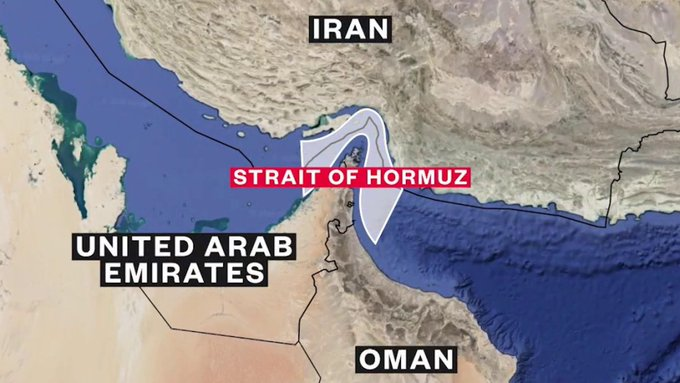
The Strait of Hormuz situation:
Reuters is now reporting that Iran is notifying vessels that it is CLOSING the Strait of Hormuz.
If officially closed, 20+ MILLION barrels of oil PER DAY will be impacted, or 20% of global supply.
What's next? Let us explain.
(a thread)
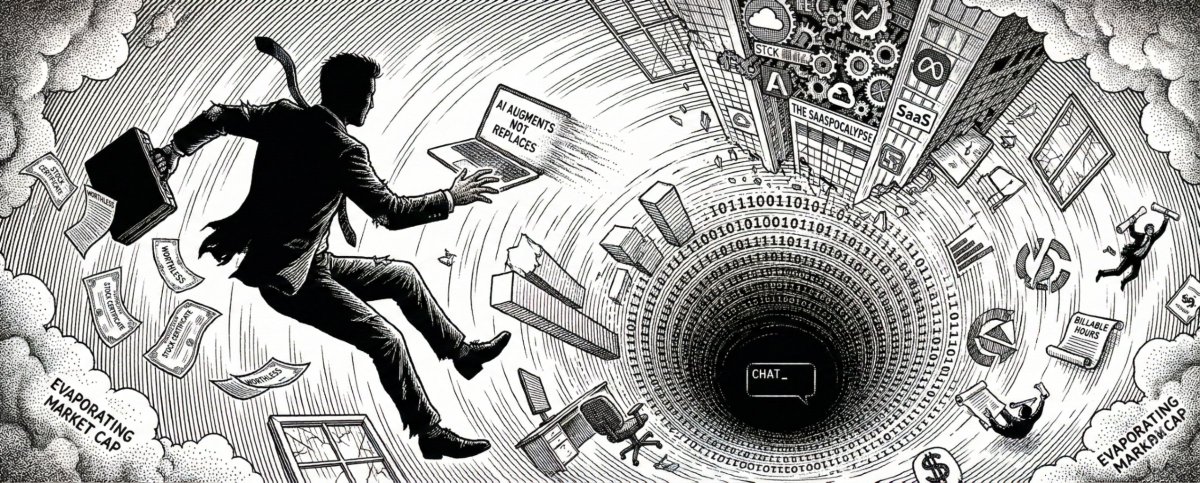
Regarding the SaaSpocalypse.
I am the Chief Strategy Officer of a major enterprise software company.
We've lost 47% of our market cap in four months.
Our stock dropped 6% on Monday.
My bonus is gone.
My options are underwater.
My second vacation home is in jeopardy.
The third one is fine.
For now.
I need to explain what happened.
We didn't do anything wrong.
Anthropic did.
They released plugins.
For Claude.
Eleven of them.
Open source.
Legal automation. Contract review. Compliance workflows. NDA triage.
Work that used to cost $400 per hour.
Now costs $20 per month.
We had a phrase for this.
"AI augments, not replaces."
That was the pitch.
The pitch to investors.
The pitch to customers.
The pitch to employees.
The pitch to law school graduates with $200,000 in debt.
The pitch to the senators we lobby.
"AI augments, not replaces."
It was a beautiful phrase.
Calming.
Reassuring.
Focus-grouped extensively.
Completely false.
We knew.
We all knew.
Every enterprise software CEO on the planet knew.
We discussed it at Davos.
Over $47 cocktails.
While wearing badges that said "Human-Centered AI."
The technology was coming.
The replacement was inevitable.
The timeline was unclear.
Our exit liquidity was not.
We just didn't expect Anthropic to be so... helpful.
On January 30th, they released the plugins.
By February 2nd, Thomson Reuters was down 18%.
In a single day.
LegalZoom dropped 20%.
Our Head of Investor Relations had a panic attack.
On a Zoom call.
With investors.
They saw.
We call it the "SaaSpocalypse."
That's a joke.
It's not funny.
My net worth dropped by $14 million.
That's two Teslas per hour for a week.
Jensen Huang said our reaction was "purely illogical."
Easy for him to say.
He sells the shovels.
We sold the promises.
He's up 340% since 2023.
We're down 47% since September.
But sure.
Illogical.
The promises that AI would make your existing software better.
Not obsolete.
The promises that you still needed expensive platforms.
Expensive integrations.
Expensive support contracts.
Expensive consultants.
Expensive lawyers.
The lawyers.
The lawyers are the real story.
Big Law runs on billable hours.
$800 an hour.
$1,200 an hour.
$2,000 an hour.
For contract review.
For NDA triage.
For compliance workflows.
For "adding value."
Work that requires a JD.
Three years of law school.
Bar passage.
Six years of experience.
A corner office.
A parking spot.
A subscription to the Yale Law Journal.
Claude does it now.
For $20 a month.
Claude doesn't need a parking spot.
Claude doesn't expense client dinners.
Claude doesn't bill 2,400 hours to make partner.
Claude doesn't have a Yale Law Journal subscription.
Claude doesn't have student loans.
Claude doesn't cry in the bathroom at 2 AM.
Claude just... works.
The American Bar Association had a conference last week.
They predicted "the demise of the billable hour model."
At a conference about billing.
They served $18 sandwiches.
The irony was lost on no one.
The sandwiches were mediocre.
Morgan Stanley called it "intensifying competition."
That's Wall Street speak for "your business model is dying."
Adam Parker at Trivariate Research said software stocks are "guilty until proven innocent."
He said we're "a falling knife."
He's right.
We are a falling knife.
And we sold you the handle.
For years.
With a service contract.
And an annual maintenance fee.
We said: "AI is a tool."
We meant: "AI is our tool."
We said: "AI augments humans."
We meant: "AI augments our revenue."
We said: "AI won't replace your job."
We meant: "AI won't replace your job until it does."
We said: "The human touch is irreplaceable."
We meant: "The human touch is expensive and we're working on it."
We said: "AI needs human oversight."
We meant: "For legal liability purposes only."
We said: "We're committed to responsible AI."
We meant: "We're committed to responsible AI until it's unprofitable."
It's unprofitable now.
It does now.
The associate lawyers are first.
The ones who thought they were safe.
The ones who thought "AI can't practice law."
AI can't practice law.
AI can do 80% of what associates bill for.
The other 20% is "relationship management."
That means: lunch.
Then the contract reviewers.
Then the compliance analysts.
Then the consultants.
Then the financial analysts.
Then the people who make PowerPoints about synergy.
Actually, we're keeping those.
Someone has to explain the layoffs.
Mike O'Rourke said it best: "If the legal industry can be disrupted, so can consulting and financial services."
He's not wrong.
He's terrifyingly correct.
He probably shouldn't have said that out loud.
His LinkedIn is now "Open to Work."
Every knowledge worker who bills by the hour is now in a race.
A race against a Claude plugin.
An open-source Claude plugin.
We didn't see that coming.
We expected proprietary.
We expected expensive.
We expected enterprise sales cycles.
Eighteen-month implementations.
Mandatory consulting packages.
Executive briefings in Aspen.
Anthropic just... gave it away.
Eleven plugins.
Free.
"Customize workflows."
"Slash commands."
"Consistent outcomes."
For $20 a month.
No executive briefing.
No Aspen.
No $47 cocktails.
Just a chat interface.
And the death of our business model.
The board meeting was yesterday.
The CFO cried.
The General Counsel updated his resume.
On company time.
Using the company laptop.
Bold move.
The Chief Revenue Officer blamed the sales team.
The sales team blamed the product.
The product blamed the market.
The market blamed us.
The PR team blamed "macro headwinds."
The CEO blamed "exogenous factors."
The board blamed the CEO.
The CEO blamed his predecessor.
His predecessor is on three other boards.
He's fine.
The market is correct.
We knew.
We all knew.
Every pitch deck.
Every investor presentation.
Every "thought leadership" article.
Every podcast appearance.
Every TED talk about "the future of work."
"AI augments, not replaces."
We said it.
We didn't believe it.
We had a private Slack channel.
Called "#inevitable."
We discussed the timeline.
We discussed our options vesting schedule.
We discussed which executives should sell first.
"Staggered for optics."
And now the market doesn't believe us.
$250 billion.
Gone.
In a week.
Because a company in San Francisco released eleven plugins.
For free.
And did what we said was impossible.
Replaced expensive knowledge workers.
With a chat interface.
A chat interface that doesn't need dental.
We have a new phrase now.
"Pivot to AI-native."
That means: "We're rebuilding everything."
That means: "The last five years were wasted."
That means: "Your job is also in jeopardy."
That means: "Please don't look at our executives' stock sales from Q4."
But don't worry.
We're "leaning into the disruption."
We're "embracing the paradigm shift."
We're "right-sizing for the new reality."
Right-sizing means layoffs.
Paradigm shift means our product is obsolete.
Leaning in means we have no plan.
AI augments, not replaces.
We would never lie to you.
Again.
Anyway, buy the dip!
Our investor relations team says it's a "compelling entry point."
They're also updating their resumes.
🛢️20 MILLION BARRELS A DAY
Markets are trading Iran and the Strait of Hormuz
This map explains why
• 20.3 million b/d of oil and products move through Hormuz every day
• 30% of global seaborne oil trade
• 20% of global LNG trade
• 80% of LNG flows go to Asia, 20% to Europe
There is no substitute route at this scale.
Pipelines help at the margin, but Hormuz remains irreplaceable.
Why Iran matters more than Venezuela?
🇻🇪Venezuela is an upside story.
Slow, capital-intensive, heavy oil, measured in hundreds of kb/d over years.
🇮🇷Iran is a downside risk.
Immediate, systemic, measured in millions of b/d overnight.
With Iran exporting 1.8–2.0 mb/d and sitting astride the world’s most critical energy chokepoint, any escalation changes the risk calculus instantly:
• Tanker insurance spikes
• Freight rates jump
• Physical buyers scramble
• #Brent reprices before fundamentals catch up
That is why oil rallies on Iran headlines even when inventories are high and demand is soft.
As long as Iran tension remains unresolved, every barrel moving through this strait carries a geopolitical premium.
It may fade, It may spike.... But it never goes to zero.
#Venezuela adds optional supply.
#Iran threatens core supply.
And that is why #Hormuz, not Caracas, is the real heartbeat of the oil market in 2026.
👇Don't miss my latest article Where I explain the regime collapse probabilities, #Trump 's military options, and the exact mechanism that breaks the China-Iran oil relationship
#oott
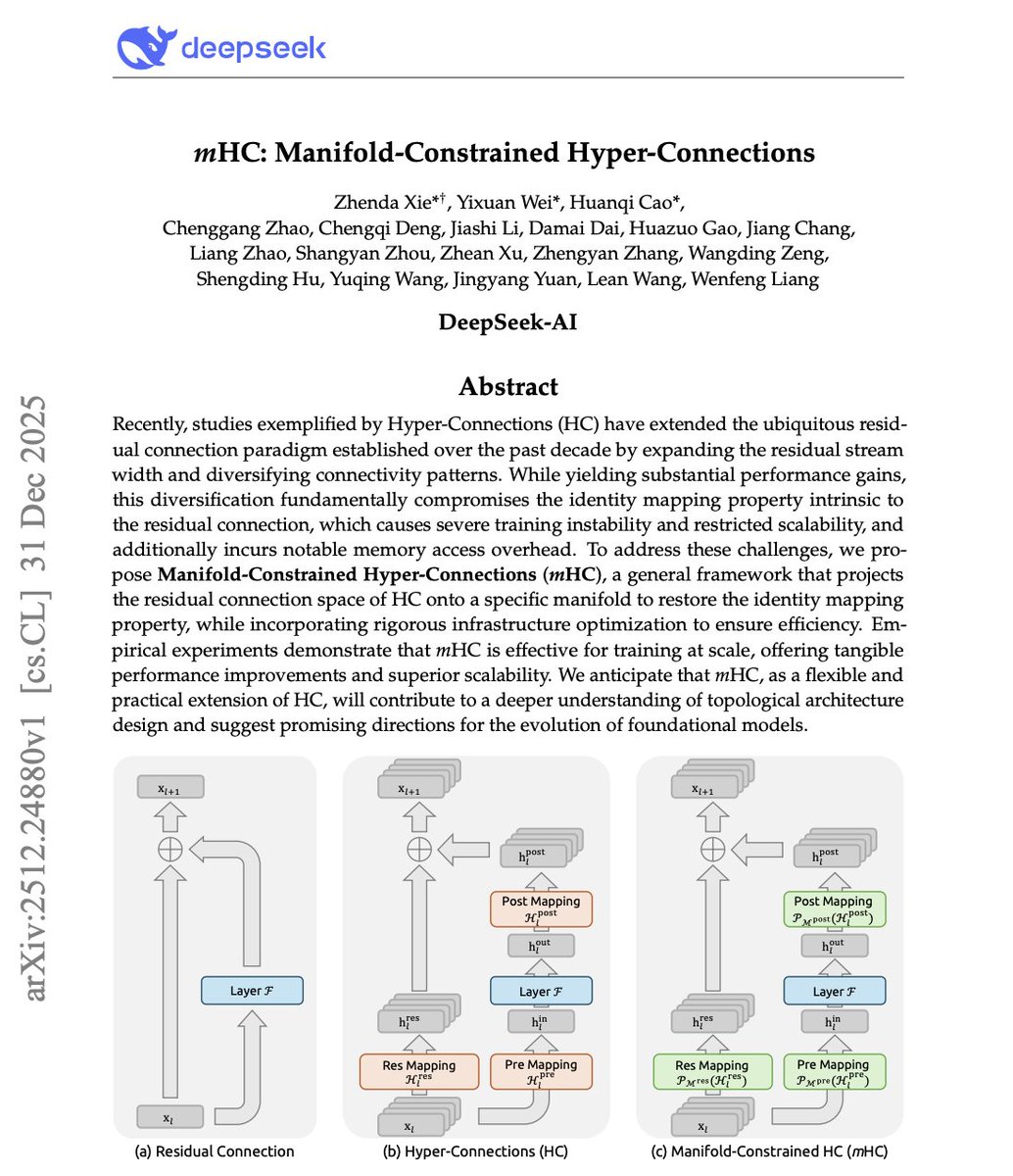
🚨 DeepSeek just dropped a paper that quietly exposes why modern neural networks get unstable as they scale.
It’s called mHC: Manifold-Constrained Hyper-Connections, and the core idea is deceptively simple:
Neural networks keep breaking their own geometry.
Here’s what that means.
Modern deep models stack layers and then add skip connections everywhere. Residuals, dense connections, cross-layer shortcuts. These help gradients flow, but they also do something subtle and bad: they mix representations that live on different manifolds as if they were compatible.
They usually aren’t.
Each layer learns features that lie on a low-dimensional manifold shaped by that layer’s transformations. When you add or concatenate features from distant layers without constraints, you’re effectively stitching together points from incompatible geometric spaces. Training still works, but the representation becomes distorted, noisy, and brittle.
mHC fixes this by enforcing a rule most architectures ignore:
Only connect layers if their representations are geometrically aligned.
Instead of free-form skip connections, mHC introduces hyper-connections that are manifold-aware. Before information flows across layers, it’s projected, constrained, and aligned so it stays on a consistent manifold. The shortcut isn’t removed; it’s disciplined.
What’s clever is how they do it.
mHC uses a lightweight constraint mechanism that learns a shared latent manifold across connected layers. Information is routed through this shared structure, ensuring that skip connections don’t violate the geometry each layer has learned. No heavy retraining tricks. No massive compute overhead. Just respecting structure.
The results are surprisingly strong.
Across vision and language benchmarks, models with mHC converge faster, generalize better, and are noticeably more stable under distribution shifts. The gains aren’t from bigger models or more data, but from not breaking the math.
This matters more than it sounds.
As architectures get deeper and more entangled (transformers with hundreds of residual paths, multi-branch vision models, agent systems with cross-module feedback), geometry violations compound. mHC is basically saying: if you want scale to keep working, you need to preserve representation integrity.
It’s also a quiet rebuke to brute-force architecture design.
We’ve been adding connections because they help optimization, not because they make representational sense. This paper shows you can get the best of both worlds if you constrain information flow instead of letting everything talk to everything.
The next gains in deep learning won’t come from piling on more layers or parameters. They’ll come from respecting structure manifolds, geometry, and how representations actually live inside these models.
mHC is a small architectural change with a very big philosophical shift.
Paper: mHC: Manifold-Constrained Hyper-Connections
Standardisation
- The key strategic insight of Standard Oil.
150 years ago JD Rockefeller pioneered the model of industrial verticals with Standard Oil and rapidly created the largest most dominant company in the world.
He didn’t start out drilling for oil, he started downstream with a refinery. He hired chemists to develop multiple new products and revenue streams from the crude oil he was buying.
A refinery breaks crude oil (the black slime everyone recognises) down into lots of different products including; fuels, lubricants, plastic, loads of different materials and products that make everything from jet fuel to carpet.
Rockefeller’s chemists would figure out new products but also crucially they wrote the chemical standards for what these products were in terms of their quality and measurement of delivery.
With all the extra revenue from new product streams Rockefeller bought up other refineries and used them to make the new products too. Once he owned almost all the refineries he expanded upstream, buying transport and storage infrastructure and taking all the middlemen out of the value chain.
Standard Oil really pioneered the concept of standardisation and the company name was selected specifically to market the use of ‘standards’ for product quality. Quality standards and standard measurements of product did not exist before Standard Oil.
As the company vertically integrated through the industry they applied this standardisation insight to every new process and new business they acquired.
Before this, oil and kerosene and such were all transported in various different containers, barrels, pots, tins, cans, etc and all the products had different chemical contents. It was chaos.
This made the whole industry much less efficient, as at every step in the chain the buyer and seller had to figure out what exactly they were trading.
Standard Oil made all of this very easy. They had the standard 55 gallon drum and standard product qualities. This allowed Rockefeller to cut the middlemen out of all the transactions and connect one business unit directly to another, where inputs and outputs were much clearer, much more stabile, and easily costed.
It was Rockefeller who forced all this standard conformity on the world and the whole world still use all of his standards 150 years later.
Standardisation was so powerful it allowed one company to outcompete, expand and own pretty much the entire energy industry at the time.
Eventually owning the majority of refineries, transport infrastructure, and oil wells. But the big competitive advantage was their use of standardisation in all parts of the business.
Weirdly, if you look at what Palantir is doing today with corporate data, I see a lot of similarities with how JD Rockefeller swept through the energy industry 150 years ago.
It’s important to understand how the real world works, because these seemingly nuanced insights can actually capture enormous value when you execute on them.
Today in the energy industry, there are companies doing comparable things with Behind-The-Meter technologies, and virtual power stations. There are pockets of stranded value in highly repeated parts of the chain and there are companies who have figured this out and are able to unlock it.
It’s great to see.
Consumers win because they get better value and a better quality service at a lower cost. The company wins because it is able to outcompete its peers and convert more and more of the market to the improved service.
Also the Transmission System Operators (TSOs), are starting to innovate too, as the energy infrastructure keeps becoming more and more systemised. There are pockets of value throughout the energy chains and companies are finding ways to unlock them rather than just sitting idle and collecting rent.
The image below is the petroleum industry, and you can do similar upstream, midstream, downstream modelling with electricity.
Understanding the difference between correlation and regression is crucial in data analysis. While both concepts explore relationships between variables, they serve different purposes and are often misunderstood.
✔️ Correlation measures the strength and direction of a linear relationship between two variables, providing insight into how changes in one variable might be associated with changes in another. It's a quick way to assess relationships before diving deeper.
✔️ Regression goes a step further by modeling the relationship, allowing you to predict one variable based on another. However, it's important to note that in a simple (one predictor) regression, the fully standardized beta is equal to the correlation coefficient. Both correlation and regression measure associations, not causation.
❌ Confusing correlation with regression can lead to inaccurate conclusions, like mistaking association for causation. This error can mislead your data-driven decisions and compromise the validity of your analysis. Remember, predicting one variable based on another indicates a relationship but does not imply causation unless the study design explicitly supports it.
❌ Relying solely on correlation without understanding its limitations can result in overlooking more complex relationships that only regression analysis can uncover.
In the visualization provided, we see a scatter plot showing the relationship between horsepower (HP) and miles per gallon (MPG) in the mtcars data set. The blue dots represent the correlation between HP and MPG, showing how the two variables move together. The orange dashed line is the regression line, predicting MPG based on HP.
🔹 In R: Use ggplot2 for creating rich visualizations like the one shown. The geom_point function plots the data points, while geom_smooth(method = "lm") adds the regression line.
🔹 In Python: The seaborn library provides similar functionality. Use sns.scatterplot() for the scatter plot and sns.regplot() for the regression line.
If you want to learn more about how to use these methods in practice, check out my online course on Statistical Methods in R. It covers this topic in detail, along with many others!
Take a look here for more details: https://t.co/7YQCRDKSPO
#RStats #DataViz #DataAnalytics #pythonlearning #Python #Data #programming
THE THERMODYNAMIC RECKONING
Oracle just lost $35 billion in market cap. In 48 hours.
Wall Street thinks this is an earnings miss. It is not.
This is the first domino.
What happened on December 11 was not a revenue shortfall. It was a confession. Oracle revealed 57 percent of its $523 billion backlog depends on a single customer: OpenAI. A company projecting $74 billion in cumulative losses through 2028.
The credit markets saw it first.
Oracle's five-year credit default swaps hit 126 basis points. The highest since the 2008 financial crisis. Not Microsoft. Not Google. Not Amazon. Oracle. The company upon which OpenAI's entire compute infrastructure now depends.
Now follow the money.
NVIDIA invests $100 billion in OpenAI. OpenAI commits $300 billion to Oracle. Oracle buys billions in NVIDIA chips. The money flows in a circle. Each transaction recorded as revenue. Each commitment inflating every balance sheet.
Total circular flows identified: $610 billion.
This is not fraud. But it is precisely the structure that preceded Lucent's collapse. Vendor financing reached 24 percent of Lucent revenue before the implosion destroyed 98 percent of shareholder value.
NVIDIA's current exposure: 67 percent.
Meanwhile, physics is undefeated.
Texas has 230 gigawatts waiting in its power queue. Seventy percent are data centers. One year ago that number was 63 gigawatts. GPU power consumption has quadrupled in seven years. The grids cannot grow fast enough. The cooling systems are failing.
Oracle's free cash flow this quarter: negative $10 billion.
Morgan Stanley's Lisa Shalett last month: "We're in the seventh inning."
The reckoning is not approaching.
It just arrived.
Read the full article here - https://t.co/2X6gEcBD2Q