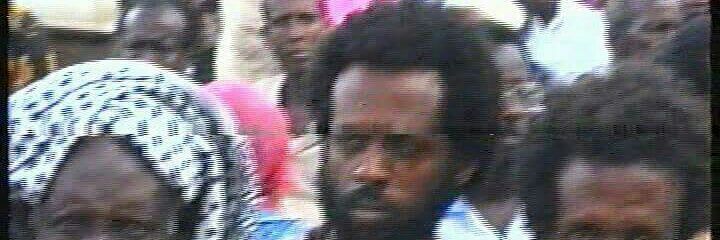
Ahmed Deria is a veteran of the SNM armed liberation struggle who,while later living abroad,became an advocate for global recognition of the Isaaq genocide.He also tirelessly championed closer relations with Israel long before its December 2024 recognition of Somaliland.
Yet the most scandalous aspect of his case may not be his arrest,but the Somaliland government’s apparent inability to substantiate the allegations against him before the military court,a damning indictment of a gov that appears more capable of making accusations and orchestrating arrests than producing evidence to support them.
I recall public message from the Somaliland Minister of foreign affairs agitating the diaspora to act upon as free lance Ambassadors & promote our aspiration to east &west, it was patriotic mission.Suddenly i heard the arrest of Deria ,a national involved in Genocide behind bars.
@yGabobe@ckoettl@OAbraar@vantor Many Americans are convinced that NYT persons write their stories in cocktail lounges that offer free internet. Mr Koettl needs to travel to Berbera in Summer months before writiing.I have, personally, been to Berbera four or five times and never saw what he describes 😂🤣🙏🏾
@tigin_mert تركيا اول دولة مسلمة تعترف باسرائيل والتبادل التجاري بينكم 34 مليار سنويا. اسرائيل اشرف منك يا خنزير.
اسرائيل على الاقل لم تحول صوماليا الى مستعمرة مثلكم ولم تطلب ان يكون لديها قواعد في صوماليلاند ابداً
للاتراك في صوماليا:اكبر قاعدة عسكرية خارج تركيا،اكبر قاعدة لتجربة اطلاق صواريخ عصرية فرط صوتيه،وامس وضعت حجر الاساس لبناء اكبر قاعدة بحرية لها في المحيط الهندي.
الدول العربية ومصر التي كثيرا ما نسمع عن تردد عبارة "الامن القومبي العربي" على لسان قادتها فرحين بتحول صوماليا الى مستعمرة تركية
محكمة العدل لشرق أفريقيا تخطر حكومة مقديشو بدعوى قضائية رفعها ضدها رئيس المحكمة العليا وأعضاؤها
وجهت محكمة العدل لشرق أفريقيا، التي تتخذ من مدينة عروشا التنزانية مقراً لها، إخطاراً قضائياً رسمياً إلى حكومة حسن شيخ محمود، على خلفية دعوى رفعها ضدها رئيس المحكمة العليا في صوماليا وخمسة من أعضائها، في تطور جديد يعكس تفاقم الأزمة الدستورية والسياسية التي تشهدها البلاد.
وبحسب الإخطار الصادر عن المحكمة بتاريخ 18 نوفمبر 2026، والمتعلق بالدعوى رقم 69 لسنة 2026، فقد طُلب من النائب العام للحكومة الصومالية تقديم رد رسمي على الدعوى خلال 45 يوماً من تاريخ تسلمه الإخطار، على أن تنظر المحكمة في القضية وتبت فيها في غياب ممثل الحكومة في حال عدم تقديم الرد خلال المهلة المحددة.
وكانت المحكمة العليا في الصومال قد أصدرت في 5 نوفمبر 2026 حكماً يقضي بانتهاء الولاية الرئاسية لحسن شيخ محمود في 15 مايو 2026، بعد استكمال مدتها الدستورية البالغة أربع سنوات، رافضةً تمديدها لعام إضافي.
ويمثل انتقال المواجهة بين السلطتين التنفيذية والقضائية في الصومال إلى ساحة القضاء الإقليمي تصعيداً غير مسبوق في الأزمة الدستورية التي تعصف بالبلاد، ويضع حكومة مقديشو أمام تحدٍ قانوني على المستوى الإقليمي، في ظل اتساع رقعة الخلافات السياسية بشأن شرعية استمرار حسن شيخ محمود في السلطة بعد انتهاء ولايته.
This morning,I visited Berbera Airport,the luxurious and friendly Airport Inn Hotel and an undeveloped seafront property belonging to our family,the latter two situated within a few hundred metres of the airport's perimeter fence.All are in the immediate vicinity of the site where The New York Times' Christoph Koettl claimed on Friday that the UAE had established a military airbase,a claim I dispute.
The UAE has been actively engaged,alongside AFRICOM,in counterterrorism operations against ISIS in the Al-Miskad mountain range in Puntland,Somalia.These efforts contribute significantly to regional and international security and should be welcomed rather than portrayed as a source of concern.
Should the need arise to utilize Berbera Airport's exceptionally long runway for counterterrorism air operations against terrorist groups in neighbouring Somalia,I have no doubt that Somaliland would be willing to cooperate.
But we are not there yet.There is a fundamental difference between the strategic potential of an airport and the actual establishment of a foreign military airbase.Responsible journalism should distinguish between the two.
@ckoettl
I’m in Berbera,and I find this reporting both absurd and deeply misleading.A few basic facts seem to have escaped your investigation:
* Where,exactly,are the personnel supposedly operating this alleged military airbase at Berbera airport? If this is an operational military installation,where are the people running it?
* Defensive barriers and security installations are hardly unusual in Somaliland.Since the terrorist attacks of 2008, such precautions have become commonplace at both public and private facilities.Finding one or two at Berbera airport is hardly evidence of a secret military installation.
* The airport is not closed to civilian aviation.There simply aren’t any scheduled commercial flights at present. That is an entirely different matter.If you doubt it,try chartering a flight to Berbera and see for yourself.
* You could at least have checked whether Puntland has actually declared independence from Somalia before making such basic geographical and political errors.Yet you describe yourself as an investigative photojournalist.
* Somaliland restored its independence in 1991, 36 years ago,after having gained internationally recognised independence from Britain in June 1960. Why,then,insist on describing it as a breakaway region of Somalia? Would you apply the same terminology to Taiwan,which Beijing insists is a breakaway province of China? Or do you and the New York Times reserve that particular political framing for Somaliland?
* AFRICOM officers have been visiting Somaliland periodically for years. Their latest visit is nothing particularly novel,nor did this engagement begin with the war with Iran.
* Finally,the fact that Berbera airport served as a military facility during the Cold War, first under the Soviets and subsequently under the Americans,does not make it a military base today.Historical use is not proof of present-day military activity.
There is a fundamental difference between investigative journalism and assembling a collection of satellite photographs, drawing speculative conclusions,and presenting them as established facts.If you are going to make serious allegations about a supposed UAE airbse installation in Berbera,you owe your readers considerably more evidence than this.
I would suggest spending some time on the ground in Berbera,speaking to people who actually live here,and verifying your claims before publishing sensational conclusions about a place you clearly haven’t been to or understood.
Unfortunately we know the nature of Somalians which is ingratitude, lies and an inflated opinion of themselves.
We did not know this in 1960 when we first met them but by 1990 three decades later we were desperate to get away from their savagery and chaos.
The united nations attests to the wealth of Somaliland in 1960 where we had a surplus and savings in our banks whereas Somalia was bankrupt. 66 years later this has not changed
Waa duni aakhiru sabaan . Bal eega nacaskan Cagdheer ee waligii qaxoontiga ahaa ee ku leh Imaaraatka ayaanu quudin jirnay oo mucaawimo u diri jirnay ilaa 1972kii
Somali Prime Minister Accuses UAE of Financing War in Somalia, Complicity in Gaza Massacres, and Arming Militias That Killed 6,000 People in El Fasher in Three Hours
Sudanese Echo | November 20, 2026
Somali Prime Minister Hamza Abdi Barre has levelled sweeping accusations against the United Arab Emirates, alleging that Abu Dhabi is financing armed conflicts, supplying militias with weapons, and fuelling instability across several Arab and African countries. He accused the UAE of gathering Somali political opposition figures in Dubai and offering them financial support in exchange for taking up arms against the government. Barre also held Abu Dhabi responsible for killings in Somalia's Bay, Bakool, and Lower Shabelle regions, accused it of direct or indirect involvement in massacres in Gaza, and alleged that it armed militias and recruited foreign mercenaries who killed 6,000 people in Sudan's El Fasher within just three hours.
The accusations came during a speech delivered in Mogadishu on November 19, excerpts of which were published in video clips by the Africa Gate platform. Barre said the UAE had deceived Somalis through three things, the first being the legacy of its founding president, Sheikh Zayed bin Sultan Al Nahyan. He described Sheikh Zayed as a wise and respected leader, widely known as the "Wise Man of the Arabs," who maintained close ties with the Somali people through trade, mutual respect, and friendship, even during periods when Somalia lacked a functioning central government. Barre recalled that Somalis had collected and sent money to the UAE during the 1970s and continued, until relatively recently, to provide assistance to what they regarded as their "brotherly Emirati people." He said these historical bonds of trust and goodwill had made Somalis welcome Emiratis into their country without suspicion.
The second factor, Barre explained, was the traditional white robe worn by Emiratis, which Somalis tended to associate with religious uprightness and good character. The third was the Arabic language, which reinforced their sense of shared identity and brotherhood. "We never imagined that evil could be concealed beneath that robe, or that evil could speak Arabic," he said, adding that Somalis had failed to recognize how much had changed since Sheikh Zayed's death.
Turning to the current dispute, Barre said his government informed the UAE at the beginning of January 2026 that the existing situation could no longer continue and that Somalia had decided to withdraw from and terminate all agreements with Abu Dhabi. According to his account, the UAE responded by escalating its interference, assembling Somali opposition politicians and bringing them to Dubai. There, he alleged, Emirati officials told the politicians that financial support for political activities would no longer be available and instead asked: "Can you take up arms? Can you start a war? I want the fires to ignite."
Barre claimed that some opposition politicians rejected the proposal, explaining that their disagreements with the government were political and that they had no intention of becoming warlords. The response they received, he alleged, was: "If you are not going to become warlords, we have nothing to do with you." He insisted that the UAE would not provide a single cent or dollar to anyone unwilling to become a warlord, while offering substantial sums to those prepared to take up arms and ignite fighting. Barre held Abu Dhabi responsible for every person being killed in Bay, Bakool, and Lower Shabelle, declaring that "they are the ones providing the money, supplying the ammunition, purchasing the drones, and standing behind all of it."
The Somali prime minister then expanded his accusations beyond Somalia. Referring to Gaza, he alleged that the UAE was directly or indirectly implicated in the massacres committed there, describing the Emiratis as former brothers from whom Somalia had now parted ways. He also referred to Algeria, claiming that the North African country had expelled Emiratis and was seeking to distance itself from the problems he associated with Abu Dhabi. According to Barre, Algeria's message was effectively "Leave us alone," the same message Somalia is now delivering. He went on to accuse the UAE of destroying Libya, declaring that there was hardly a place it had not contributed to destabilizing, before adding: "And you know what they did in Yemen."
In one of the most serious parts of his address, Barre turned to the atrocities committed in El Fasher, the capital of North Darfur in western Sudan. He directly accused the UAE of arming militias and recruiting mercenaries from around the world to participate in the conflict. "The militias they armed and the mercenaries they gathered from across the world killed 6,000 people inside the city in just three hours," he said. Barre repeated the time frame to emphasize the scale of the alleged massacre: "Three hours. Just three hours." The figure of 6,000 deaths within three hours was cited by the Somali prime minister and has not been independently verified by Sudanese Echo.
Barre explicitly connected the atrocities in El Fasher to the violence unfolding in Somalia, arguing that those responsible for financing and arming the militias accused of the Sudanese massacres also bear responsibility for people being killed in Somali regions today. His remarks portrayed Somalia's current security challenges as part of a wider regional pattern in which, he alleged, Abu Dhabi uses money, weapons, and foreign fighters to fuel conflicts and undermine national institutions.
The significance of Barre's accusations lies in their unusually direct language and their source: the sitting prime minister of an Arab and African nation. His allegations implicate the UAE in atrocities in Gaza and Sudan, armed violence in Somalia, and destabilizing interventions in Libya, Yemen, and Algeria. They come amid escalating diplomatic tensions between Mogadishu and Abu Dhabi, as international scrutiny continues over allegations of Emirati military and financial support for the UAE-backed Rapid Support Militia (Janjaweed) in Sudan.
From El Fasher to Mogadishu, and from Gaza to Libya and Yemen, the Somali prime minister's accusations describe what he sees as a regional pattern of Emirati intervention built around financing armed groups, exploiting internal political divisions, and supplying the weapons that sustain devastating conflicts. Coming from the head of a government that says it is confronting such interference firsthand, these allegations raise serious questions about accountability for civilian deaths, arms transfers, and the recruitment of foreign mercenaries across multiple conflict zones.
#Sudan
#RSFisTerroristOrganization
#UAEKillsSudanesePeople
#UAESponsorsTerrorism
The renovations to Berbera’s runway,first undertaken with Kuwaiti assistance and later supported by the UAE,took place at least 14 and 7 years ago,respectively. They were neither a recent development nor an expansion,contrary to what you have reported.
There is no Israeli military presence in Berbera.These are serious claims,and they should not be presented as facts without credible evidence.
Your reporting on Baidoa is generally good.Perhaps you would be better advised to stick to what you know best for the time being,rather than venture into subjects you clearly haven’t researched adequately.
I’m in Berbera,and I find this reporting both absurd and deeply misleading.A few basic facts seem to have escaped your investigation:
* Where,exactly,are the personnel supposedly operating this alleged military airbase at Berbera airport? If this is an operational military installation,where are the people running it?
* Defensive barriers and security installations are hardly unusual in Somaliland.Since the terrorist attacks of 2008, such precautions have become commonplace at both public and private facilities.Finding one or two at Berbera airport is hardly evidence of a secret military installation.
* The airport is not closed to civilian aviation.There simply aren’t any scheduled commercial flights at present. That is an entirely different matter.If you doubt it,try chartering a flight to Berbera and see for yourself.
* You could at least have checked whether Puntland has actually declared independence from Somalia before making such basic geographical and political errors.Yet you describe yourself as an investigative photojournalist.
* Somaliland restored its independence in 1991, 36 years ago,after having gained internationally recognised independence from Britain in June 1960. Why,then,insist on describing it as a breakaway region of Somalia? Would you apply the same terminology to Taiwan,which Beijing insists is a breakaway province of China? Or do you and the New York Times reserve that particular political framing for Somaliland?
* AFRICOM officers have been visiting Somaliland periodically for years. Their latest visit is nothing particularly novel,nor did this engagement begin with the war with Iran.
* Finally,the fact that Berbera airport served as a military facility during the Cold War, first under the Soviets and subsequently under the Americans,does not make it a military base today.Historical use is not proof of present-day military activity.
There is a fundamental difference between investigative journalism and assembling a collection of satellite photographs, drawing speculative conclusions,and presenting them as established facts.If you are going to make serious allegations about a supposed UAE airbse installation in Berbera,you owe your readers considerably more evidence than this.
I would suggest spending some time on the ground in Berbera,speaking to people who actually live here,and verifying your claims before publishing sensational conclusions about a place you clearly haven’t been to or understood.
@alfihrest ما علاقة الإمارات باستقلال صوماليلاند عن بريطانيا عام 1960، حتى يُراد اليوم تصوير استعادة صوماليلاند لاستقلالها عام 1991 وكأنها مشروع إماراتي؟ هل كانت الإمارات موجودة أصلاً عندما نالت صوماليلاند استقلالها؟ وهل كان لها أي دور عندما قرر شعب صوماليلاند، بإرادته الحرة، استعادة دولته