The entire Criterion Closet is now available as a website, where you can browse all 1,247 films by walking the shelves, thanks to redditor olievans.
https://t.co/O2b7MwzCZj
A few weeks ago I noticed that Linear got slower than it used to. Especially on the new Diffs feature, that we were getting ready to release, it was pretty bad. For days I was running profiles, staring at profiles, bisecting with agents from every direction.
The pattern was clear - we accessed the DOM a ton, which blocked the main threads on style recalcs and layout for 10s or 100s of milliseconds over and over.
I shipped dozens of PRs to get rid of those layout-causing calls, using pretext and whatever tricks the agents and I could come up with. It helped, but only a bit. I was getting desperate.
Before jumping into books like DDIA or Database Internals, it helps to understand the systems layer these designs are built on.
A lot of the design of such data-intensive systems is based on virtual memory: page tables, page faults, mmap, the page cache, swapping, NUMA placement, TLBs, and the tradeoffs between what the OS wants and what the database wants.
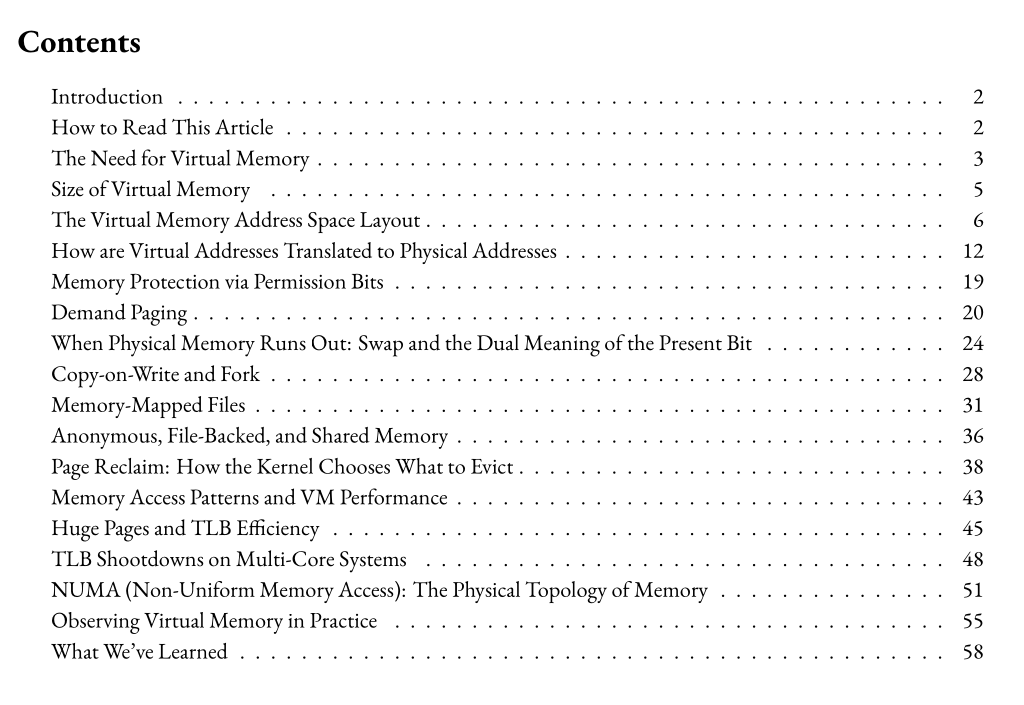
My latest article is a ~25,000-word mini-book on virtual memory.
It starts from first principles and goes all the way down to advanced topics like NUMA placement and performance debugging with tools like perf and /proc.
I also wrote it differently: as a dialogue between a user-space process and the kernel.
Most treatments of virtual memory are dry and fact-heavy. I wanted this one to feel more like a story, while still being technically deep.
Link below.
@eddiejiao_obj@drewocarr @LTXStudio @modal_labs All of this is live! it's early and slow. many of the demos above are sped up/edited, but we can't wait to see what you think. Try it yourself at https://t.co/bcephqPu1c (5/5)
Imagine every pixel on your screen, streamed live directly from a model. No HTML, no layout engine, no code. Just exactly what you want to see.
@eddiejiao_obj, @drewocarr and I built a prototype to see how this could actually work, and set out to make it real. We're calling it Flipbook. (1/5)
Starting today, personal superintelligence is just one tap away.
No download, no signup.
Text Poke for free now:
https://t.co/x9ipMywiNU 🌴
—
0:00 – What's Poke?
0:50 – Introducing Poke Recipes
1:25 – Create a Recipe in 10 seconds
1:43 – Earn on Poke
2:44 – Build with npx poke
12:58 – Recap
13:36 – Parisian Love
What Claude Code has revealed is that most people either have mediocre ideas or no ideas at all. The tool is a force multiplier for those who already know what they want to build and how to think through it systematically; it elevates competence, rewards clarity, and accelerates execution for people who would have gotten there anyway, just slower. If you have a sharp vision and can break it into coherent steps, Claude Code becomes an extension of your own capability.
But there's another mode of use entirely. For people without that clarity, the appeal is precisely that the input can stay vague; you gesture at something, hit enter, and wait to see what comes out. This is structurally identical to a slot machine: low effort, variable reward, and that intermittent reinforcement loop that hooks the susceptible. So the same tool that elevates the focused and capable is also manufacturing a kind of gambling behavior in people prone to it.
If you've ever seen someone tweet some cool shader and thought "I don't really even know what a shader is and at this point I'm too afraid to ask" - I've written something just for you.
https://t.co/0ez5xz5vCP
Performance Hints
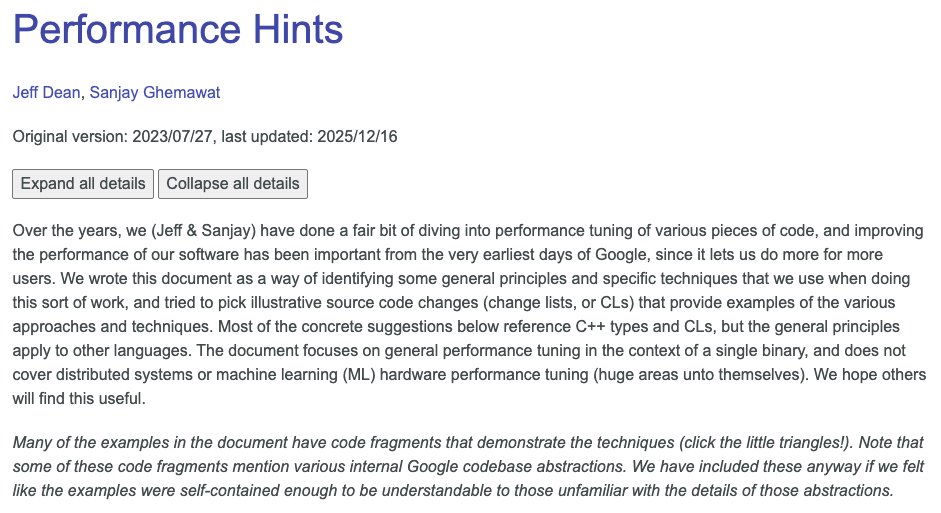
Over the years, my colleague Sanjay Ghemawat and I have done a fair bit of diving into performance tuning of various pieces of code. We wrote an internal Performance Hints document a couple of years ago as a way of identifying some general principles and we've recently published a version of it externally.
We'd love any feedback you might have!
Read the full doc at: https://t.co/jej95g236P