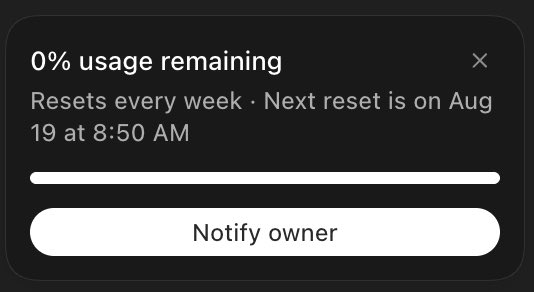
@thsottiaux It’ll help if you could be transparent about business users not getting a reset every now and then. This week was particularly frustrating
https://t.co/IvoPge80nH
@thsottiaux It’ll help if you could be transparent about business users not getting a reset every now and then. This week was particularly frustrating
https://t.co/IvoPge80nH
How can @OfficialFPL, in 2023, take more than an hour to update points and standings across leagues / cups?
I can’t fathom why it would take this long to recalculate a few million rows, they have like ~8 million players and maybe a million leagues and cups.
I think this is a fair read on why founders build what they build, but I’d push back on it being mostly about today’s market.
To me this didn’t start with e-commerce / 10-min delivery. It goes back to the services giants in the 90s who had decades and fat margins to build real products and just didn’t, because staying safe paid well enough.
The same habit is everywhere now, with everyone piling into whatever’s already working. Wrote out the longer version below.
https://t.co/VbNZaxh1gI
We’ve basically already run the experiment article is proposing, and it didn’t really work.
I think this is a fair defense of why Indian founders build what they build. Where I’d push back is the idea that it’s mostly about today’s market and today’s constraints. To me the real story is older than that, and it starts in the 90s.
After liberalization, our big services companies (TCS, Infosys, Wipro, etc) made money hand over fist for ~30 years. Strong margins, global clients, cash piling up, and every chance to put some of it into building real products.
Most of it went into buybacks and dividends instead. R&D sat ~1% of revenue for years. They stuck with services because services was comfortable and it paid.
The article’s logic is that you climb the ladder one rung at a time, and today’s builders set up tomorrow’s. But we already had a cohort reach a high rung, cash-rich and globally competitive, and they just stopped climbing.
And yes, capital is genuinely scarcer here than in the US and the risk a founder takes on is real. I’m not disputing that. It just doesn’t explain a wealth engine that had three decades and chose to play it safe.
The same instinct is everywhere right now. The moment one category starts printing money, everyone piles into a version of the same thing. The market can tell you what’s working today, but it can’t tell you what’s worth building next.
The harder bet is backing a category that doesn’t exist yet, before anyone validates it for you. That’s the part I find missing, and it has a lot less to do with how much the average Indian can spend than we like to admit.
We’ve basically already run the experiment article is proposing, and it didn’t really work.
I think this is a fair defense of why Indian founders build what they build. Where I’d push back is the idea that it’s mostly about today’s market and today’s constraints. To me the real story is older than that, and it starts in the 90s.
After liberalization, our big services companies (TCS, Infosys, Wipro, etc) made money hand over fist for ~30 years. Strong margins, global clients, cash piling up, and every chance to put some of it into building real products.
Most of it went into buybacks and dividends instead. R&D sat ~1% of revenue for years. They stuck with services because services was comfortable and it paid.
The article’s logic is that you climb the ladder one rung at a time, and today’s builders set up tomorrow’s. But we already had a cohort reach a high rung, cash-rich and globally competitive, and they just stopped climbing.
And yes, capital is genuinely scarcer here than in the US and the risk a founder takes on is real. I’m not disputing that. It just doesn’t explain a wealth engine that had three decades and chose to play it safe.
The same instinct is everywhere right now. The moment one category starts printing money, everyone piles into a version of the same thing. The market can tell you what’s working today, but it can’t tell you what’s worth building next.
The harder bet is backing a category that doesn’t exist yet, before anyone validates it for you. That’s the part I find missing, and it has a lot less to do with how much the average Indian can spend than we like to admit.
What does dangerous mean in this context?
The popular opinion since Fable launched is that it is more capable than the current SOTA models, and these researchers allegedly found a way to jailbreak the guardrails and basically ask the model to do whatever they want.
Isn’t this dangerous especially re: cybersecurity vulnerabilities that haven’t been patched yet?
Wanting an honest education system, and immediate accountability isn’t a political issue, it’s a human one. If a student wants to scream that message from a cockroach party, ruling party, opposition party, Bhangra party or a kitty party…they should have everyone’s support.
What are your thoughts on the new dynamic workflows / ultracode introduced in Claude Code alongside Opus 4.8?
I’m a heavy kiro-cli user and Kiro’s visible thinking is still way easier for me to follow than CC. But ultracode feels like the right shape for deep work: dynamic planning, parallel tasks, verification, etc.
I’ve been doing this manually with a forked multi-agent orchestrator (oh-my-opencode) on top of kiro-cli, using a supervisor-style agents that spins up research / review / summary workers based on the task.
Seeing this become a native kiro-cli workflow would be huge.
I’m told this progress is attributable to:
* JD Vance being sidelined (which led to his discussion of dropping presidential bid)
* Rubio quietly taking over lead
* Rubio switch lead mediator from Pakistan to Qatar due to Pakistan’s “discretion” issues
* Rubio being able to convince Iranian delegates that the Congressional restraints on military action outside the 60-day window are serious, and that the US can only engage defensively
Unlike the talks in Pakistan, we are hearing *a lot* less public claims of progress, but there is apparently substantially more real progress behind the scenes.
Trump’s unpredictability, rhetoric and Netanyahu being a loose cannon are still causing material delays, but it sounds like there is at least a round one deal getting close.
(And that senior Republican leadership have quickly jumped ship from Vance to Rubio in a potential ‘28 bid, after he showed how little statecraft is needed to move something stable forward here)
@championswimmer Have you never faced any issues with websites not loading properly with AdGuard?
I use NextDNS, and there are several websites that already detect it as an ad-blocker and force you to disable it.