Thai police: BTS victims can file complaints over Italian youths' behaviour
Thailand's police spokesperson says anyone who believes they were insulted or demeaned by the group of Italian youths who allegedly made obscene gestures and behaved disruptively on a BTS train can file a criminal complaint.
Lt. Gen. Trairong Phiwphan said that because the incident occurred in Thailand, any offence committed by foreign nationals is subject to Thai law. He added that videos and photos circulating online could be used as evidence in any investigation.
He also said any decision to revoke the group's visas would fall under the authority of immigration officials if the legal criteria are met. Police urged the public to avoid confrontation, prioritise their safety, preserve evidence where possible and report incidents through the proper legal channels. #ThailandNews #Italy #ItalyinThailand #อิตาลี่
You all never can guess Trump, you all didn’t even see him being president for the 1st and 2nd time. So just stop trying and wait and see what he will mess up or not.
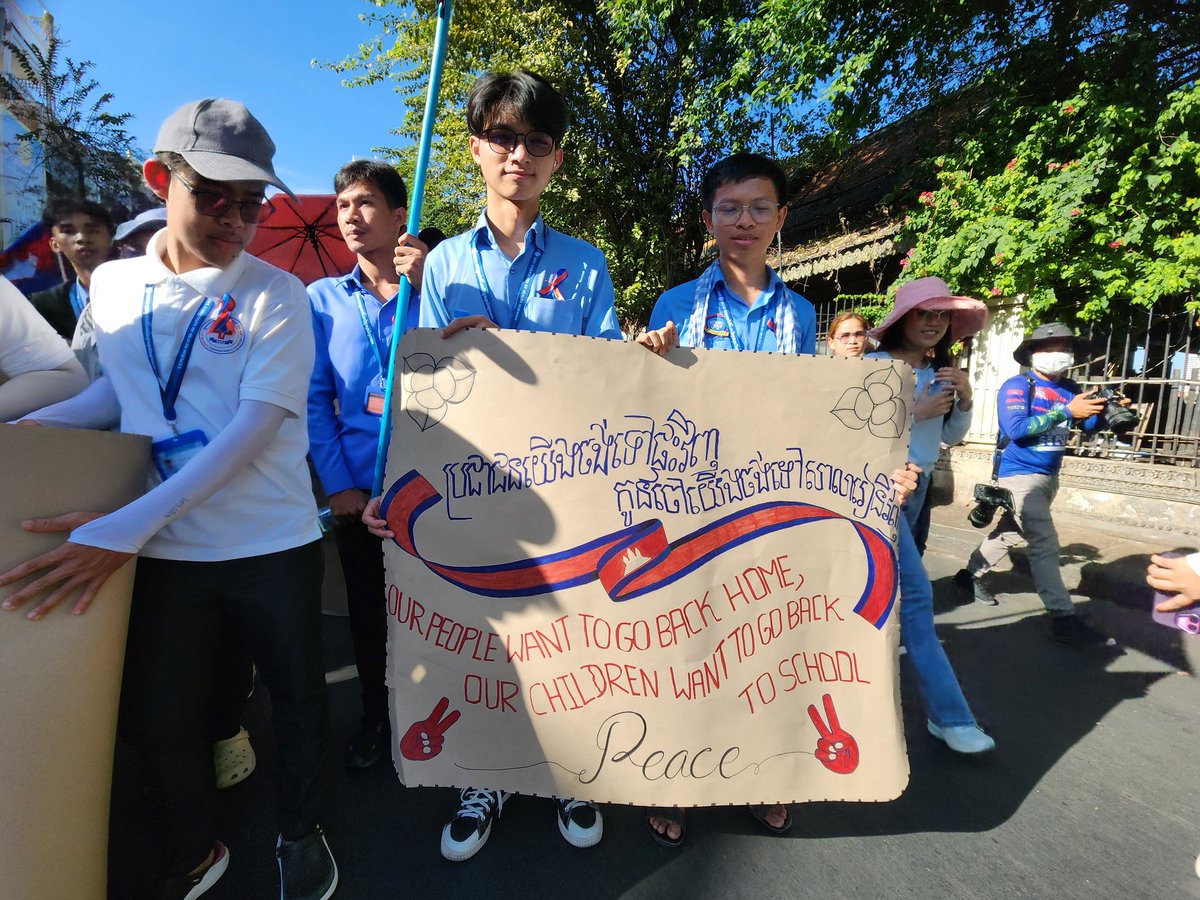
#Cambodians walk for peace in #Phnompenh Dec 18 as they plead for the border conflict between #Thailand & #Cambodia to end. The clashes resumed Dec 8 & it has lasted >10 days now. At least 1/2 million people displaced on both sides https://t.co/Kh0erMTYfd
ASEANFocus+ - @AKittikhoun argues that by treating the #Mekong as an interconnected system rather than a patchwork of national interests, ASEAN can help transform the river into a model of regional cooperation, sustainability, and shared prosperity. https://t.co/JAsX5u8GGx
One of the most bizarre aspects of the #Cambodia-#Thailand conflict is the new crop of Western digital nomad/travel influencers who have pumped up their Facebook follower counts by cooking up clickbait propaganda for their chosen side.
What’s also sure is the suffering of both sides of people especially when they are from similar bloodline with Thailand border towns of Sisaket, Buriram and Surin constitutes approximately 30% of Northern Khmer ethnicity.
or did Cambodia deliberately planted a new one. It sure paved a way for Thailand to be appearing stronger this time which is obvious from their responses and rhetorics with government and military on the same page this time.
Fulcrum Commentary by Pongkwan Sawasdipakdi (@pongkwans) - Territorial sovereignty and the military’s image as guardian of the nation limit the kingdom’s attempts at conciliation in its current dispute with Cambodia. #Thailand https://t.co/SWB1bjDGY4
We’ve found a “third state” between life and death.
Some cells refuse to accept death when the organism does. Instead, they adapt, reinvent themselves, and sometimes start over.
Researchers have found that certain cells, taken from a recently deceased body and placed in the right conditions, can awaken into a surprising new existence. They self-organize into living, moving entities that behave in ways their original bodies never did. Scientists describe this neither as full life nor true death, but as a third state—something in between.
In a landmark experiment, skin cells from deceased frog embryos were scattered into a dish. Within days, they gathered into multicellular clusters called xenobots. These tiny creations could crawl, self-repair, and—most astonishingly—reproduce by sweeping loose cells into piles that then became new xenobots.
The phenomenon isn’t limited to frogs. Human lung cells, harvested postmortem, recently formed anthrobots—microscopic blobs that propel themselves through liquid and can even encourage healing in damaged neural tissue nearby.
This remarkable plasticity reveals that even after the organism dies, many of its cells retain not only basic function but a kind of creative agency—the ability to change identity and build entirely new structures.
The implications are profound. In the near future, patient-derived biobots could be engineered to deliver drugs directly to tumors, scrape plaque from arteries, or mend injured tissue, then harmlessly dissolve after weeks without triggering immune reactions.
Death, it turns out, is not always final at the cellular level. Some of our cells may still have work left to do long after we’re gone.
["Biobots arise from the cells of dead organisms − pushing the boundaries of life, death and medicine." The Conversation, 2024]