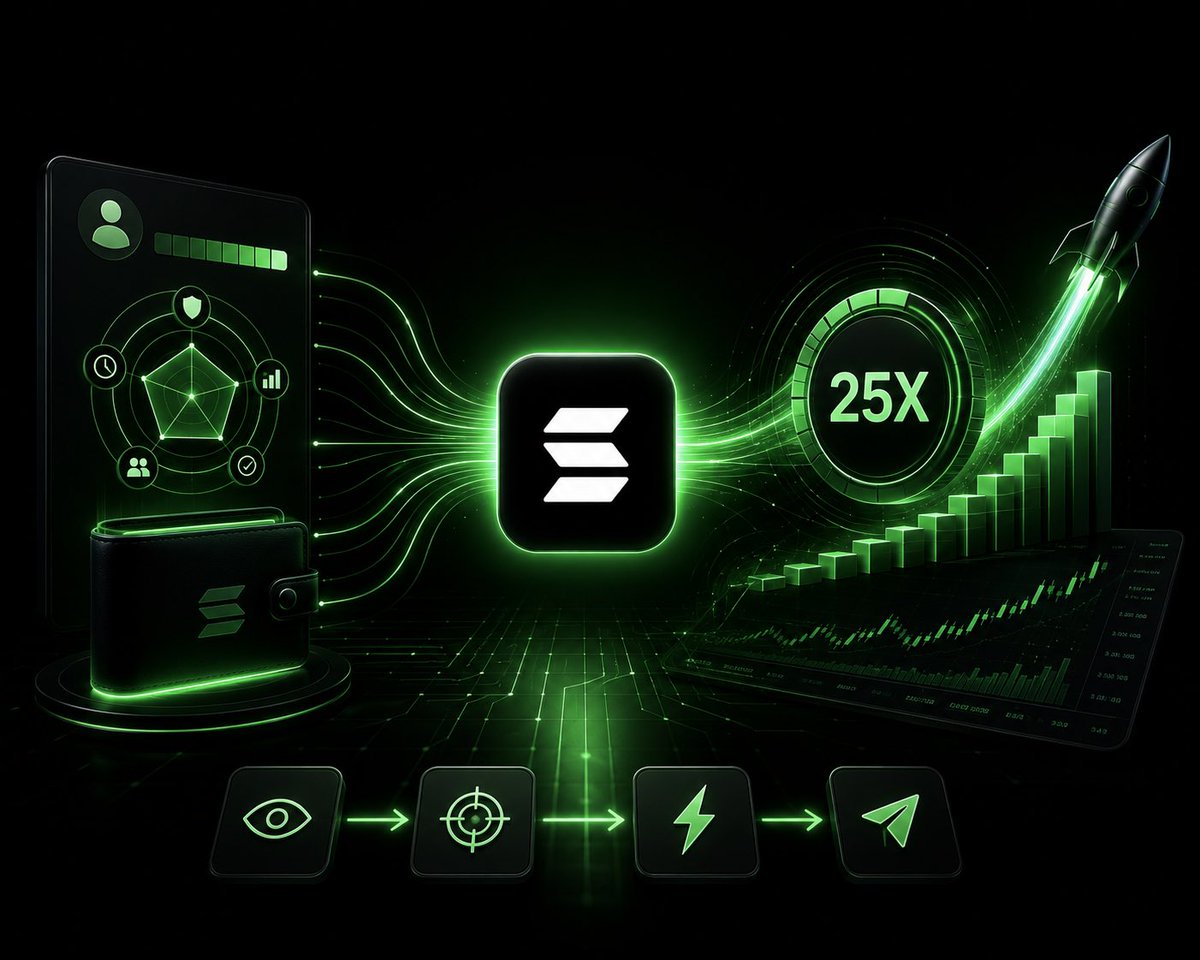
Given the same input…
They produce the same result.
And that is one of the foundations of good software.
Trading shouldn’t be any differen
Your workflow shouldn’t change because you forgot which tab to open first
Or because an interface buried an important metric
Or because you lost track of which wallet was active
Random workflows create random outcomes
Deterministic workflows create consistency
The same philosophy applies to capital
Your ability to execute shouldn’t be determined solely by the cash sitting in your wallet.
We are exploring a model where trusted traders can unlock up to 25× buying power based on their credit profile
Not because everyone should trade with leverage.
But because capital efficiency should be earned and not gated by centralized platforms
Execution is more than clicking Buy
It is the workflow
The infrastructure
And the access to capital when opportunity appears
And that is what we are building with on the $Solard Terminal
A deterministic trading experience from decision to execution
Trading shouldn’t be limited by the cash sitting in your wallet.
What if your onchain reputation could unlock buying power?
That is what we are building.
With the $Solard terminal,eligible traders can access real leverage based on their credit profile.
Spend $1 and Control up to $25 of exposure
No centralized exchange
No depositing collateral into another platform
Just more capital efficiency for traders who have earned it.
This isn’t about encouraging reckless leverage.
It is about giving trustworthy traders access to better execution.
Crypto has spent years building transparent markets.
Now it is time to build transparent credit.
And this is one of the ideas we are exploring at $Solard
The future of trading isn’t just faster execution.
It is also about smarter access to capital
Leverage availability depends on your credit score and risk profile
We are building Solard around a simple belief:
Execution is a product feature.
The difference between catching a move and missing it often isn’t strategy.
It is everything that happens between seeing an opportunity and submitting a transaction.
> Opening tabs.
> Switching wallets.
> Copying addresses.
> Waiting for interfaces to load.
> Signing multiple prompts.
Every one of those steps introduces friction.
With $Solard,we are working to remove as much of that friction as possible.
The terminal isn’t the goal.
Better execution is.
Every update we ship is aimed at reducing the distance between intent and execution,while giving traders more visibility and more control over what happens under the hood.
There is still a lot to build.
But we are getting closer with every release.
stay with us
That is why we are building the $Solard terminal for trader to make better decision,catch early runners and execute their trade faster with $0 trading fees
47M2U1eVot6VPWjcqEFWe2CesUTBGBXfSDovaqTmpump
We are not building Solard CLI to replace a web app.
We are building it because some workflows are simply better in a terminal.
When you are actively trading,every extra click,page load and confirmation adds friction. Over hundreds of trades,that friction becomes your workflow.
With Solard CLI,you can script your own execution,organize multiple wallets with names, choose exactly how transactions are broadcast and execute trades without leaving your terminal.
No unnecessary abstractions.
No hidden routing.
No guessing what is happening under the hood.
The goal isn’t to build another CLI.
The goal is to build the fastest path between a trading decision and an onchain transaction.
This release is another step toward that vision, and we are already working on what comes next.
Dont forget to use the $Solard terminal
We are building Solard Terminal with one goal:
To give traders everything they need in one seamless trading experience
47M2U1eVot6VPWjcqEFWe2CesUTBGBXfSDovaqTmpump
When the Markets move fast
Your trading terminal should do too
The $Solard Terminal is designed specially to help traders track the market,execute with confidence and focus on making better trading decisions with less stress and $0 fee as chargeback for trading
47M2U1eVot6VPWjcqEFWe2CesUTBGBXfSDovaqTmpump
GM! I's a new exciting week ahead 🔥
To kick it off, we’re doing a small giveaway for the community.
Comment SOLARD below (one comment per person)
Winners will be randomly selected live during our next livestream.
Good luck! 🍀
One signal is an opinion.
Multiple independent signals are evidence.
In distributed systems,a single node doesn’t decide the truth.
Consensus does.
Why?
Because individual nodes can fail.
Become outdated.
Or report incorrect information.
Markets behave the same way.
A whale buy isn’t enough.
A volume spike isn’t enough.
A trending token isn’t enough.
Each signal can be manipulated in isolation.
But when independent signals begin to agree
Wallet accumulation
Holder growth
Liquidity expansion
Organic transaction activity
Sustained social momentum
you move from speculation to probability.
The strongest trading decisions don’t come from the loudest metric.
They come from signal consensus.
Most terminals ask you to interpret every signal yourself.
We think software should do the correlation first.
And thats how we approach the $Solard terminal
Not looking for one perfect indicator.
Building market consensus before surfacing an opportunity
Every dependency is a delay.
In software engineering,tightly coupled systems are fragile.
One component fails
Everything slows down.
Trading workflows have the same problem.
Your decision depends on:
>One charting site.
>One block explorer.
>One wallet tracker.
>One holder analyzer.
>One social feed.
>One liquidity checker.
Miss one piece…
Your confidence drops.
Wait for one platform to load…
Your timing disappears.
The more tools your workflow depends on
The more fragile your edge becomes.
The best trading terminals don’t just aggregate data.
They reduce dependencies.
One interface.
One workflow.
One source of conviction.
That is how $Solard is built.
Not as another tool in your stack.
As the layer that replaces the stack.
The fastest data is the data you don’t have to fetch.
Modern CPUs are incredibly fast.
Yet they spend most of their time waiting.
Not because they are slow.
Because data is in the wrong place.
Engineers solved this with one idea:
Keep the right information close to where decisions happen.
Trading terminals have the opposite problem.
The chart lives in one tab.
Liquidity in another.
Wallets somewhere else.
Holder distribution somewhere else.
Social activity on a different platform.
Every decision becomes a cache miss.
Your brain spends more time retrieving information than interpreting it.
That is hidden latency.
Not network latency.
Cognitive latency.
The next generation of trading software won’t win by collecting more data.
It will win by reducing the distance between insight and action.
And that is one of the principles behind solana:47M2U1eVot6VPWjcqEFWe2CesUTBGBXfSDovaqTmpump
Not just bringing data together.
But bringing context to where decisions are made
Aggregation is not intelligence.
Most trading platforms aggregate data.
They pull together:
>Price
>Liquidity
>Wallet activity
>Holder distribution
>Social metrics
Then they stop.
Aggregation solves an access problem.
It doesn’t solve a decision problem.
A useful trading system needs another layer.
Inference.
For example:
A whale accumulation event isn’t inherently bullish.
But combine it with:
>Increasing unique holders
>Stable liquidity
>Net exchange outflows
>Organic social velocity
>Healthy wallet distribution
Now the probability distribution changes.
The value isn’t in any individual metric.
It is in the relationships between them.
This is why simply adding more dashboards doesn’t create an edge.
You are still responsible for correlating everything manually.
The next generation of trading infrastructure won’t compete on data coverage.
It will compete on how well it transforms raw signals into actionable inference.
And that is the direction we are taking with $Solard
Not another dashboard
But an inference layer for on-chain markets
1/ solard: open-source Solana trading terminal that runs on your machine, not someone else's server.
CLI + SDK + web UI. Multi-wallet. Keys and trade history stay in encrypted local storage.