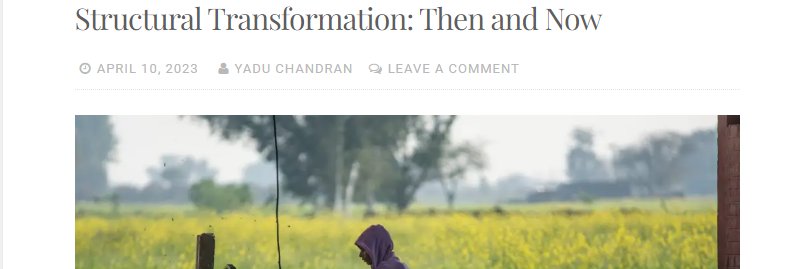
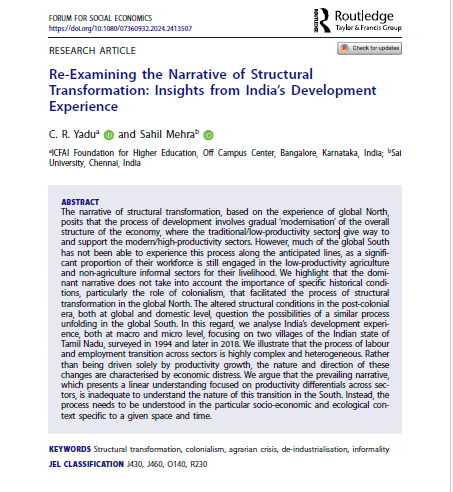
World Development Report 2024 says Development=Structural Change. Is that so? In this article, we critically examine the Lewisian paradigm, which suggests an inevitable transition of labor and employment from agriculture to the industrial sector.
https://t.co/lQHis3cp3O
Policy debates celebrate rising female labour force participation but are we asking the right questions?
My new paper challenges the U-shaped narrative and shows why context, norms, and aspirations matter.
Read: https://t.co/REcYFhRsdh
Does ‘Feminization U Hypothesis’ Hold?
A Discussion on Women’s Work Participation in Rural India - a new paper by C.R Yardu in Agrarian South: Journal of Political Economy (@Agrarian_South).
https://t.co/hDxm0Py5ub
New publication alert!
C.R. Yadu (CASAS member) revisits a widely cited hypothesis on women’s work and offers a grounded perspective that shows how social norms and institutions shape women’s labour market outcomes in complex & context-specific ways.
Link: https://t.co/2hd39PzU7w
I am pleased to share that the thematic issue The Politics of Pro-Poor Policies in the Global South (2026, Volume 14), edited by Wil Hout, Andrew Fischer, and Markus Kaltenborn, has now been published. The issue includes my article, too. Complete issue https://t.co/QZF2rPcl16
New paper in @AgrarianChange w @MadhuraFAS: https://t.co/sP3GlZIEo8
If agri-commercialisation ≠ land concentration, what explains unequal outcomes? Evidence from West UP’s sugarcane boom points to caste-class mediated tenancy and interlinked transactions. Data: @fasagristudies
📢 New paper out in Agrarian South: Journal of Political Economy!
A bottom up view of how gender, social norms, and institutions shape women’s labour outcomes in rural India.
🔗 https://t.co/REcYFhRsdh
.@BanOrAnir, Raj and I write about wealth inequality in India based on our findings from tracking the top rich individuals in India.
Read here:
https://t.co/yBo7YQXrOn
C.R. Yadu’s talk titled “The Crisis of the Small Farm Economy in India: Towards a World-Ecological Understanding” is on 25 March (Wednesday) at 12:00. Location: Zoom. Link to register online:
https://t.co/MAXrVAqBBa
"Vast tracts of land given by past kings to plantation owners on long tenancy are lying unutilised in Kerala. It has now become important for the State to carry forward the land reforms that the government had instituted, into the plantation sector"
@jacobjoshy_ es estudiante de doctorado en Economía en la Jawaharlal Nehru University (JNU) de India, y en The Daak nos recuerda algo fundamental: la economía no es neutral, y la historia del pensamiento importa para entender sus categorías (1/N) https://t.co/OQMtDbJo3Q
We begin 2026 with a new blog in @AgrarianChange: Jacob Joshy explores contemporary dynamics of the agrarian question in his piece ‘The Patterns of Capital Intensification in Indian Agriculture’. Check it out on our Editors’ Website! https://t.co/QGCjTmxwcI
The costs of dismantling the MGNREGS will not be evenly borne. They will fall disproportionately on women, landless workers and marginalised caste groups, writes CR Yadu.
https://t.co/17auDbbDxV
Opinion | Yadu CR, Postdoctoral Fellow at WELL Labs, writes for @scroll_in about how MGNREGA set off profound social change by weakening hierarchies of power in rural India, and the implications of dismantling it.
Read the full piece here: https://t.co/W3VOL4A7fR
https://t.co/dJ7b77GnRq "What is being presented as efficiency or reform risks restoring monopoly control over labour and livelihoods to landlords and dominant castes." writes @yaducr
MGNREGA was never just an employment scheme. It reshaped rural power relations, strengthened labour’s bargaining power, and expanded dignity and choice for the working class. Dismantling it risks undoing a quiet social revolution.
Read: https://t.co/PgmnzJwUi8
📄 New working paper on rural transformation in India.
Using evidence from village studies, the paper questions linear narratives of transformation and highlights uneven development, labour precarity, and continuing agrarian distress.
Read here: https://t.co/D2Q52DeB1e
If you wish to understand what the new bill proposed by the govt to dilute MGNREGA, India’s largest employment guarantee programme, means, please watch this interview with Jean Dreze (economist, activist, and one of the architects of this programme).
https://t.co/kJoMrttmKI