Anthropic engineer just dropped a 2-hour workshop on “Graph Engineering” for agentic systems:
“80% of our engineers are using self-improving loops. Now everyone is building agentic graphs.”
• 04:43 - Introduction to RAG and graphs
• 26:30 - Core of graph engineering (nodes, edges)
• 01:09:11 - Agents data indexing in Graphs
• 01:30:50 - Three layers of Graphs for agents
• 01:48:15 - Adaptive RAG for self-verification
• 02:16:37 - The future of graph engineering
This 2-hour workshop will replace your $500 agentic memory course.
Watch it today, then read how to become a graph engineer in the article below.
ANTHROPIC'S LEAD ENGINEER WON A $1.2M BONUS FOR A SYSTEM THAT TURNS ANY DATA CHAOS INTO A GRAPH IN 8 STEPS
raw chaos in - self-updating graph out - and the agent gets +42% productivity from day one
Load → Extract → Graph → Index → Query → Memory → Swarm → Update
eight steps, one pipeline, graph grows while you sleep
documents, code, Slack - everything into one stream through Claude Code - nothing gets lost
Fable 5 + Opus 5 extracts entity relationships - Neo4j builds a live structure - zero duplicates
three types of search in one answer - vectors, keywords and graph - merged ranking gives accuracy no RAG delivers alone
a nightly agent pulls new data and updates the graph automatically - the system gets smarter while you sleep
bookmark and paste into Claude Code - a $1.2M system now free
BREAKING: NVIDIA CEO Jensen Huang has now surpassed his LinkedIn follower count on 𝕏.
He joined 𝕏 recently and made his first post just 2 days ago, yet already has more followers than he gained on LinkedIn in nearly 10 years.
The power of 𝕏.
🚨 EVERYONE IS MAKING THE SAME MISTAKE THEY MADE WITH PALANTIR.
And they're about to do it again with $SPCX.
In 2020...
Palantir IPO'd.
The stock exploded.
Twitter called it the easiest money of the decade.
Then it collapsed.
$35 → $7.
Nearly 80% wiped out.
That's when most people gave up.
That's also where the real money was made.
From $7...
...Palantir went to $44+.
Now look at SpaceX.
IPO around $150.
Rally above $215.
Now the panic has started.
Sound familiar?
The crowd always buys the story.
Smart money waits for the fear.
That's why I'm not chasing green candles.
I'm waiting for my accumulation zone:
$80–100.
My long-term target hasn't changed:
$230+.
The funny part?
Most people won't touch $SPCX there.
They'll buy after it doubles...
...because that's when the headlines tell them it's "safe."
That's how every cycle works.
When I start building my position...
I'll post every buy here in real time.
Turn notifications on.
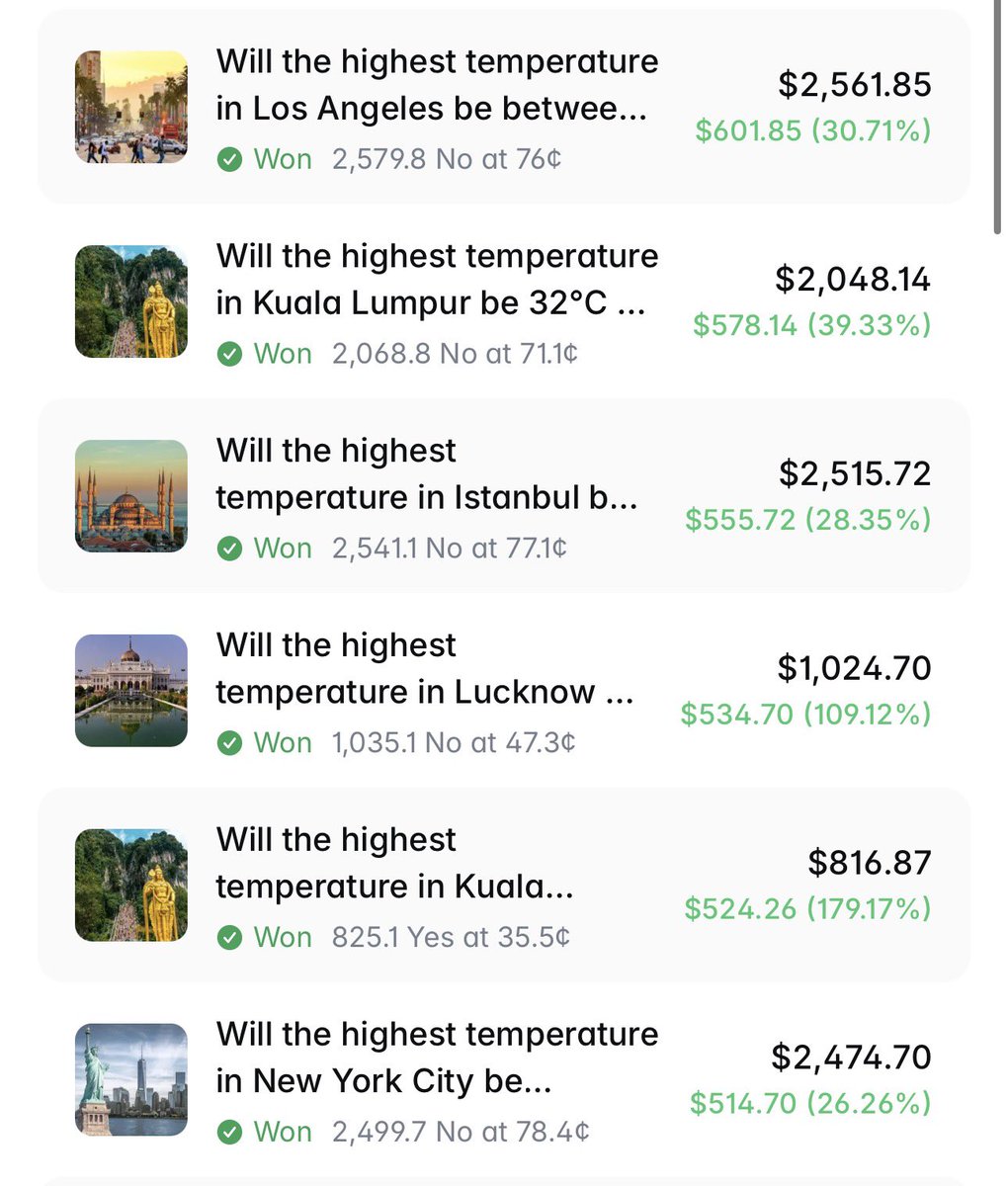
He made $52,000 trading NO outcomes priced 70¢+ on Polymarket weather markets.
+$28,000 last month.
+$1,000/day on average.
He has almost no 10x+ trades.
Instead, he buys NO outcomes at 70-99¢.
Strategy:
> monitors Wunderground (Polymarket resolution source)
> tracks the highest temperature already recorded
> once a temperature has been exceeded, buys NO on all lower outcomes
Example - Highest temperature in Buenos Aires:
> Wunderground has already recorded 17°C
> the day's high can no longer be 16°C
> buys NO 16°C at 70-99¢ and waits for the market to resolve
He isn't predicting the weather.
He's simply faster than everyone else at reacting to new data.
Dozens of weather markets every day.
1-30% profit on each.
That's how he makes +$1,000/day.
from prompt → context → harness → loop → graph engineering.
the list keeps growing, and every new term gets treated as a replacement for the last one. each layer wraps the one before it, and the cleanest way to tell them apart is to ask what a single unit of work looks like.
𝗽𝗿𝗼𝗺𝗽𝘁 𝗲𝗻𝗴𝗶𝗻𝗲𝗲𝗿𝗶𝗻𝗴 𝗶𝘀 𝘁𝗵𝗲 𝗺𝗲𝘀𝘀𝗮𝗴𝗲.
the model remembers nothing before this call, so the prompt has to carry the full universe of what it needs. a role, the background, the instructions, a few examples, a format.
when the output falls short, the skill is working out which ingredient let you down, not rewriting the instructions every time.
the unit of work is one input.
𝗰𝗼𝗻𝘁𝗲𝘅𝘁 𝗲𝗻𝗴𝗶𝗻𝗲𝗲𝗿𝗶𝗻𝗴 𝗶𝘀 𝘁𝗵𝗲 𝗺𝗲𝗺𝗼𝗿𝘆.
across many steps the window is finite and the available information is not, which forces a curation step. a curator keeps what matters, compresses what is useful but bulky, and drops the rest.
good curation is mostly about knowing what to throw away, not packing more in.
the unit of work is what stays in the window.
𝗵𝗮𝗿𝗻𝗲𝘀𝘀 𝗲𝗻𝗴𝗶𝗻𝗲𝗲𝗿𝗶𝗻𝗴 𝗶𝘀 𝘁𝗵𝗲 𝗺𝗮𝗰𝗵𝗶𝗻𝗲.
on its own a model just generates text. the harness gathers what it needs, runs it, calls tools or sub-agents, and verifies the result with tests or a judge.
that verify step is the entire difference between calling an api and running an agent.
the unit of work is one pass through the machine.
𝗹𝗼𝗼𝗽 𝗲𝗻𝗴𝗶𝗻𝗲𝗲𝗿𝗶𝗻𝗴 𝗶𝘀 𝘁𝗵𝗲 𝗿𝘂𝗻.
one pass rarely finishes the job, so something has to decide whether to run the machine again. that decision needs a goal defined upfront, brakes like max iterations and budget caps, and a completion check that is automated rather than felt.
an agent that stops asking for tools has ended its turn, which is not the same as finishing the task.
the unit of work is the whole run.
the diagram covers those four. here is the fifth.
𝗴𝗿𝗮𝗽𝗵 𝗲𝗻𝗴𝗶𝗻𝗲𝗲𝗿𝗶𝗻𝗴 𝗶𝘀 𝘁𝗵𝗲 𝗰𝗼𝗼𝗿𝗱𝗶𝗻𝗮𝘁𝗶𝗼𝗻.
once several loops have to work together, you need to say what runs when, what runs in parallel, and who checks whom. nodes do the work, edges decide what runs next, and shared state flows between them.
a single loop is just a one-node graph with an edge pointing back at itself, which is why graphs govern loops instead of replacing them.
the unit of work is the whole job.
here is the part that ties it together.
prompt and context both live inside the harness gather step. the harness is one pass, the loop decides whether to run that pass again, and the graph decides which loops run at all.
zoom out and the unit of work gets bigger. zoom in and you are back at the prompt.
that also tells you where to debug. find the layer whose unit of work broke, then fix that layer.
the prompt is the easiest layer to edit, which is why it keeps taking the blame for failures that live three layers up.
i also published this deep dive on graph engineering, covering the core idea, how to get started, shared state, routing you can trust, and when a graph is genuinely overkill.
the article is quoted below.
AGENT HARNESS vs LOOP ENGINEERING vs GRAPH ENGINEERING
That’s the real stack for production agents
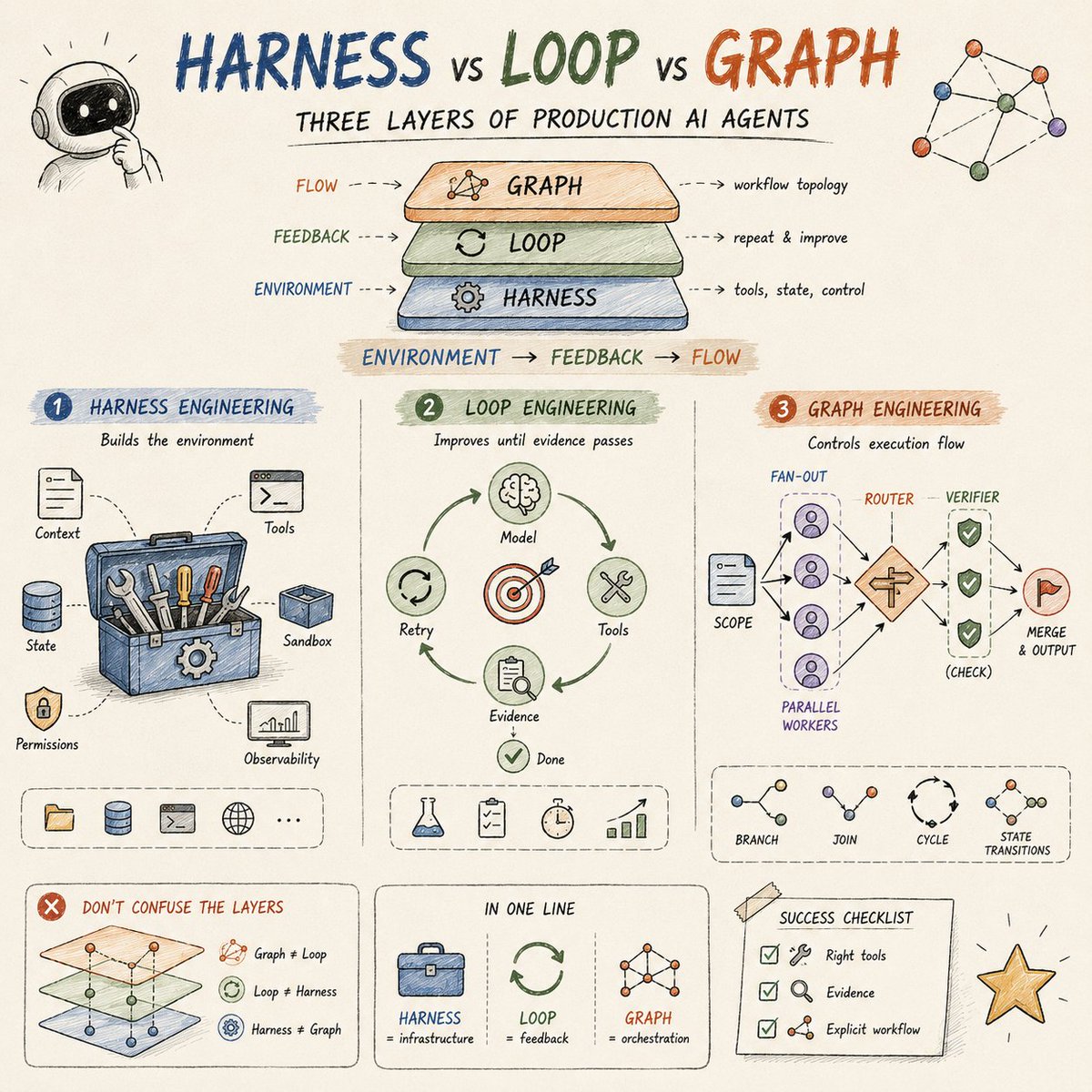
Harness
> Everything around the model: tools, state, permissions, memory, sandboxes, retries, observability
Loop
> The repeated cycle of work + evidence + feedback + clear stop conditions
Graph
> The explicit topology: which nodes run, in what order, with which branches, joins, and controlled cycles
A model can only be as reliable as the environment it runs in, the feedback it receives, and the control flow that governs it
When something fails, diagnose the layer:
1\ Missing capability or state → harness
2\ Unreliable completion → loop
3\ Uncontrolled branching or order → graph
Design them together. Don’t mix the terms
This is the practical distinction that actually matters once agents leave notebooks
Bookmark this so you don't lose it
article below
Claude Opus 5 just made Call of Duty with 5v5 multiplayer with one prompt!
AI just made one of the best selling games of all times in half an hour.
The other models have been struggling with map creation and complex design. Before it's mostly been flat maps. Now there's terrain, buildings you can enter or go on top of!