@Ulysse_Nemo@wouilisam@Neo_Koben Et si notre croyance dans leur existence leur offrait un pouvoir d’agir particulier ? C’est une des pistes qui justifierait le secret, un rapport avec notre inconscient collectif. Genre : Fallait pas manger la pomme Adam…
@Prof_Simone_95 C'est documenté que faire le même travail sur un PC au rythme de l'humain un impact carbone supérieur à une requête IA. (A condition que tu utilise bien le temps gagné)
Science gasps for breath. They are removing all the ocean monitors to understand changes in currents and climate, and the excuse is a master class in obfuscation & double speak . (1/2) https://t.co/vs782YbcI3
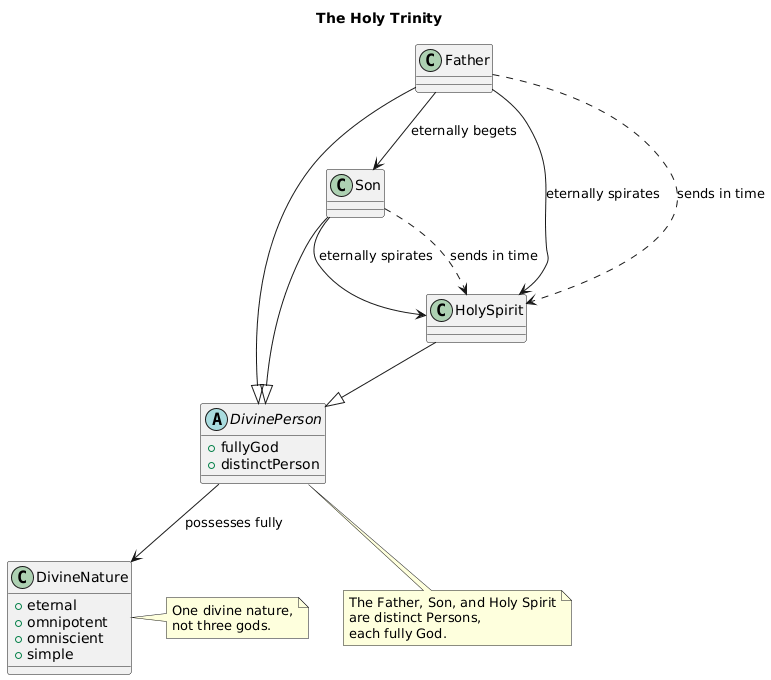
Happy Solemnity of the Most Holy Trinity.
I offer you a UML class diagram explaining the nature of the Trinity.
Any theology and computer science nerds out there, please feel free to correct it if you see anything wrong.
@libremax_off Ce sera probablement la principale valeur ajoutée de l'IA en France : gérer la technocratie à notre place et nous libérer de la bande passante pour le reste.
Two economists just published a mathematical proof that AI will destroy the economy.
Not might. Not could. Will — if nothing changes.
The paper is called "The AI Layoff Trap." Published March 2, 2026. Wharton School, University of Pennsylvania. Boston University. Peer reviewed. Mathematically modeled.
The conclusion is one sentence.
"At the limit, firms automate their way to boundless productivity and zero demand."
An economy that produces everything. And sells it to nobody.
Here is how you get there.
A company fires 500 workers and replaces them with AI. A competitor fires 700 to keep up. Another fires 1,000. Every company is behaving rationally. Every company is following the incentives correctly. And every company is building a trap for itself.
Because the workers who were fired were also customers.
When they lose their jobs faster than the economy can absorb them, they stop spending. Consumer demand falls. Companies respond by cutting costs — which means automating more workers — which means less spending — which means more falling demand — which means more automation.
The loop has no natural exit.
The researchers tested every proposed solution. Universal basic income. Capital income taxes. Worker equity participation. Upskilling programs. Corporate coordination agreements.
Every single one failed in the model.
The only intervention that worked: a Pigouvian automation tax — a per-task levy charged every time a company replaces a human with AI, forcing them to price in the demand they are destroying before they pull the trigger.
No government has implemented this. No major economy is seriously discussing it.
Meanwhile the numbers are already tracking the curve. 100,000 tech workers laid off in 2025. 92,000 more in the first months of 2026. Jack Dorsey fired half of Block's workforce and said publicly: "Within the next year, the majority of companies will reach the same conclusion."
Nobody is doing anything wrong. Companies are following their incentives perfectly. That is exactly the problem.
Rational behavior. At scale. Simultaneously. With no mechanism to stop it.
Two economists built the math. The math leads to one place.
Source: Falk & Tsoukalas · Wharton School + Boston University ·
@fringedotcom@gangatoday1 The rules of the filter are clear : what you did to others, you did it to Me. So it’s what you decide with a pure intention, and your acts. Only your free will. Nothing else and specially not a damaged DNA
https://t.co/14FAEX9NXj
🇫🇷👍🏻 Les Échos se mettent au niveau du sujet des Ovnis. Voilà un bon titre d'édito :
"Et si les ovnis étaient la prochaine révolution copernicienne ?"