Most professionals want to compound capital in US equities but lack the time to babysit charts. The industry pushes options writing or blind buy-and-hold. Neither works for asymmetric capital preservation.
Here is the framework I use to extract alpha without the leverage risk. 🧵
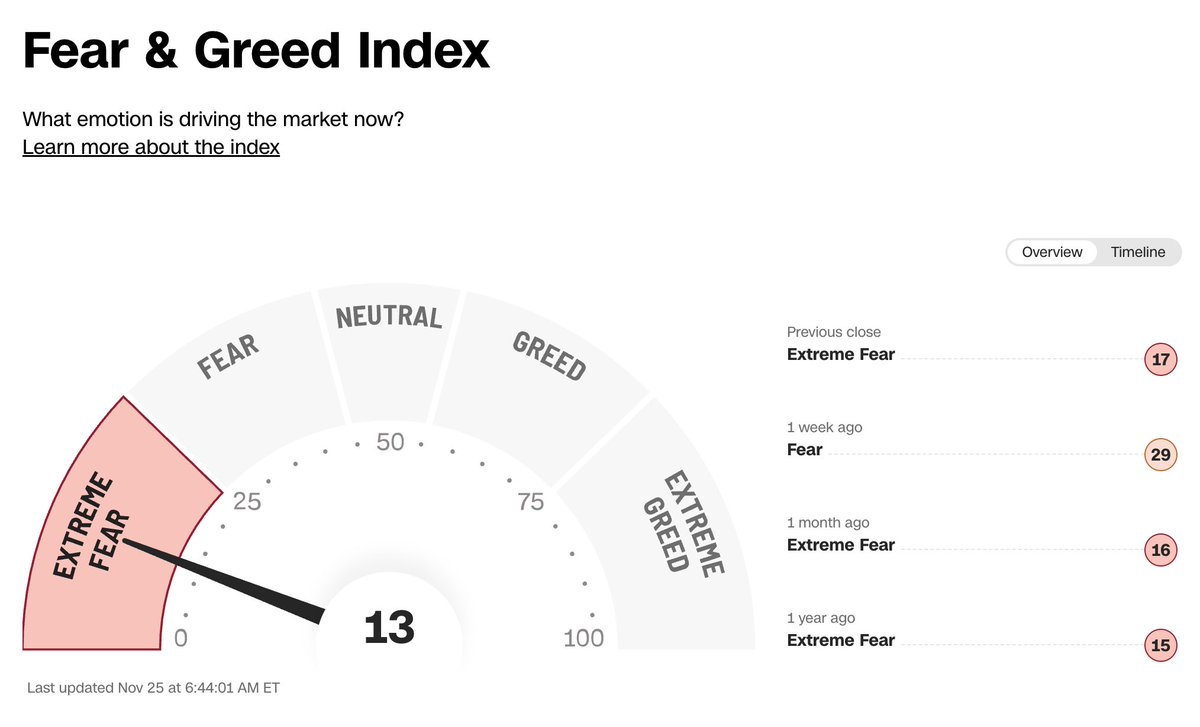
The Fear & Greed Index is sitting at 13 this morning.
The Nasdaq 100 is down 19% from its October highs, Anthropic just broke below its $83 IPO price and PCE inflation numbers drop right before Thanksgiving.
This is the exact kind of week where traders blow up months of progress in two days.
When the VIX is above 26 and single headlines move stocks 5% to 10% overnight, trying to make decisions in the middle of the session is a trap. You either panic-sell the bottom or chase the first green candle out of relief.
Set your entries and stop losses before the opening bell. If you are making up rules while the screen is flashing red, you don't have a plan.
Analog Devices posted a record quarter and dropped 17%.
Dell raised its full year revenue and profit forecasts and still fell 6%.
Nvidia ripped 31% on Monday, gave back 6% yesterday and is down another 5% premarket on new tariff headlines.
Meanwhile, boring healthcare and retail stocks like Merck, Amgen, Nike and Target quietly jumped around 5% yesterday.
That is what happens when everyone crowds into the same AI trade and stops caring about valuation. When a stock is priced for perfection, even good earnings get sold.
I would much rather buy beaten down quality stocks near support with a clear stop loss than try to guess which way chip stocks gap overnight.
Yesterday was the S&P 500's 33rd biggest single-day gain since 1957.
$SPY jumped 4.73%, $QQQ ripped 6.51% and $NVDA added almost a trillion dollars in one session after Jensen Huang came back as CEO.
Days like that mess with traders' heads way more than red days do.
Half the market panic-sold on Friday after seven straight down days, and the other half is itching to chase green candles this morning right before Wednesday's PCE inflation report and a thin holiday week.
This is why I stick to daily charts and preset limit orders during regular hours. If a setup already ran away on a headline, I let it go. Plenty of undervalued names are still sitting near support while everyone stares at the same three tickers.
Chasing a +6% Nasdaq day into a holiday week is how you hand back an entire month of gains in 48 hours.
Between Friday's close and Monday's close, the exact same crowd calling for a market crash started feeling FOMO again.
After seven straight red days pushed $SPY into correction territory, Monday turned into a +4.73% rip and $QQQ jumped 6.51%.
The VIX is still sitting above 26, so the big swings probably aren't over yet.
Trying to guess headlines or time the exact bottom in a tape like this will burn you out fast. You can't force yourself to stay calm when your screen is flashing red all week.
You need written rules before the market opens. Know your position size, know where your stop loss sits and know your exit plan ahead of time. Once those rules are set, a 5% swing day stops feeling like an emergency.
Jensen Huang’s massive post on X today is already at over 21 million views in just 4 hours, proving the entire world is watching. And with $NVDA reporting its critical earnings today, the spotlight couldn't be any brighter.
Looking at the chart, $NVDA has dipped below our target red line, currently hovering around $153. But with earnings after the close, the short term uncertainty is peaking. As systematic traders, we don't try to gamble on the immediate reaction. These events are just natural price disruptions that create eventually lucrative opportunities.
For a swing trade, the chart is still missing one key ingredient: a solid, stable consolidation at these lower levels. We need to let the earnings volatility pass and wait for the price to actually build a base before looking for an entry.
But if you are a long term investor, this is becoming one of the best historical entry levels for this company. $NVDA is an incredibly high quality business, currently holding an unprecedented Quality Score of 89%.
Most importantly, our core fundamental parameter the Valuation Gap is sitting at 32.6%. For a company of this scale, that is a massive margin of safety. We just need the chart to match the numbers.
No gamble, just waiting for the base to form.
Over the past week, I’ve been overwhelmed by the love and support of friends, industry colleagues, and people I've never met. Thank you to everyone who has shown kindness to my family and me. It means the world to me.
I came to the United States 53 years ago, and becoming an American citizen is one of the greatest gifts and proudest moments of my life. NVIDIA has been my life’s work. Building it into the company it is today alongside my colleagues has been a privilege and an honor. Nowhere but in America could a company like NVIDIA be possible. I love our country, and I love NVIDIA.
I did not live up to the standards expected of everyone at NVIDIA, and I have made serious mistakes in my personal life. I created problems for the Board that I deeply regret. I own my mistakes completely, and I am committed to cooperating with the Board’s independent investigation.
Since my departure, I’ve seen an outpouring of calls from NVIDIA’s employees, investors, business partners, and customers for me to return as CEO. Many continue to reach out to me directly as the company navigates complex technology, market, competitive, and geopolitical dynamics. NVIDIA is a once-in-a-generation company. If the Board of Directors decides that my return is in the best interest of our shareholders, our employees, the company, and America, I would be honored to answer these calls and return as CEO.
Thank you again to everyone who has shared their good wishes. I am profoundly humbled by your support. To my family: I love you, and I will spend the rest of my life being worthy of yours.
Jensen
Jensen Huang’s massive post on X today is already at over 3 million views in just a few hours, proving the entire world is watching. And with $NVDA reporting its critical earnings today, the spotlight couldn't be any brighter.
Looking at the chart, $NVDA has dipped below our target red line, currently hovering around $153. But with earnings after the close, the short term uncertainty is peaking. As systematic traders, we don't try to gamble on the immediate reaction. These events are just natural price disruptions that create eventually lucrative opportunities.
For a swing trade, the chart is still missing one key ingredient: a solid, stable consolidation at these lower levels. We need to let the earnings volatility pass and wait for the price to actually build a base before looking for an entry.
But if you are a long term investor, this is becoming one of the best historical entry levels for this company. $NVDA is an incredibly high quality business, currently holding an unprecedented Quality Score of 89%.
Most importantly, our core fundamental parameter the Valuation Gap is sitting at 32.6%. For a company of this scale, that is a massive margin of safety. We just need the chart to match the numbers.
No gamble, just waiting for the base to form.
Intuition and guessing get you the PINK line.
A strict, rule-based mathematical system gets you the PURPLE line.
You can either spend your life trading on emotion, or you can build a machine that actually extracts capital.
The math speaks for itself.
No one talks about the hardest skill in trading: doing absolutely nothing.
When the market is chopping, retail traders start forcing entries. They lower their criteria just to feel the action because they think they have to be in a trade to be productive.
They treat the market like a casino instead of a business.
A true system has strict filters. If the fundamental floor is missing, the trade is ignored. If the price compression is not tight enough, the trade is ignored.
Capital preservation is an active strategy.
The hardest part of a mechanical system is accepting that sometimes, doing nothing is the edge.
Everyone tells you that you need to build "screen time" to become a profitable trader, but staring at charts all day is exactly why most people lose money.
When the market is chopping and the right setups are not there, retail traders get bored. They lower their criteria just to feel the action.
They treat the market like a casino instead of a business.
A true system has strict filters. If the fundamental floor is missing, the trade is ignored. If the price compression is not tight enough, the trade is ignored.
Capital preservation is an active strategy.
Sometimes the most profitable thing you can do all week is keep your laptop closed.
@DodgysDD Spot on. The market tests everyone before it pays anyone. Those early days of getting smoked are exactly what build the discipline to eventually just sit on your hands and wait for those A+ setups.
Trading did not come into your life to build character. It came to transfer your capital to someone with a better system. The market is not a self help seminar; it is a math problem. If you are relying on emotional intelligence instead of a mechanical framework, you are just the liquidity for those of us running strict rules.
Retail traders constantly ask me if their trade was a mistake because a stock kept rallying after they took profit.
They feel like they left money on the table.
If you operate a strict rule-based framework, what the chart does after your exit is completely irrelevant. Your only job is to execute a verified edge over a large sample size.
When my Value Velocity screener flags a setup and my time-decay exit formula triggers, I sell. The spreadsheet makes the decision. I do not look at the chart again to see what I missed.
Judging a single trade by its maximum possible outcome is a guaranteed way to destroy your account. It creates hindsight bias. It makes you hold your next position too long and completely invalidates your risk parameters.
If you get upset about missing a further rally, you are treating the market like a casino. Your brain gets hijacked by the uncertainty of short-term price swings. You start wanting the dopamine hit of a massive win instead of the cold reality of mechanical execution.
Professional trading is just running a math equation hundreds of times under identical conditions.
Ask yourself one simple question after every closed position.
Did I execute exactly according to my rules?
If the answer is yes, the trade was flawless.
If the answer is no, you are just gambling.
The unprofitable phase only lasts as long as you rely on intuition. The moment you write down a strict set of rules and build a mechanical system, you stop trading on emotion. People will take you seriously when you treat your trading like a business with strict risk parameters, not a guessing game.
The stock market is just a mechanism for transferring money from the impatient to the mechanical.
When you do exactly what everyone else is doing, you become the liquidity they need to exit their positions.
Most traders think being a "contrarian" just means buying the dip. True contrarianism means rejecting the entire retail playbook. It means removing human discretion completely.
While the crowd is micromanaging 5 minute candles, the real money is running daily screens, defining the exit math before entry, and spending exactly 15 minutes a day at the desk.
Stop trying to outsmart the herd. Just stop playing their game entirely.
$QQQ