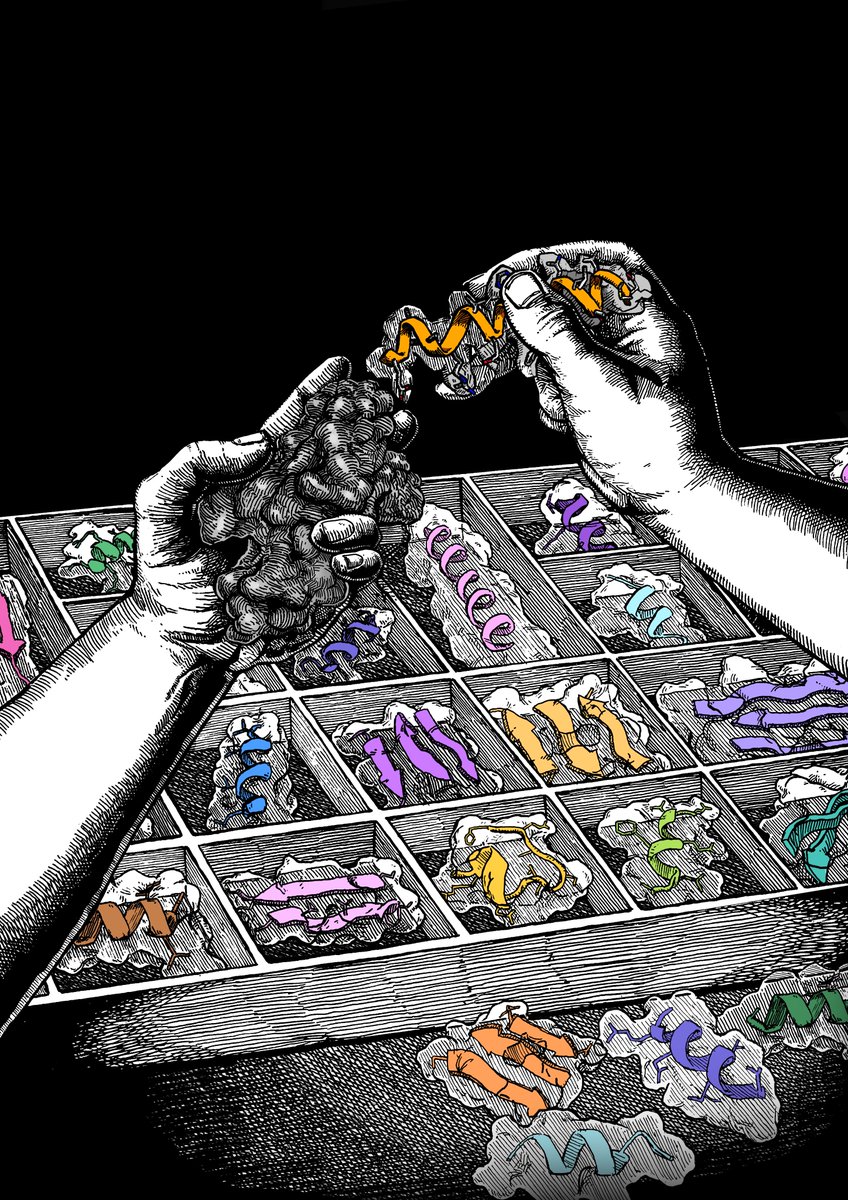
Mapping Targetable Sites on the Human Surfaceome for the Design of Novel Binders
1. A groundbreaking study maps the human surfaceome, identifying 4,500 targetable sites across 2,886 cell-surface proteins. This resource unlocks new therapeutic opportunities for precision medicine.
2. The study leverages MaSIF, a geometric deep-learning framework, to predict protein-protein interaction sites. Nearly 3 billion docking runs were performed to generate high-quality binder "seeds" for targeted design.
3. A novel web platform, SURFACE-Bind, is introduced. It provides open access to predicted binding sites, corresponding binder seeds, and data visualization tools. This resource aids drug discovery and protein design.
4. Experimental validation highlights three critical targets—FGFR2, IFNAR2, and HER3. De novo-designed binders showed high success rates, targeting key interfaces with nanomolar to micromolar affinities.
5. The team optimized protein design pipelines by integrating ProteinMPNN and AlphaFold2, improving biophysical properties like stability and binding affinity, achieving 11-fold higher success rates in subsequent rounds.
6. A peptide design pipeline was also developed. Interface motifs from mini-protein binders were stabilized as cyclized peptides, yielding 5 target-specific peptides with demonstrated binding activity.
7. This work underscores the power of integrating deep learning and physics-based methods to advance de novo protein and peptide design for therapeutic applications, targeting underexplored surfaceome regions.
8. By combining computational innovation with experimental validation, this research sets a new benchmark for precision protein engineering and opens the door to the next generation of biologics.
@befcorreia@hamed_khakzad@yangche7@SiFulle@J_Damjanovic_
💻Code: https://t.co/S8qD7CnRcg
📜Paper: https://t.co/FLmbHhA5qg
#ProteinDesign #DeepLearning #Surfaceome #ComputationalBiology #DrugDiscovery #MachineLearning
The newly-funded https://t.co/3OJza4weKs Center in Leuven (Belgium) is recruiting 3 (!) group leaders focusing on answering fundamental biological questions with AI/ML. Great opportunity to join a dynamic community, with competitive conditions.
New amazing research from the @befcorreia lab! @zanderharteveld and Alexandra explore protein topologies that have not been found in nature using a novel deep learning pipeline called Genesis
@CasperGoverde Fantastic work @CasperGoverde and Martin, I thought you guys just had this idea back to the RC last year, and now the works are done 😲what a speed !
@befcorreia@MartinPacesa@jroeltou@CasperGoverde Will second Bruno !! Probably at some point we need to separate de novo structure or de novo sequence as so far they are all in the same category of de novo design ? And great work from you guys, amazing !😁
Our paper with @befcorreia@CirauquiPablo et al on protein design using geometric deep learning is finally in @nature We show experimental results of diverse de novo designed binders
https://t.co/TwcwF9Y4e2
@MartinPacesa That is so cool man ! Especially in the second example it suddenly refold to beta propensity, if that holds true perhaps it may be chaperone there 🧐btw how do you make this gif/video, super nice 👍
@AnastassiaVoro2 It does seems AF2 can better capture the subtle detail that distinguish folded from unfolded sequence even for TM barrel 😀 but ESMfold also does quite amazing prediction with no doubt! Just curious how the landscape of traditional reverse folding prediction looks like here🧐
The @befcorreia lab is looking for a postdoc! As a postdoc there myself, I can tell you that Lausanne is a stunning city, EPFL has a strong collaborative environment, and the lab researchis super exciting! On top of that, Bruno is a really chill dude 😎 https://t.co/JkF42PlNNh
Using local geometries and a simple string encoding to generate existing and novel protein folds. Really happy this work w/ @zanderharteveld, @yangche7, @SesterhennF, Stéphane and @befcorreia is finally out! https://t.co/xIfXxRIdpH
preprint of a new paper with @befcorreia's group on using MaSIF #geometricdeeplearning architecture to build novel protein binders for various targets (oncological and antiviral)--with experimentally confirmed structure
We’ve been having a lot of fun with these switches! Thank you guys #lpdi for so much hard work specially Sailan @Scheller123@yangche7 Pablo and good collaborators @saireddy911