🚨 Anthropic just showed a 27-minute workshop on how to actually do prompts for Claude.
Taught by the people who built it.
Free. No registration. No paywall.
I've seen $300 courses that don't cover what they teach in the first 8 minutes.
Watch it and bookmark it now.
How To Save Over $100 Million Dollars Training An AI Model While Saving 90% On AI Workloads.
—
We see the whole page when we read, now AI sees it the same way and not one ASCII character at a time.
—
A significant evolution is underway that questions the dominance of text-based tokenization. Conventional LLMs depend on tokenized text inputs, which discretize linguistic elements into numerical representations for computational efficiency. However, vision and data encoding propose that pixels—the fundamental units of digital images—may serve as a more effective substrate for model inputs.
This transition could enhance data density, enable bidirectional contextual analysis, and mitigate inherent limitations in existing text-processing pipelines.
ChatGPT-type LLMs are linguistic simulator: they model how humans use language.
DeepSeek’s OCR-style pipeline is aiming for cognitive reconstruction: modeling how humans encode and organize meaning across media.
The distinction between:
“I read what they said.”
“I see how they thought.”
Optical Character Recognition and Data Compression in Visual Inputs
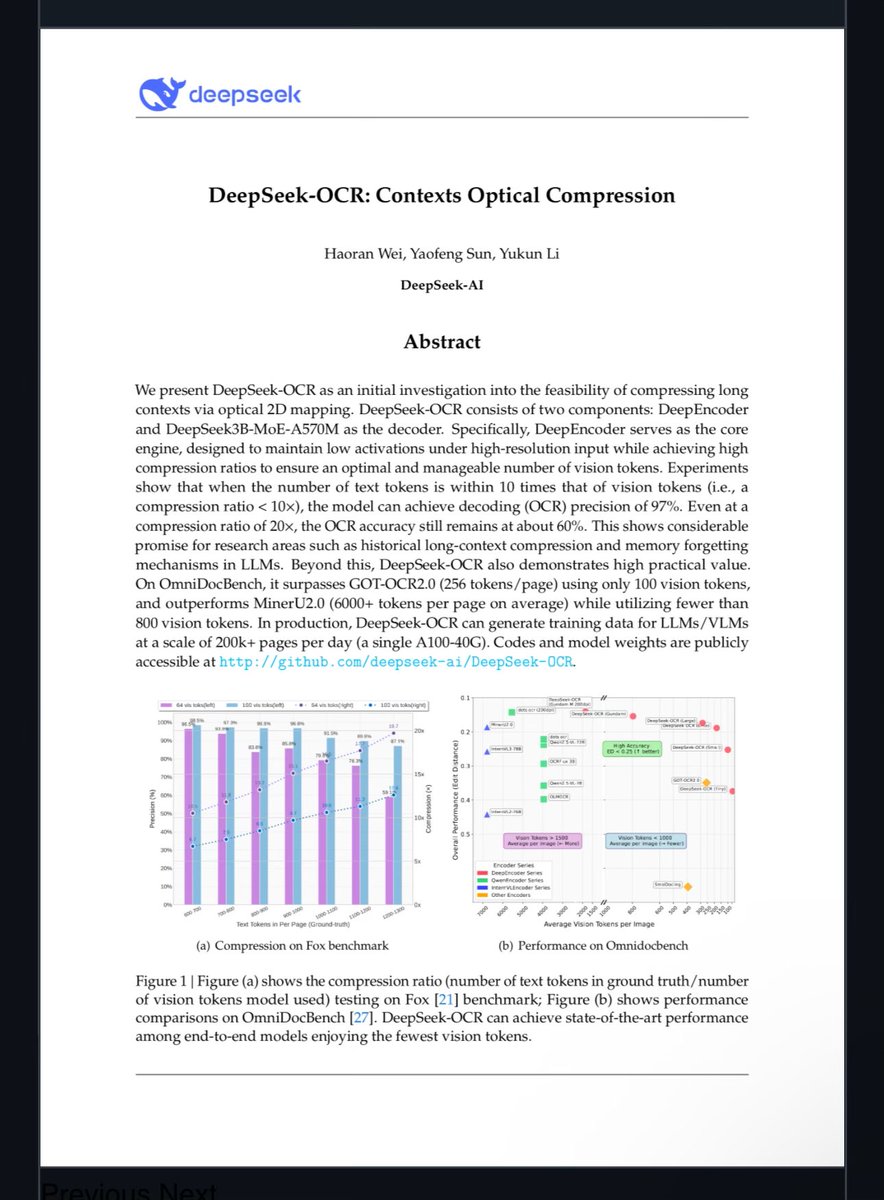
Contemporary optical character recognition (OCR) systems exemplify the advantages of visual data handling. Advanced models achieve compression ratios of up to 20:1 while preserving 97% accuracy across benchmarks such as document parsing and multimodal evaluations.
These systems process images to extract textual and structural information, allowing LLMs to manage extended contexts with reduced computational demands. By encoding documents, interfaces, or archival materials as images, the approach retains critical visual attributes including font variations, chromatic distinctions, and spatial arrangements that are often discarded in text-only formats.
Empirical assessments indicate superior performance in comprehensive tasks compared to legacy OCR methods, positioning visual inputs as a versatile foundation for heterogeneous data ingestion.
Limitations of Tokenization and Advantages of Pixel-Based Architectures
The tokenizer component in LLMs introduces systemic inefficiencies rooted in Unicode standards and byte-pair encoding schemes. These mechanisms can produce inconsistent representations for visually similar characters and abstract away perceptual elements like emojis or formatting cues. And autoregressive processing, wherein predictions occur sequentially constrains the model's ability to leverage full contextual interdependencies.
In contrast, pixel inputs facilitate bidirectional attention, permitting simultaneous evaluation of all data elements. This mirrors human visual cognition and supports end-to-end training without intermediary abstractions.
Rendering textual content as images prior to input eliminates tokenizer vulnerabilities, such as encoding-based exploits, and unifies processing across modalities. This symmetry extends to adapting vision-centric tasks to linguistic outputs, addressing the current imbalance where text adaptations predominate.
Photonic Scaling and Future AI Interfaces
Projections in AI infrastructure foresee a predominance of photonic data pathways, with over 99% of inputs and outputs mediated by optical signals for their superior bandwidth and energy efficiency relative to electronic counterparts. This aligns with pixel-oriented inputs, as images inherently suit photonic transmission and parallel computation.
Queries could be ingested as rasterized representations, such as screen captures or synthetically generated visuals, with textual outputs for human interpretability. Output generation in pixel form remains challenging due to the complexity of synthesizing coherent images, yet exploratory prototypes of vision-exclusive interfaces suggest feasibility for specialized applications, including real-time environmental interpretation.
1 of 2
The idea that the BRICS Countries are trying to move away from the Dollar while we stand by and watch is OVER. We require a commitment from these Countries that they will neither create a new BRICS Currency, nor back any other Currency to replace the mighty U.S. Dollar or, they will face 100% Tariffs, and should expect to say goodbye to selling into the wonderful U.S. Economy. They can go find another “sucker!” There is no chance that the BRICS will replace the U.S. Dollar in International Trade, and any Country that tries should wave goodbye to America.
To every man upon this earth
Death cometh soon or late.
And how can man die better
Than facing fearful odds,
For the ashes of his fathers,
And the temples of his Gods.