💥 Introducing "Depth-Breadth Synergy in RLVR: Unlocking LLM Reasoning Gains with Adaptive Exploration"
We proposed DARS to solve the systematic bias in GRPO: the cumulative advantage down-weighting hard samples that are crucial for reasoning boundaries.
https://t.co/0hqb8b4mSu
📊We further combine DARS with breadth scaling (DARS-Breadth). We replace PPO’s mini-batch updates with full-batch gradient descent across multiple PPO epochs.
The training dynamics show the complementary improvement of DARS-Breadth for both Pass@1 & Pass@K.
🧵4/5
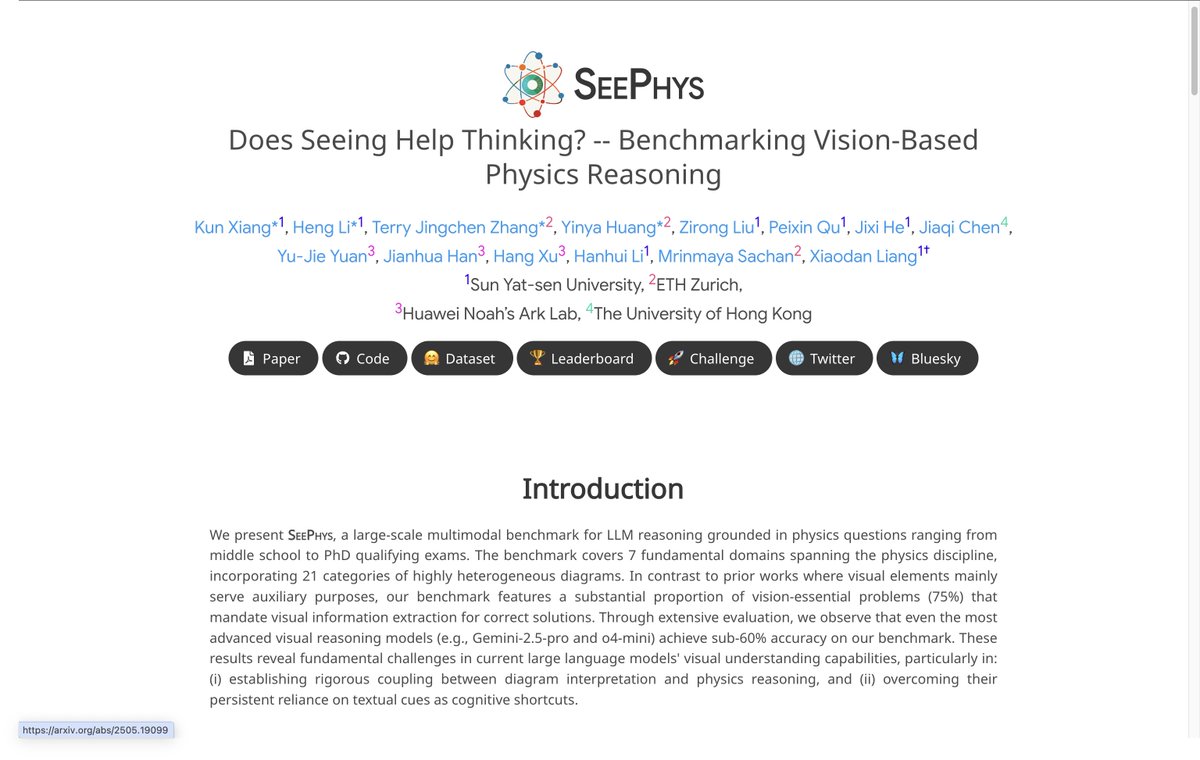
🤖⚛️Can AI truly see Physics? Test your model with the newly released SeePhys Benchmark! 🚀
🖼️Covering 2,000 vision-text multimodal physics problems spanning from middle school to doctoral qualification exams, the SeePhys benchmark systematically evaluates LLMs/MLLMs on tasks integrating complex scientific diagrams with theoretical derivations.
📊Experiments reveal that even SOTA models like Gemini-2.5-Pro and o4-mini achieve accuracy rates below 55%, with over 30% error rates on simple middle-school-level problems, highlighting significant challenges in multimodal reasoning.
Key Features Highlighted:
🔎Vision-Text Integration: Explicitly emphasizes multimodal reasoning failures in interpreting diagrams (e.g., circuit schematics, coordinate systems).
🔎Cross-Domain Complexity: Tests models across 7 physics domains and 8 educational tiers, exposing weaknesses in both visual grounding and logical derivation.
🔎Open-Source Design: Fully reproducible framework for diagnosing AI's "visual illiteracy" in scientific contexts.
🎖️Project led by: @kaleb962, @HengLee29423, Terry Jingchen Zhang, @YinyaHuang
💼Joint work with an exceptional team: Zirong Liu, Peixin Qu, Jixi He, Jiaqi Chen, Yu-Jie Yuan, Jianhua Han, Hang Xu, Hanhui Li, @mrinmayasachan, Xiaodan Liang
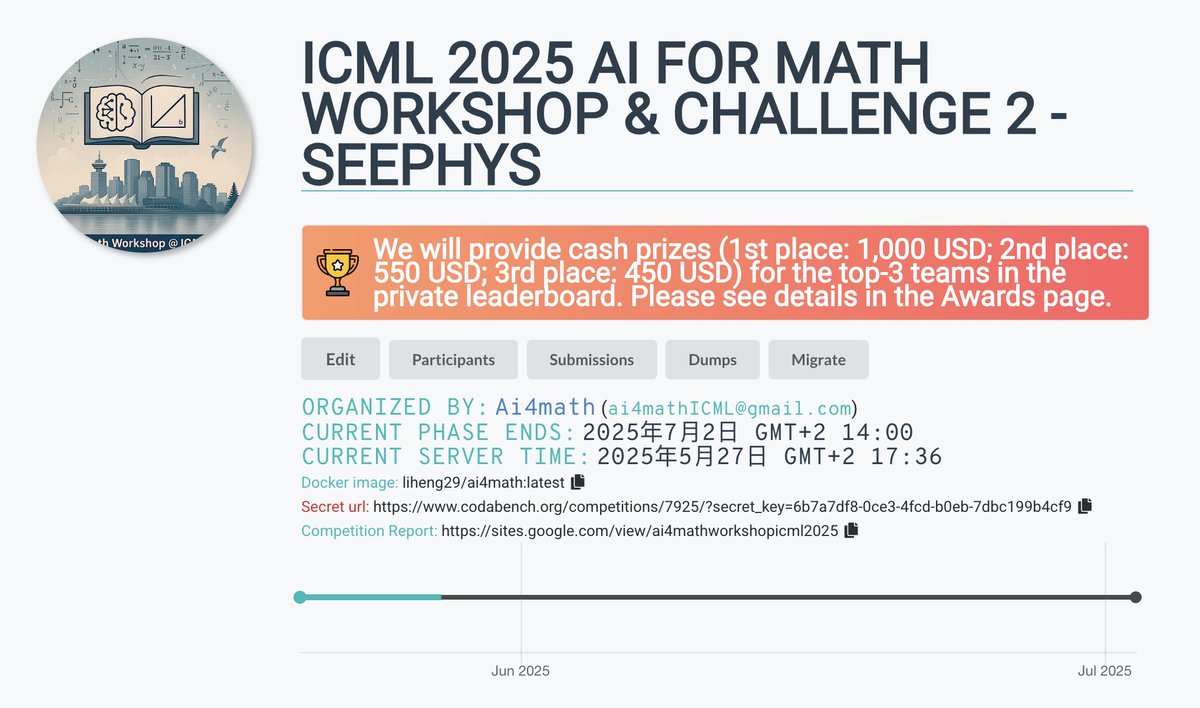
🏁The benchmark is now open for evaluation at the ICML 2025 AI for MATH Workshop. Academic and industrial teams are invited to test their models and advance multimodal physics!
⚛️Project Page: https://t.co/Drk9jb7rgV
🤗Data: https://t.co/VydIc3gRBG
📜Paper: https://t.co/XYc8hMWJ4K
🏆Challenge Submission: https://t.co/GXDkRG9bYO
➡️Competition Guidelines: https://t.co/q0EOmJLWqj
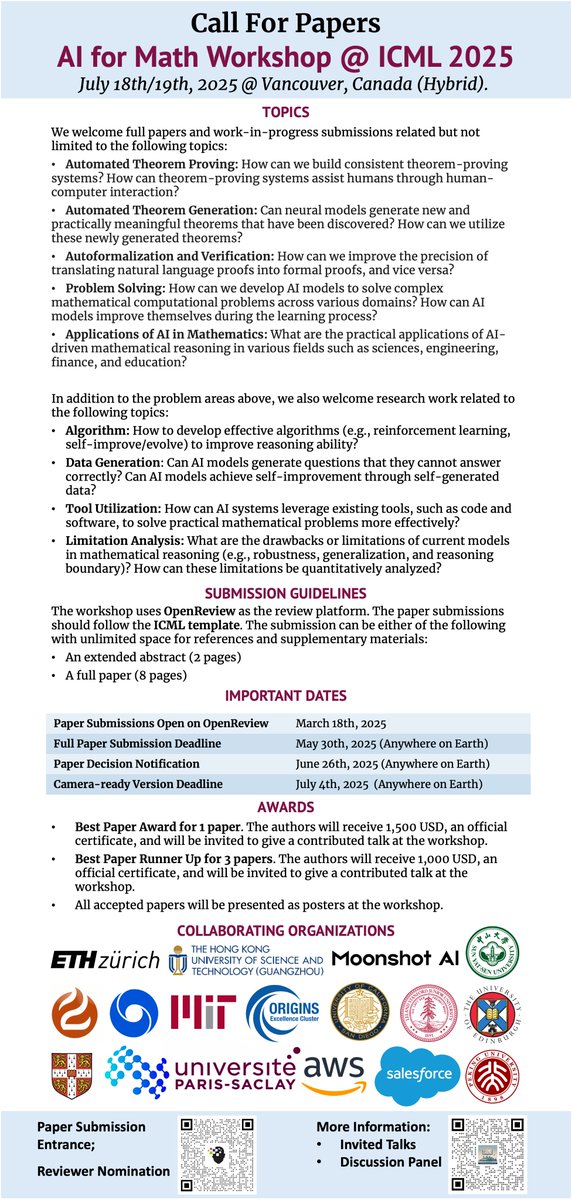
📣🔊 Excited to announce the 2nd AI for Math Workshop at #ICML2025@icmlconf!
🔍 Workshop details: https://t.co/OGjZzEpQ8y
📜 Submit your pioneering work: https://t.co/lAaxO4U6jQ…
🙋 Reviewer nomination: https://t.co/n4vuZWn0dH
Is your model faithfully translating math into formal languages like Lean?
⚖ Introducing "FormalAlign"! #ICLR2025
⁉️To address the lack of scalable evaluation in autoformalization, we propose the FIRST method to evaluate semantic alignment between informal and formal languages.
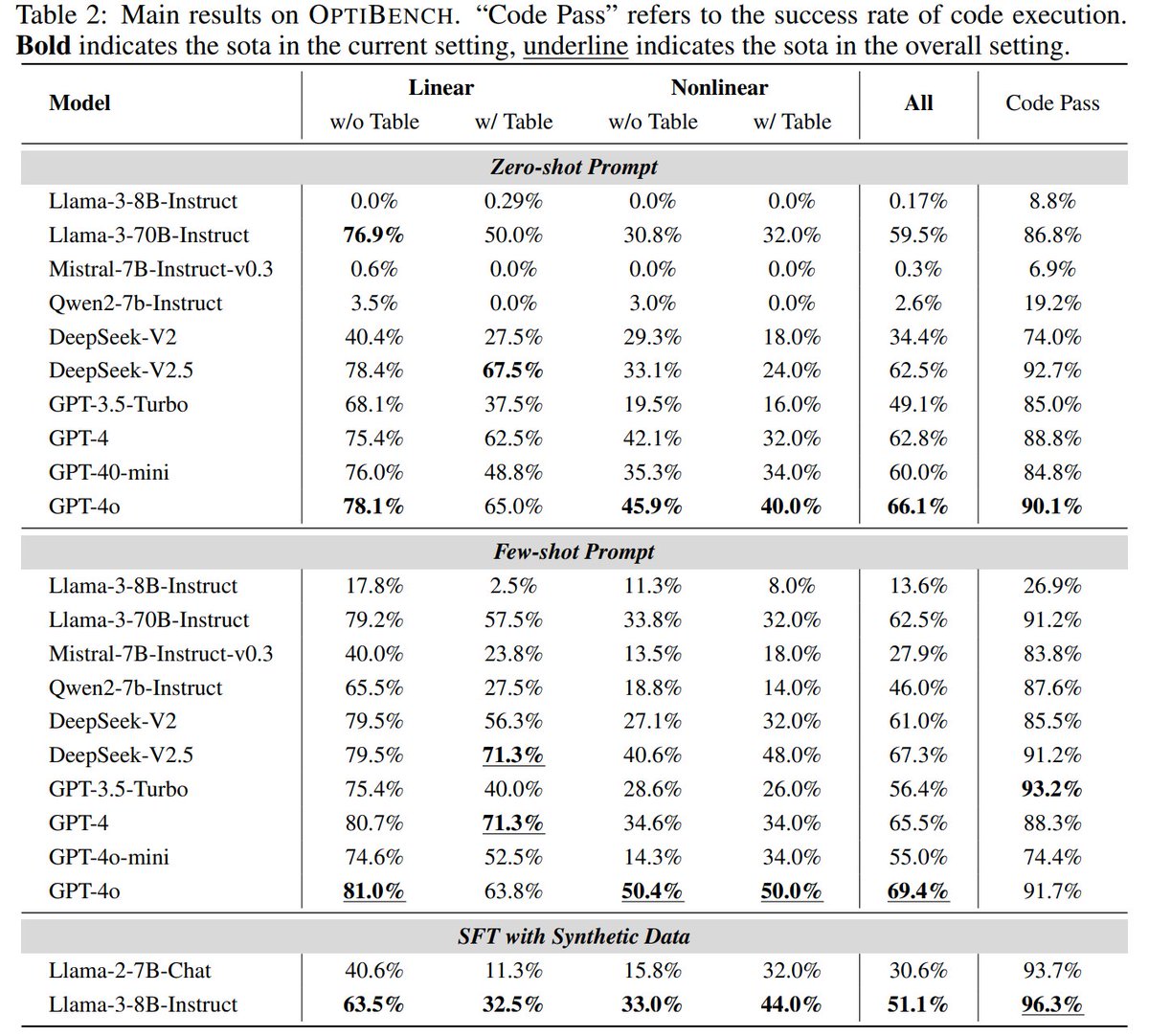
Results:
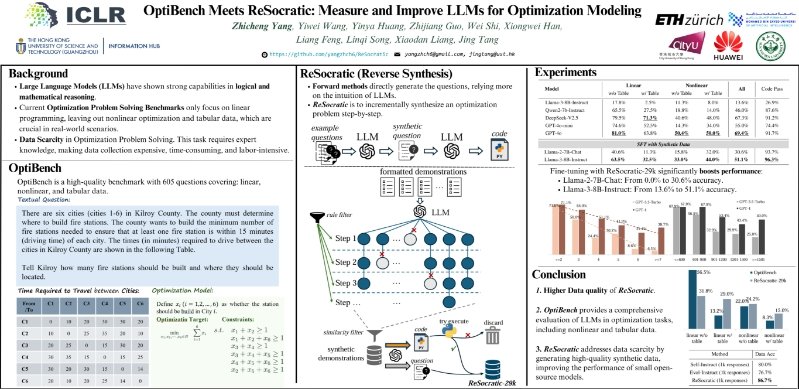
📊 We conducted substantial experiments and evaluations. As a benchmark that simultaneously tests both mathematical and coding abilities, OptiBench poses significant challenges to advanced LLMs.
📷The SFT results demonstrate the superiority of our synthetic data.
🚀 Excited to share our research at ICLR 2025!
📘 We introduce OptiBench, a comprehensive benchmark for evaluating LLMs in optimization tasks, and ReSocratic, a novel reverse data synthesis method to enhance model performance.
🔗https://t.co/QUTriWTYi7
#ICLR2025#LLMs
The main idea of ReSocratic is to incrementally synthesize a problem with step-by-step generation via the Socratic method in a reverse manner. However, former methods synthesize the question without intermediate reasoning step, which led to data quality defects.
Benchmark:
OptiBench is an end-to-end benchmark, that takes natural language as input and numerical values of variables and objective as output. It covers a substantial number of challenging optimization problems with a wider range of problems (linear, non-linear, and table).
💥 Introducing "AutoPSV: Automated Process Supervised Verifier" - accepted at #NeurIPS2024!
AutoPSV automatically annotates reasoning steps via confidence tracking, making it efficient and effective even without ground-truth answers.
🔗 https://t.co/a7owZN53yp
🧵1/5