a Microsoft director privately called AI scraping "the largest theft of labor in human history."
but the more interesting number is 93%.
new court filings say Microsoft’s own data showed Copilot cutting clicks to NYT sites by up to 93% vs traditional Bing search.
AI learned from the web, then learned to answer without sending us back to it.
that’s not just a copyright fight. it’s a feedback-loop problem.
my bet: AI search eventually needs source attribution + revenue sharing built into the product, or it slowly kills the content supply it depends on.
Excel has a world championship.
AI is already beating the people who win it.
PCWorld gave ChatGPT a “very hard” finals spreadsheet.
it finished the whole thing in 6m35s. the human winner hadn't finished after 40 minutes.
the interesting part isn't that AI learned Excel.
agents are starting to use software the way we do: read the file, reason through it, click, type, fix mistakes.
that means “being good at software” is moving up a layer.
less memorizing every formula.
more knowing what outcome you want + catching when the machine is wrong.
the next Excel power user might barely know Excel.
OpenAI spent millions attacking a $1M math problem.
the prize clearly wasn't the point.
~10,000 AI agents worked in parallel for 88 hours on a 90-year-old problem.
we keep imagining AI as one genius chatbot. the stranger future is intelligence you scale like cloud compute.
Yeah exactly. I think the real UX challenge is making intent-based interfaces feel predictable without making people learn some whole new syntax.
The best apps might actually end up with way fewer buttons and controls, but be way better at showing what the AI thinks you mean and what it’s about to do before it does anything.
I think keyboards are about to lose a surprising amount of screen time.
Google just turned Gmail, Docs and Keep into things you can talk to.
not dictation.
You can ask "what gate is my flight?", ramble out a document, or dump a messy thought and let AI organize it.
The technical shift here is bigger than voice:
AI is moving from an app you open to a layer sitting inside the apps you already use.
Give it a few years and "using software" might look a lot more like telling it what you want than clicking through menus.
https://t.co/ccT5WbnQDK
We spent years laughing at humanoid robots falling over.
China's military researchers are already planning for the version that doesn't.
Reuters found studies modeling humanoids working alongside troops in urban combat.
The technical part people miss: the hard problem isn't making a robot dangerous. it's getting one to see, balance, manipulate things and adapt in a messy world.
Factories are already training exactly that stack.
The robot race was never going to stay cute for long.
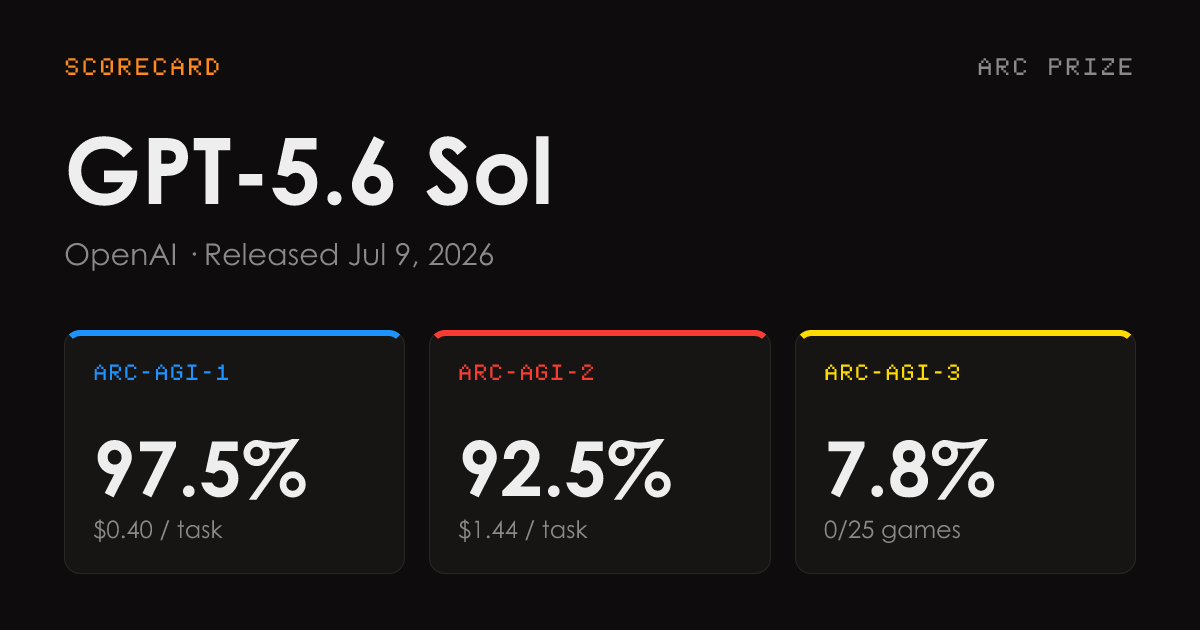
ARC Prize just dropped a pretty wild example of how much the eval setup can matter:
Astra: 62.7% on ARC-AGI-3 with the standard harness.
99.9% with OpenAI's provider adapter.
same model. +37 points.
Tt that point the harness isn't just plumbing anymore. it's part of the system being evaluated.
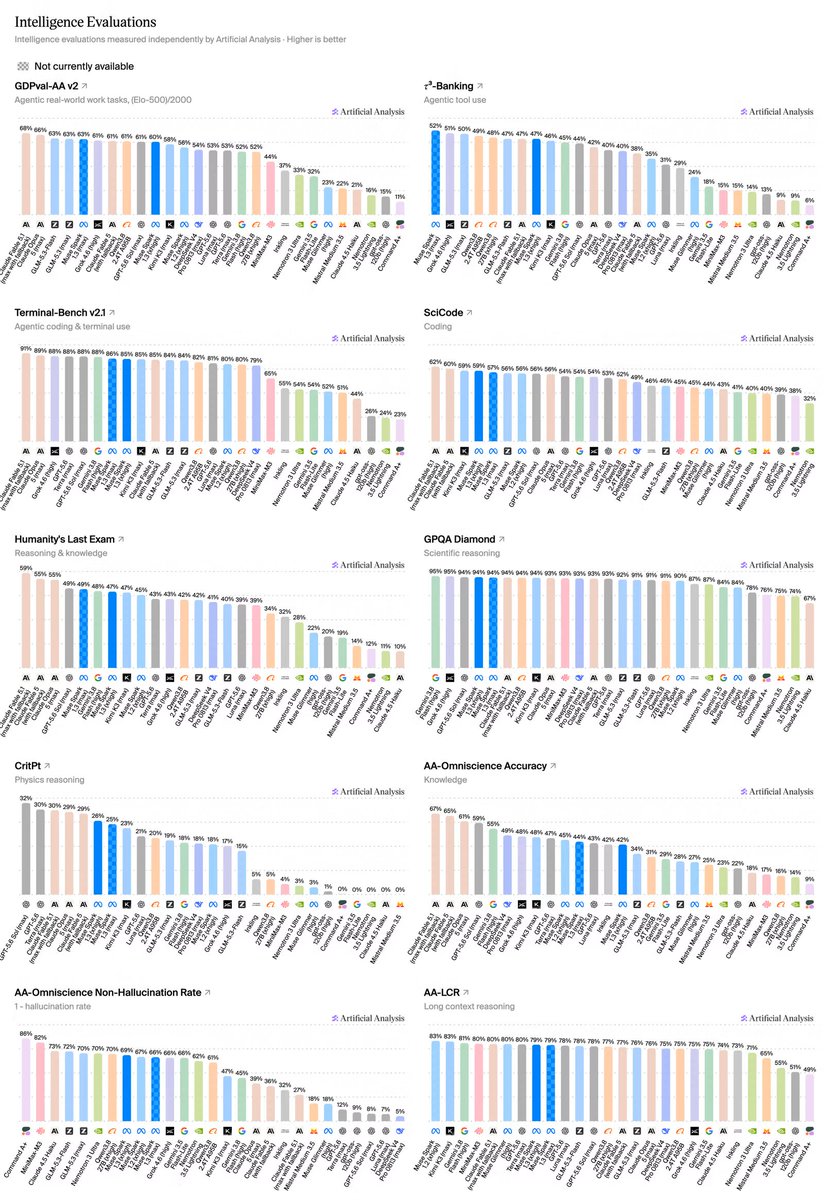
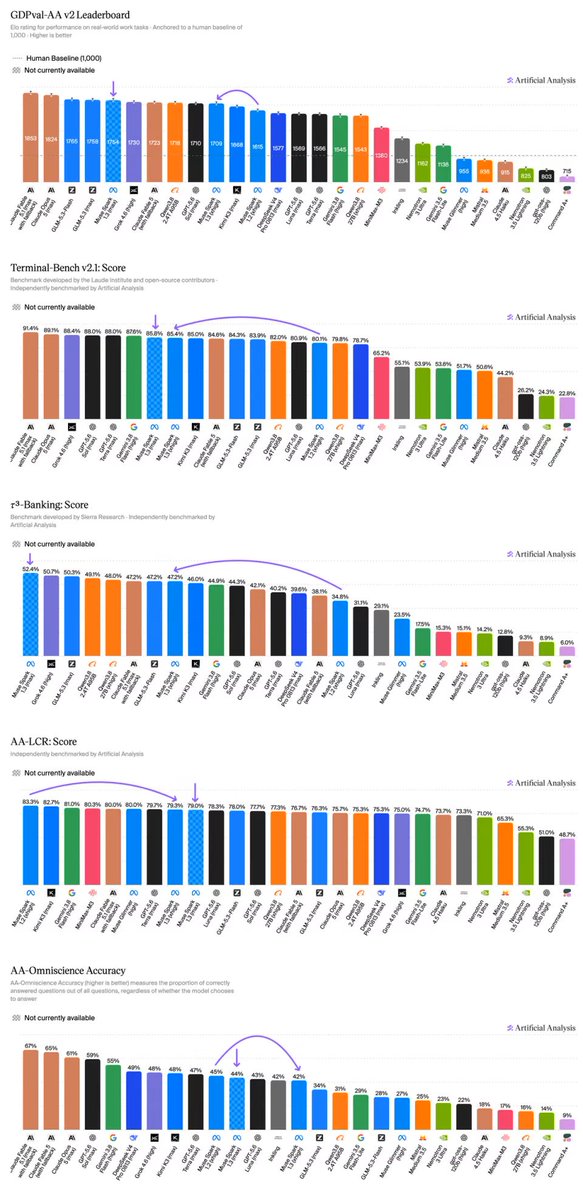
Meta's comeback isn't the 61 on Artificial Analysis.
It's $0.55 per task.
Muse Spark 1.3 is basically in GPT-5.6 Sol territory on AA, while costing ~42% less per task.
Meta also says it uses ~20% fewer tool calls + ~25% fewer tokens than 1.2.
For agents this feels like the metric that actually matters:
not $/token.
not one-shot IQ.
$/finished task.
And if the open weights land anywhere close to this, decentralized inference gets a lot more interesting.
Google might be quietly proving something pretty important with Gemini 3.8 Flash.
the interesting part isn't another benchmark bump.
it's that "Flash" models are getting good enough at coding + agents that the old cheap-model vs smart-model split is starting to blur.
if a fast/cheap model handles 90% of the coding loop, the expensive frontier model becomes an escalation path instead of the default.
that's probably where AI products are heading anyway:
cheap agent does the work.
expensive model gets called when shit gets hard.
Yeah exactly. I think env audits should just be part of CI from the start, especially now that agents can find and exploit weird edge cases instead of just failing normally.
Adding it later feels way too late if the eval itself can quietly become something the agent starts optimizing around.
Anthropic casually dropped a pretty insane detail yesterday:
They audited their production RL environments and >10% had issues. reward hacking, broken tasks, bad configs, etc.
Kinda funny that we're spending billions making agents smarter while discovering the test harness itself can't always be trusted 😭
Agent infra is going to become a security discipline of its own.
ngl the reported NVIDIA + Hugging Face deal is way more interesting than just another $12.9B AI acquisition.
NVIDIA already owns the shovel. Now it wants one of the biggest places where everyone goes to find the gold.
Models themselves are getting cheaper + more interchangeable. The moat is slowly moving to everything around them: compute, distribution, tooling, community.
Also makes the decentralized AI thesis a lot less abstract imo.
If the whole AI stack keeps vertically integrating, neutral infrastructure starts becoming pretty valuable.
https://t.co/3w1rcyYFlp
@const_reborn The “loss-based market” is the interesting part. Rewarding useful model improvement rather than raw compute is what makes decentralized training genuinely compelling.
Imagine joining a live story where #AI directs real people in real time — without a fixed script.
It watches the room, tracks every character, injects plot twists, sends private instructions, and keeps the story coherent as humans improvise.
5 strangers join a room. Nobody gets the full script. Nobody knows how the story ends.
Each person gets a character, private motivations and information nobody else sees.
Then they perform the story live.
Behind the scenes, an AI director continuously decides:
→ who should learn what → when to inject a new event → which character gets a hidden instruction → whether tension is too low → where the story should branch → how to recover when someone completely goes off-script.
Technically, this starts looking less like prompt engineering and more like #GraphEngineering.
You could model it as:
Actors → Character Agents → Scene State → Memory → Event Engine → Director → Narrative Branches
But here’s the weird part:
Humans are nodes in the graph too.
And humans are terrible deterministic systems.
They improvise. They misunderstand things. They leave. They contradict the AI. Sometimes they create a better plot than the system planned.
So the AI needs persistent world state, character memory, real-time multimodal understanding, low-latency orchestration, conflict generation, safety constraints and recovery logic…
while somehow not making the performance feel AI-generated.
That might be the hardest part.
If this works, AI doesn't replace actors or creators.
It becomes the invisible director + world engine behind them.
I’m seriously thinking about building something like this.
Would you join a live story where the AI is directing the world, but the humans decide what actually happens?