The chokepoint trap: How the search for economic security will end in geopolitical calamity. A very good and highly recommended read... https://t.co/Kzb6ATDmKd
Once more, India has dodged a bullet.
Perhaps it's instructive to recall Dr S. Radhakrishnan's witty but farsighted remark to former Canadian PM Lester Pearson: "In the end, diplomacy is neither an art nor a science. It is merely a dodge."
Shakti is important. But deploying the Shakti into action is also important. India was always Shaktishali. But it has failed to use the strength when needed effectively.
This has been India's Achilles heel. Even now India is very strong, but it is not using its strengths well due to inaction and apathy of many.
For just one example out of so many, India has tens of times more economic leverage than Pakistan. Yet India is unable to change narrative in its favor just vis-a-vis a poor Pakistan running on loans.
Why? Action isn't taken by India's missions abroad against blatantly fake news on India emanating from these countries' media at the behest of some others.
In India, action isn't taken to effectively control social media misinformation after years of apathy.
Action only happens if PM's post itself is taken down. Other citizens, fighting for India's interests, getting banned left and right are of no concern. Their voice and urging to act has no takers.
Or take the recent protests for example - some people are openly inciting India's armed forces to coup, revolt, and regime change. What action has been taken with all the power at hand? Did you hear of any?
So yes, like Ajit Doval ji says, being Shaktishali is very important. But being Shaktiprayogi is more important.
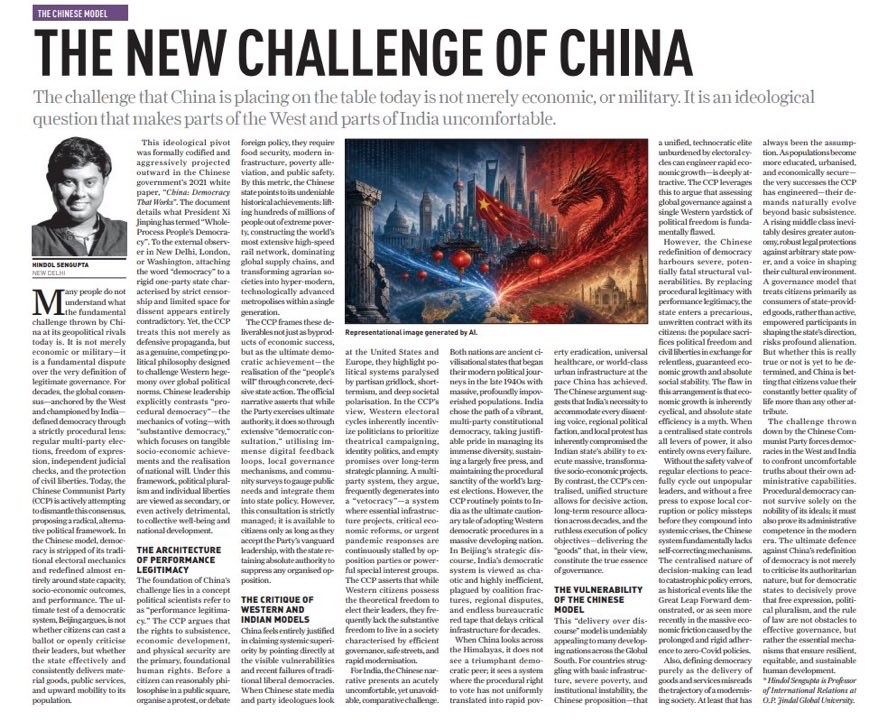
A typical Chinese perspective that holds one side (India) responsible for all that ails bilateral ties. More opinion than fact, that aligns with the party-state’s narrative to shape cognitive thinking in India.
Loud is not the same as connected. Pakistan's crises make headlines but rarely touch the four functions that hold the state together. A new paper by Agravaani research models why collapse keeps not happening - and why India should plan for a durable, troubled neighbour. The kind of research our think tanks should produce and don't.
https://t.co/Y3ambKLd1E
Lu Xun (1925): "Advocates of reading the classics know full well that reading the classics is not enough to save the country ... but they do play tricks and treat the people as muddled fools, and 'reading the classics' is merely the tool occasionally used for this trick."
The Problem of Weak States
In this 1988 book, Joel Migdal offers a broad theory of the interactive relations between state and society and puts the focus on state capabilities. It studies Egypt, India, Israel, Mexico, and Sierra Leone. A really interesting book.
The real losers in an informal U.S.-China G2 are America’s own friends, who will be compelled to hedge against U.S. unpredictability.
Taiwan worries that its security could become a bargaining chip in U.S.-China negotiations. Japan fears that Trump's accommodating approach to China could dilute the U.S.-Japan alliance. India sees a G2 framework as fundamentally incompatible with its vision of a genuinely multipolar Asia.
#WATCH | New York, USA: At the Asia Society event, External Affairs Minister Dr. S. Jaishankar says, "...you're dealing with China, you're dealing with Russia, with Ukraine, with other parts of Asia, with Europe... what people used to say about us, Washington is today practicing with a great deal of gusto... that is the world which we are moving into... Everybody is openly dealing with everybody else. That is how we are heading towards multipolarity. This will be a universal gum. Everybody is going to be chewing it. And everybody is actually going to get the best deal that they can out of a given situation from a much sharper definition of their interest... We may like it, we may not. But once Washington takes the lead on that, it becomes, in a way, a kind of a global trend. So that's the reality."
#WATCH | New York, USA: Addressing the Asia Society event, External Affairs Minister Dr. S. Jaishankar says, "...If there are countries which have significant military leads, it gives them today a sense of confidence, sometimes even a sense of risk-taking, vis-a-vis the international system. The net result of that, I think what we are seeing is a world which used to be content playing it safe, where deterrence was, in a sense, the default option. That was the norm. It has become a much more impatient world. When there are capabilities, there's a temptation to exercise those capabilities. So it's a kind of 'use it or lose it' mindset which today has set in. That perhaps ascribes a lot to where we are."
Urban educated India is a cultural colony of the US. Language, trends, tastes, desires. It’s all mimicry of the West, mostly Blue Westerners. And I include myself in this 🤷🏻♂️