Across Zerodha, here’s roughly the percentage of individual traders who are profitable:
- Futures: ≈50%
- Option sellers: ≈40%
- Option buyers: ≈10%
- MTF: too early to tell, considering it’s a new product
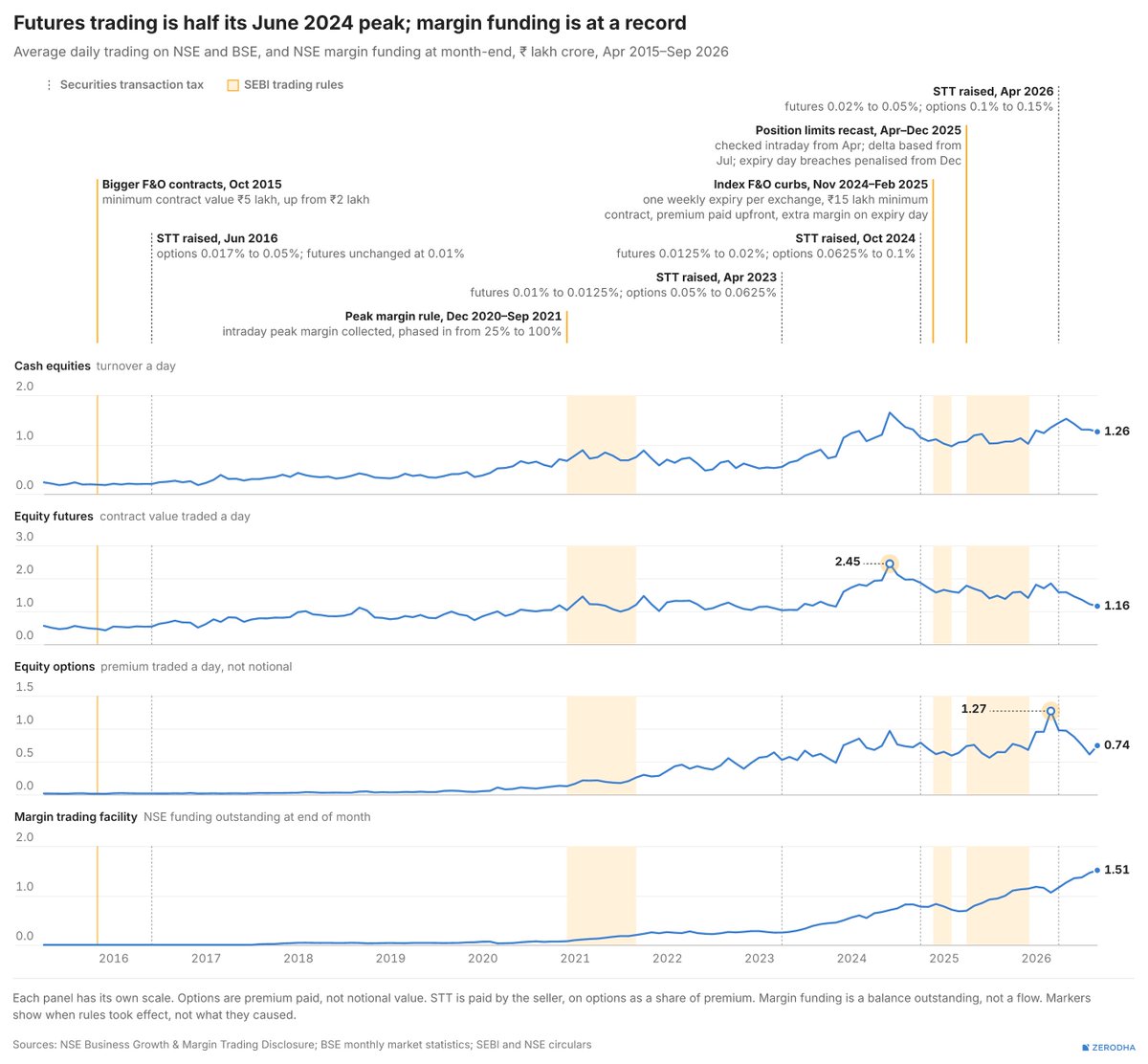
One of the unintended consequences of increasing STT and all the other measures to curb F&O speculation is that they may have pushed traders toward even riskier trading behaviour.
Yes, in theory, losses from buying options are limited to the premium paid. But buying options repeatedly, more often than not, ends with traders losing more money over time than trading futures or selling options. This is not to say that trading futures or selling options is low-risk. It’s a relative comparison.
There are a few reasons why options buying has become so popular.
Most traders don’t realise this, but STT is already one of their largest costs. As STT on futures increased steadily over the years, trading activity migrated from futures to options. Today, options are about 90% of all F&O trading activity.
At the same time, larger contract sizes have made trading futures and selling options more expensive in terms of the margin required. Buying options, on the other hand, is cheaper because it only requires the premium. Hence, more retail traders are buying options.
The other big factor is weekly expiries. Earlier, traders mostly traded monthly expiries. As more contracts started expiring every week, trading effectively became 0-day options. Traders began thinking in days rather than weeks and betting on price moves over increasingly short horizons.
All of these factors have also led to significant growth in MTF, or margin trading facility. With MTF, traders can borrow against eligible stocks and hold positions for extended periods. But MTF is long only.
The intent behind increasing STT, contract sizes, and all the other measures may have been to discourage speculation. The unintended consequence has been traders moving to riskier options trades.
This isn’t just about F&O, by the way. These measures also explain the spectacular increase in crypto F&O volumes. Crypto F&O exists in a grey zone where it’s neither legal nor illegal, and traders can get as much as 100x to 300x leverage on many of these contracts. In the last couple of weeks alone, I’ve come across multiple new platforms advertising crypto F&O contracts, including perpetual futures, none of which are regulated. That’s another unintended consequence of these regulatory measures.
The larger point I’m making is that any regulatory or taxation change has second- and third-order effects. These changes fundamentally alter market structure, and not always for the better, as the recent measures show. The risks always show up in the most unexpected places. And they show up especially in market phases like this one, when markets fall or trade sideways, and liquidity starts to evaporate. That shows up as wider spreads, higher impact costs, and a further drop in trading volumes.
This is perhaps one of the biggest challenges in regulating markets. Indian markets are no longer a backwater, the recent bear phase notwithstanding. We need careful thinking about second- and third-order effects, and thoughtful regulatory design and calibration.
@PulkitA30298377 Less like index, more on individual stock move might be the theme for coming months, plus if crude goes below 86, can expect broader momentum gaining.
@TreasureHunt_TH But if turnover and profit increases, they will collect more on higher base even with deducted slab, also ignoring this, more loss in term of outflow and currency depreciation turns out to be a vicious cycle.
EAM JAISHANKAR HOLDS UP A MIRROR TO THE WEST! 🇮🇳
At the 26/11 memorial, EAM S. Jaishankar introduced Taj Hotel security official Sunil Kudyadi to US Secretary of State Marco Rubio.
Kudyadi, who was present inside the Taj during the 2008 Mumbai terror attacks, briefed Rubio as he sought more details about the Pakistani terror attack.
A powerful reminder of Pakistan-sponsored terrorism, delivered by someone who witnessed the horror firsthand.
India no longer misses an opportunity to remind the world of the reality of Pakistan's terrorism.
BREAKING: Trump considering firing Defense Secretary Hegseth after the midterms in an effort to take the blame of the unpopular Iran war off of himself and onto Hegseth in order to "protect his legacy" and "reputation as an anti-war president," per multiple initial reports.
Trump is also on the verge of firing several key members of his administration in an effort to "clean house" amid mounting corruption allegations and expected midterm losses, as per the reports.
“There are times when friends become foes, so it is very important to identify the factors that could make your production and economy vulnerable to someone else's policies,” warns Minister Ashwini Vaishnaw