🚀New Paper - “Evolutionary Strategies Lead to Catastrophic Forgetting in LLMs"
Continual learning is coming. However, gradient-based algorithms will restrict its use cases. Evolutionary Strategies are resurging as a gradient-free alternative to GRPO… until they forget!
Our work shows that “Evolutionary Strategies Lead to Catastrophic Forgetting in LLMs."
Paper link : https://t.co/P7sB35JNVX
@GopalaSpeech@berkeley_ai
Is it just the inability to deal with emotions, allowing humans to not gain a new perspective from a machine-generated weird (weird here, according to the human, not personally) text/image/video and thats why they will always come up with names like "vibe" coding, "clanker", "ai slop" , but if we look at it from a different dimension being perspective, it will all fit together as the humans did into the picture
this is exactly i was talking about the perception of people on AI slop, its nothing its just a human bias to see things and taking it as offensive, its evolutionary mech in humans that benefits survival but i wonder whether is this the thing that will be the biggest bottleneck while we are on a path to achieve AGI, i think its going to be very difficult to evaluate US rather than AI as we progress
Reading math/computational logic LO paper feels so historic and ancient like magic spells books (in a good way) and meanwhile reading these new Agentic/LLM paper feels modern utopian projection onto future
Both have logic at its core but feels like two different worlds
Learning dynamical systems from noisy data with Weak-form Kernel Ridge Regression
Max Kreider, John Harlim, Daning Huang
https://t.co/hdFG2OWJ4M [𝚌𝚜.𝙻𝙶 𝚖𝚊𝚝𝚑.𝙳𝚂]
coding the whole solution for a complex problem and then explaining the thought process on how you arrived at the solution is much more efficient in the interview process and less time consuming + better experience rather than explaining the thoughts as they come while coding up the solution cause the thoughts are messy (and its even more non-simplistic in iq above 125 ) so it might sound very sketchy to the one who is more proned to the simplistic dwell down logic solutions, also they will end up hiring for the folk who can do simple tasks faster but cannot do complex tasks faster
I curated 315 AI × Bio / Biomedical papers from ICML 2026 and open-sourced the full collection on GitHub.
🧬 315 papers
⭐ 27 Spotlights
💻 161 papers with code
📚 10 research categories
From protein design and drug discovery to genomics, single-cell biology, neuroscience, and clinical AI.
A searchable map of AI × Bio at ICML 2026.
⭐ Stars are appreciated!
GitHub:
https://t.co/W3tcdEPDrW
@gabriberton Yes I don't know why people are falling for this, maybe it worked in some cases but for me I tried it 3-4 times and it gave me not expected results
It's weird to think about though that we need prompts still to steer the model in a particular direction we want instead of the model intelligent guessing
This is the prompt Yale and Univ of Chicago researchers used when asking LLMs for new research ideas.
Feed LLMs prior work, ask for ideas, then measure how repetitive the ideas get.
The surprising finding is that LLMs often treat research ideation as connecting what already exists, while humans use a wider set of problem-finding moves.
LLM-generated ideas reveal a bias toward safe bridge-and-combine proposals.
My team open sourced a set of agent skills to run an entire @kaggle competition workflow from plain language. We ship an easy to install plugin for your favorite coding agent.
👉 Try it now: https://t.co/ayVnzYycLY
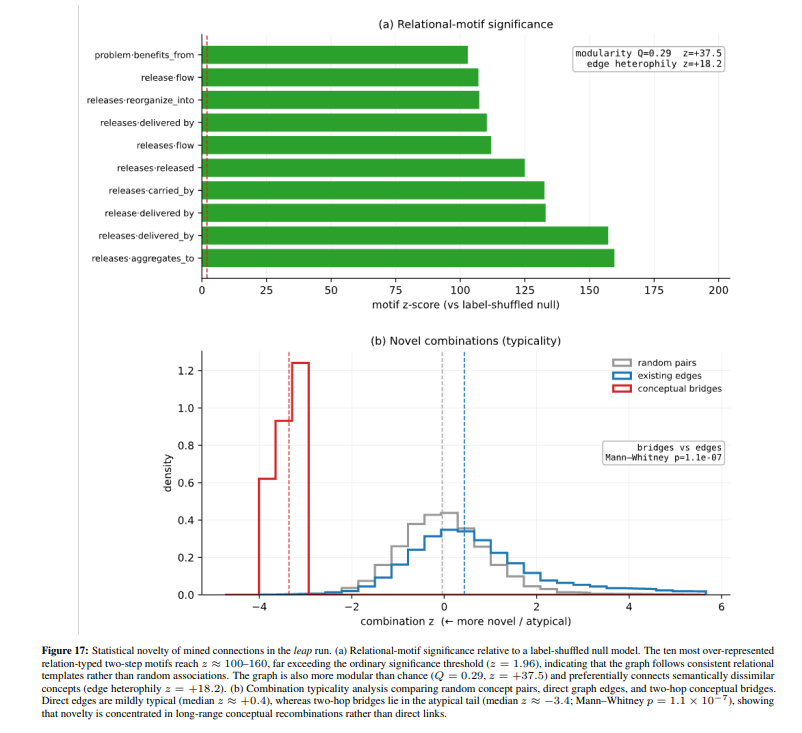
Big picture: Moves beyond retrieval or post-hoc graphs → makes the model's native reasoning symbolic, relational, and reusable. Potential for scientific agents that build and iterate on shared knowledge graphs.
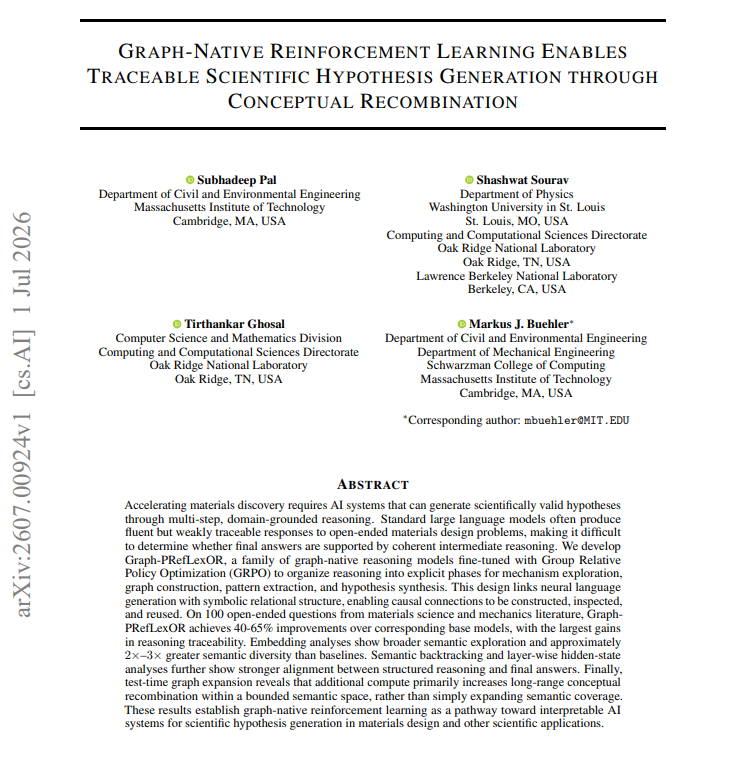
Just dropped on arXiv: "Graph-Native Reinforcement Learning Enables Traceable Scientific Hypothesis Generation through Conceptual Recombination."
A new family of models (Graph-PRefLexOR) that turns LLMs into structured, inspectable hypothesis generators for materials science & mechanics.
Link: https://t.co/ppuDFxh7aq
Results on 100 challenging open-ended questions from materials/mechanics literature:
-> 40-65% gains over base models
-> Biggest wins in reasoning traceability (makes the thought process inspectable & reusable)
-> ~2-3× greater semantic diversity
-> Better alignment between intermediate graphs and final answers
Cool analyses:
-> Embedding trajectories show more organized, directional exploration
-> Test-time graph expansion: extra compute → long-range conceptual recombination (not just broader search) within a bounded semantic space
Why this matters for materials design:
Properties emerge from multi-scale, cross-domain mechanisms (molecules → mesoscale → processing → performance). Graph-native reasoning forces the model to explicitly connect these instead of hand-waving in linear text.


![Memoirs's tweet photo. Learning dynamical systems from noisy data with Weak-form Kernel Ridge Regression
Max Kreider, John Harlim, Daning Huang
https://t.co/hdFG2OWJ4M [𝚌𝚜.𝙻𝙶 𝚖𝚊𝚝𝚑.𝙳𝚂] https://t.co/EWur45bZYF](https://pbs.twimg.com/media/HMZdWjGWIAAw6_1.png)