el nuevo disco de los strokes es como una paja con 2 dedos en el culo, esta bueno pero es raro, un poco te incomoda porque no estas acostumbrado pero le agarras el gusto
India will never produce an NVIDIA, and it has nothing to do with talent. R&D is the purest form of investment, and the central bank has spent decades making investment the dumbest thing you can do with a rupee.
I've been surfing the semiconductor wave for a while now, reading 10-Ks for fun. Spent last month in the Bay Area and the gap between India and the US is not a gap; it's a different universe. Conversations about agentic AI and the next decade of hardware, with my boomer relatives Waymo-ing around SF and self-driving home on Tesla FSD like it's normal. Nobody there thinks any of this is remarkable; they already live in the future.
NVIDIA spends nearly twice as much on R&D as every listed company in India combined. Silicon Motion, the world's leading maker of NAND flash controllers and around since 1995, ploughs 29.7% of revenue back into R&D. Micron runs 10.2%, NVIDIA 9.9%, on revenue bases that dwarf anything we have. India Inc? 0.85% of turnover, and half our listed companies report zero R&D at all.
The easy move is to lambast our promoters and the dhandomaxxing capitalist class, or the foreign MNCs running India as a glorified offshoring unit, or the babus who fund nothing useful. Satisfying. But Wrong. The reason no rational Indian founder pours money into frontier R&D is that there is genuinely no payoff at the end of it. Why?
1. R&D compounds, and compounding punishes laggards. At the edge of science a 1-2% gain is a moat; Intel spent 20+ years performing impossible physics every 24 months because Moore's Law was the business model, and that consistency makes them one of the goated companies of all time even after they got mogged recently. NVIDIA lives the same way today: invent at the limit or cease to exist. If you're 50% behind, no quantum of innovation closes that. You never touch the high end. You stay a mass-market producer of things that already exist. India is precisely there.
2. The supply side is the real thesis, and it's monetary. Two decades of high inflation, high money-printing, high nominal rates. That regime subsidises consumption and taxes patience. R&D is the longest-duration, highest-variance bet on the board; it is the first thing a 8% risk-free rate kills. Frontier R&D only ever gets funded two ways: a psychopathically risk-tolerant capitalist with cheap capital, or a state with Stalin-grade control. The USSR took agrarian peasants to the first man in space in 20 years; China built its own version. India has neither the state capacity, the political will, nor the balance sheet to do that. So nobody does it.
Talent was never the bottleneck. Capital structure was. If you want a SpaceX or a TSMC born here, you need an environment where a conglomerate can deploy $10B and sleep at night: a low-rate regime that makes long-duration investment rational, IP and patent courts that actually function, and policy that doesn't get rewritten every 2-3 years on a minister's whim. Stability is the input. Innovation is the output.
Bay Area versus Bombay, we are several universes apart, and you cannot print your way across that distance; you can only compound your way there, and we've spent years optimising for the opposite. The gap won't be bridged. With luck, it narrows.
"India is overcrowded" is the most successful gaslighting campaign Indian babus ever ran on their own citizens. They underbuilt the country for forty years and convinced 1.4B Indians to blame themselves for it.
Every overcrowded space you've ever queued in is a supply failure the state engineered, not a demographic accident. Five lifts in a hospital, one working. Seven railway counters, one ticketer. Toll plazas, water boards, municipal offices: built once in 1972, patched once in 1996, abandoned ever since. The only exception is airports, and even those lounges are gigafried at peak.
Why did this happen? 4 reasons, none of them are "too many people."
1. Cost of capital. Rupee down 60% against the dollar in two decades. Inflation 5-7% on paper, 8-10% in reality. Risk-free rates above 7%. No rational allocator underwrites a hospital with a 30-year payback under those conditions. Capital flows into software and consumer brands; anything with a 3-5 year ROI window. Parks, ports, metros, dams, schools need multi-decade underwriting that India's macro structurally cannot support.
2. The regulatory stack is engineered to prevent construction. 50+ clearances across municipal, state, and central bodies for any large project, each with its IAS gatekeeper extracting rent. Real builders give up. The only construction happening at scale is therefore illegal, which is exactly why slums mushroom while sanctioned housing projects sit at 15% completion for a decade.
3. The corruption tax. Budget 15-20% of project cost in bakshish before pouring a single slab. Stacked on top of GST, stamp duty, capital gains, property tax, labour cess. Software shops escape it; they ship from a laptop. Anyone touching cement, steel, or land pays the surcharge in cash, off the books, with zero recourse and zero deductibility.
4. State capacity has collapsed into pure friction. GST portal crashes on filing deadlines. MCA21 is a relic. Every regulator (SEBI, RBI, IRDAI, FSSAI, BIS) optimises for CYA, never throughput. Babus paid 1990s salaries to administer 2026 complexity respond rationally by doing nothing.
India's perpetual undercapacity is a capital allocation story the political class would rather you never learn. The 1.4B is a feature. The people running the country are the bug. Until cost of capital drops, the regulatory fat gets gutted, and the corruption surcharge gets squeezed out, the lifts and the counters and the hospitals will stay exactly as broken as they were when your grandfather first complained about them in 1987.
At Coachella, The Strokes projected footage of the bombings in Gaza and Iran while repeating, “What side are you standing on?” Exposing their government’s crimes during thier biggest music festival.
Meanwhile in India, celebrities lick government’s boots in fear of backlash, raids and boycotts.
India's Economy Is Smaller Than You Think
- India slipped from the 5th to the 6th largest. Everyone blamed the dollar.
- The dollar fell 10% in 2025. Its steepest first-half decline since 1973.
- So if the dollar crashed, why did the rupee crash harder?
A March 2026 PIIE paper by Arvind Subramanian (former Chief Economic Adviser to the government) estimates India's real GDP has been overstated by 22% since 2011.
If that's even half right, India was never the 5th largest economy to begin with.
1/13
the year is 2003. our bloodthirsty ruling class has initiated a ruinous war in the Middle East. there is a new Strokes album. the year is 2026. our bloodthirsty ruling class has initiated a ruinous war in the Middle East. there is a new Strokes album. the year is 2038. our bloo
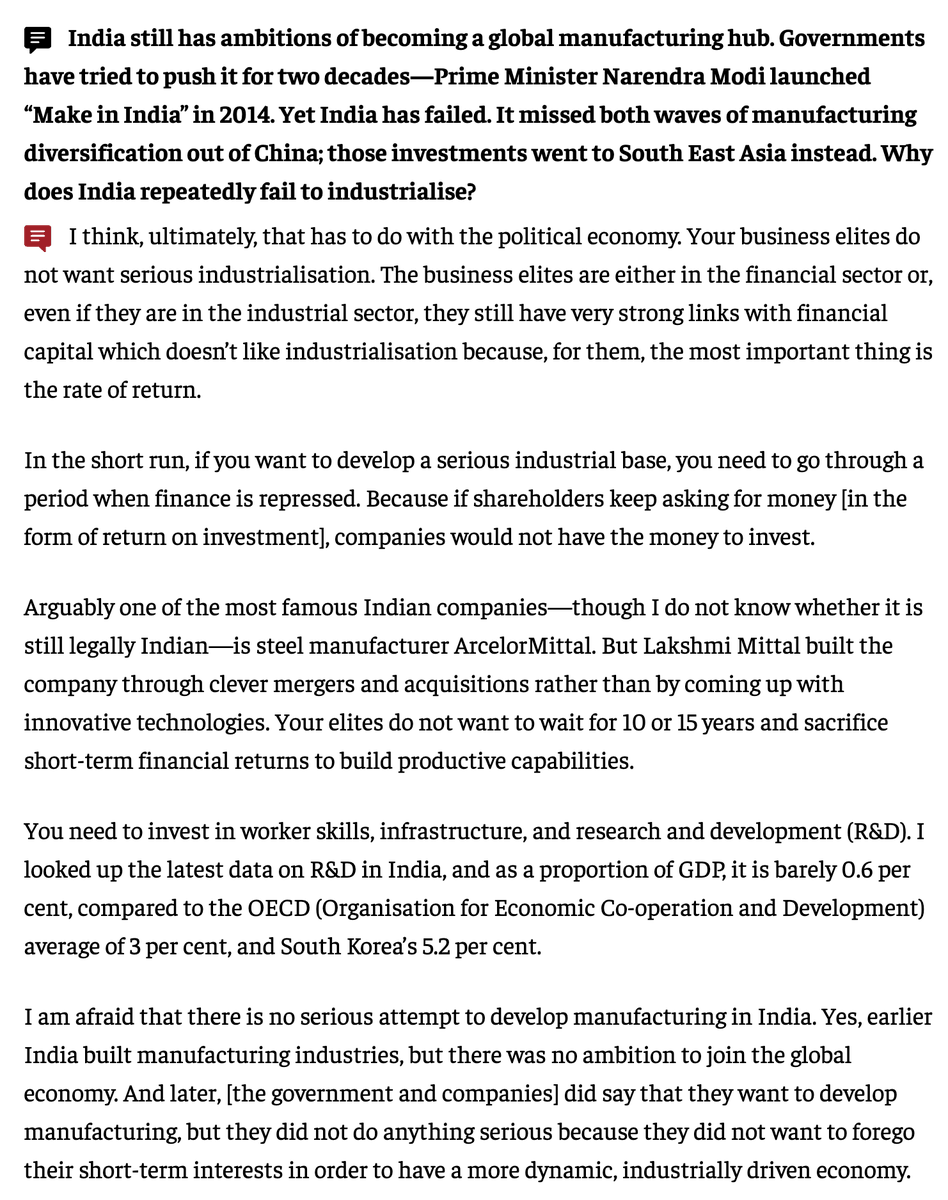
Why has India failed to industrialize?
Ha-Joon Chang argues that it’s because India’s business and financial elites oppose industrialization — and that it won’t happen unless their power is curbed.