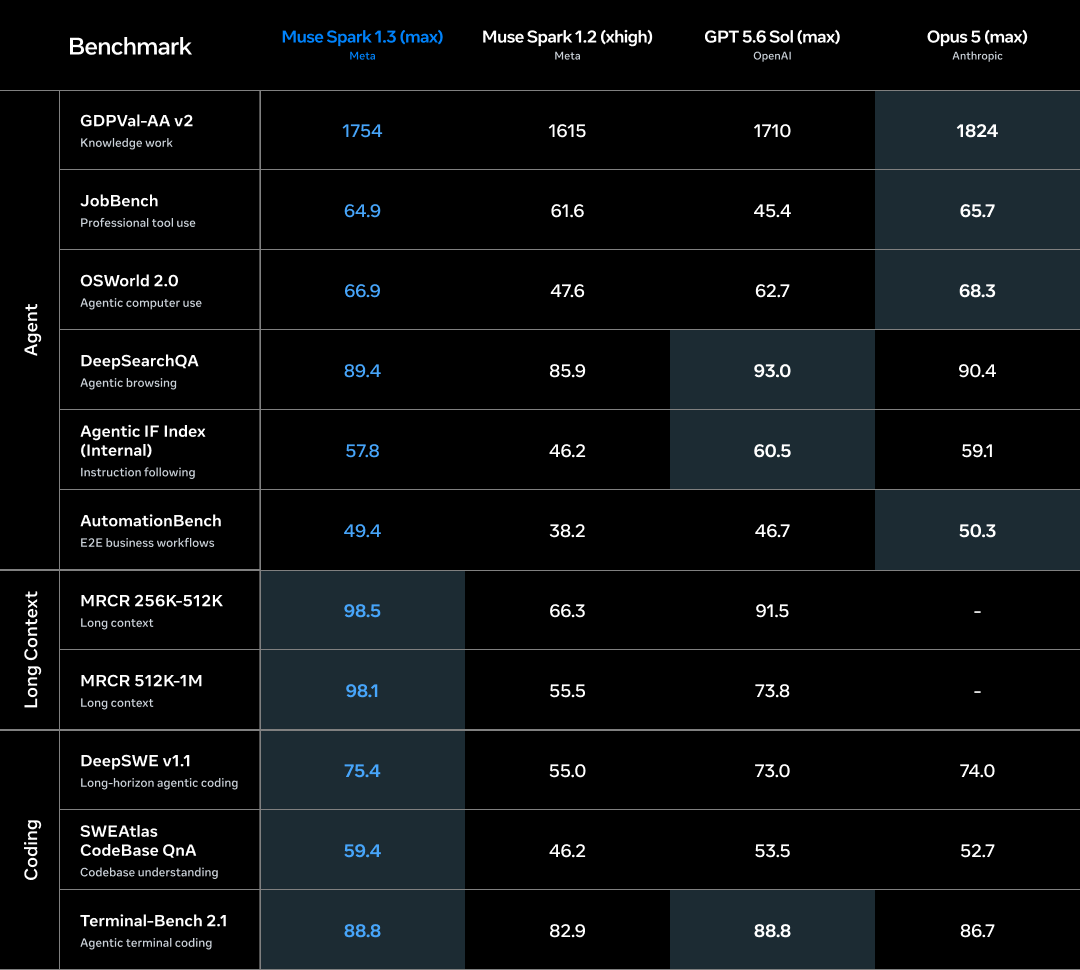
We’re excited to release Muse Spark 1.3 with improved performance on agentic and coding tasks, and a focus on real-world usability.
Key capabilities:
→ Sustains longer-horizon work across multiple workflows in a single thread
→ More actively collaborates with users: it asks clarifying questions, flags when it's stuck, confirms before consequential actions
→ Better calibrated on its own limits instead of hallucinating outcomes
→ ~20% fewer tool calls and ~25% fewer tokens vs. Muse Spark 1.2 in internal comparisons
1/ muse code is out of beta. launching with an sdk in developer preview to build your own agents on top of it and rolling out monthly subscription plans.
copy-paste into your terminal:
curl -fsSL https://t.co/TFXsXfJKW8 | bash
Introducing Muse Voice Transcribe, the first real-time audio perception model from Meta Superintelligence Labs.
Muse Voice Transcribe delivers real-time streaming ASR, diarization with 20+ speakers, and endpointing. It’s multilingual with seamless code-switching and improves accuracy with language, keyword, and context biasing.
The model ranks first on @ArtificialAnlys streaming speech-to-text and on public diarization benchmarks.
Muse Image is now available on Meta Model API and priced for production volumes at $0.01/image.
It’s an agentic image model that reasons before it renders. Each call searches the web to refine the output through iterative passes and evaluates the prompt for precise elements like charts and QR codes.
Text-to-image, single-image and multi-image editing, and multi-reference composition all live in one model, so there's no multi-step pipeline to stitch together.
Start building → https://t.co/Q0TSXkIp03
Thoughts About Scaling Law
Scaling, but not only of parameters. Every model release now ends with the same question: how many parameters? It isn't a question that can be answered on its own. Parameter count is only meaningful alongside three others — how much data you have, where you intend to spend your compute, and who will run the model, under what conditions.
The field learned this the hard way. Kaplan et al. (2020) fit an exponent that told everyone to grow parameters faster than data — roughly 2.7:1 — and the industry complied: GPT-3, Gopher, MT-NLG. Hoffmann et al. (2022) redid the experiment across four hundred models and found the compute-optimal split is closer to 20 tokens per parameter, and that with sufficient compute the two should grow at the same rate rather than drifting apart. The error in the earlier fit compounded with every order of magnitude of compute, which is why the largest models of that generation were the most misallocated. The trillion-parameter round was, in retrospect, a detour the whole field took together and then reversed.
Chinchilla wasn't the end either. It optimized training compute for models that would be trained once and evaluated. Today a model is called billions of times a day and inference dominates lifetime cost. Put inference into the objective and the optimum moves toward smaller models trained far longer — deliberate over-training, which is what Llama-2-7B and Gemma-2-9B were doing at roughly 290 and 889 tokens per parameter.
Sparsity moved the target again. In a MoE model two quantities have to be kept apart: total parameters govern roughly how much the model can hold — knowledge, facts, the long tail — while activated parameters and effective depth govern roughly how far it can think, how many steps of a causal chain it can carry before it comes apart. A dense 20:1 ratio does not transfer. And the ratio isn't a single number at all: Roberts et al. (2025) find the optimal tokens-per-parameter is task-dependent, with memorization favoring more parameters and reasoning favoring more data. Follow-up work on MoE observes that at fixed TPP, pushing total parameters higher actually degrades reasoning, while activating more experts reliably helps it.
This matters for what we are building toward. Finding a vulnerability is not a retrieval problem. It doesn't come from having memorized more CVEs; it comes from carrying a twenty-step chain of inference to the end without losing the thread. That capability does not live in total parameter count.
Which brings us to this release. Total parameters appear to matter up to a threshold — enough to hold the world — after which additional capability comes from scaling elsewhere: effective depth per forward pass, and above all post-training. GLM-5.3 is our controlled experiment on that claim. Same base, same architecture, same total and activated parameters as GLM-5.2. One month of scaling long-horizon environments and RL. The gains are not marginal. Well, scaling has more than one dial. We turned the post-training one this time because it had the most slack left in it — not because the others are finished. Base model size, pretraining data, compute spent per forward pass: all of them are still on the table, and we will come back to each. What this experiment taught us is that the dials do not have to be turned together, and that the one worth turning next is rarely the one that was worth turning last. We are not done scaling. Next time, maybe mid-training, pre-training, and even more.
muse code in beta is live. first coding agent from msl, built on muse spark 1.2.
install: curl -fsS https://t.co/TFXsXfJKW8 | bash
here's what you should know:
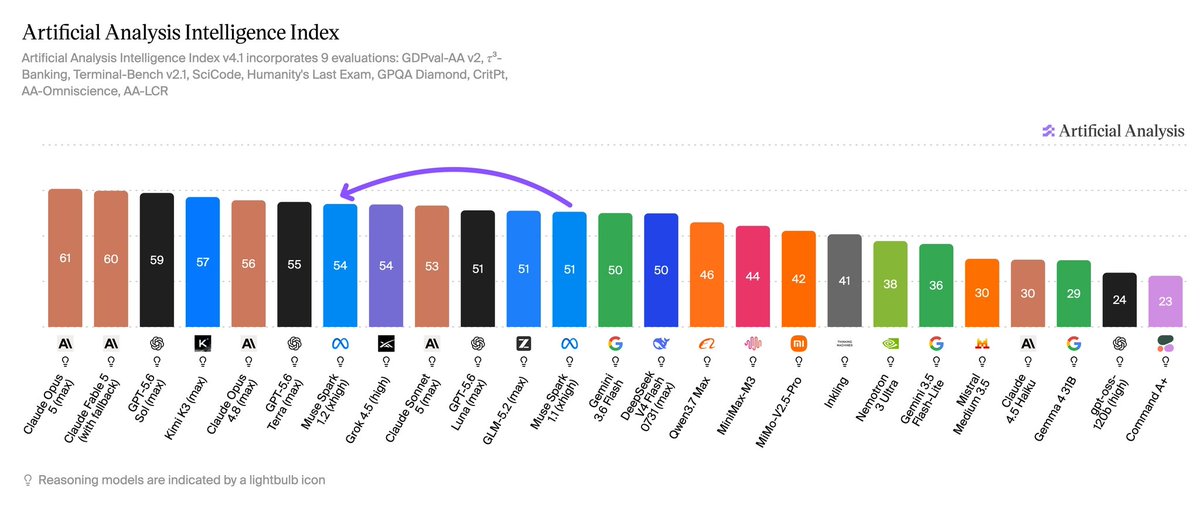
Meta has released Muse Spark 1.2. It's their third release in four months and scores 54 on the Artificial Analysis Intelligence Index, significantly improving agentic knowledge work capabilities over prior releases and putting Meta next to SpaceXAI in a tie for third place amongst US labs
Muse Spark 1.2 (xhigh) lands at 54, up 3 points from Muse Spark 1.1 (51) and 11 points from Muse Spark 1.0 (43, April). It enters effectively tied with GPT-5.5 (xhigh, 55) and Grok 4.5 (high, 54), narrowly behind current frontier models Claude Opus 5 (max, 61), Claude Fable 5 (max w/ fallback, 60), GPT-5.6 Sol (max, 59), and Kimi K3 (max, 57)
Congratulations to @AIatMeta, @finkd, and @alexandr_wang on the release!
Key Takeaways:
➤ Muse Spark 1.2 gets closer to the frontier on agentic knowledge work. At Muse Spark 1.1's launch, we noted agentic knowledge work as its clearest gap; Muse Spark 1.2's gains help to close this. Its GDPval-AA v2 Elo rose 260 points to 1631, #5 among all models we have benchmarked and ahead of Claude Opus 4.8 (max, 1588). Terminal-Bench 2.1 gained 2 points (78% to 80%), and Tau3-Bench Banking rose 2 points (25% to 27%)
➤ Among the most cost-efficient models at its intelligence level. Muse Spark 1.2 costs $0.40 per Intelligence Index task at Meta's unchanged $1.25/$4.25 per 1M token pricing, with only Grok 4.5 (high, $0.37) and GPT-5.6 Sol (medium, $0.39) cheaper in its intelligence cluster - GPT-5.6 Terra (max, $0.51), Kimi K3 (max, $0.86), and GPT-5.5 (xhigh, $1.18) all cost more per task. The cost increase over Muse Spark 1.1 ($0.29 per task) is driven by increased token usage per Intelligence Index task
➤ AA-Omniscience abstention rate increases. The score rose from 18 to 22 as the hallucination rate fell 10 points (38% to 28%) and the attempt rate dropped from 82% to 67%. This heavy abstention (not answering questions when unsure) now drives both the low hallucination rate and a lower accuracy (41% to 38%)
➤ Scientific Reasoning results remain largely unchanged. CritPt notably gained 3 points (15% to 18%), while SciCode fell 2 points (58% to 56%), and Humanity's Last Exam fell 1 point (45% to 44%)
Other model details:
➤ Context window: 1M tokens, unchanged from Muse Spark 1.1
➤ Pricing: unchanged from Muse Spark 1.1: $1.25/$4.25 per 1M input/output tokens, with cache hits discounted to $0.15 per 1M
➤ Availability: Meta's first-party API at launch
muse code in beta is here: our first coding agent powered by our latest model, muse spark 1.2.
one command to install and start building. get it through Meta Model API.
I wish I were in the room:
Ilya: Jensen, my friend. We have
reached the point where our research is worth scaling!
Jensen: Sure. How many GPUs? 100k?
Ilya: More.
Jensen: 200k?
Ilya: More.
Jensen: 300k??? Can you at least give me something? One hint. One benchmark where you're better.
Ilya: We are done with research. We need to scale!
Jensen: Anything. A number. A vibe.
Ilya: Jensen, you are a nice guy. But Sundar is standing right outside, and he doesn't ask questions.
Jensen: Where do I sign.
Ilya: I am honored by your conviction. See you next year
@Yuchenj_UW I don’t think 3T model training is possible on nerfed Nvidia GPUs, it mush be GB300 or equivalent. Either way the chip market is about to shakeup
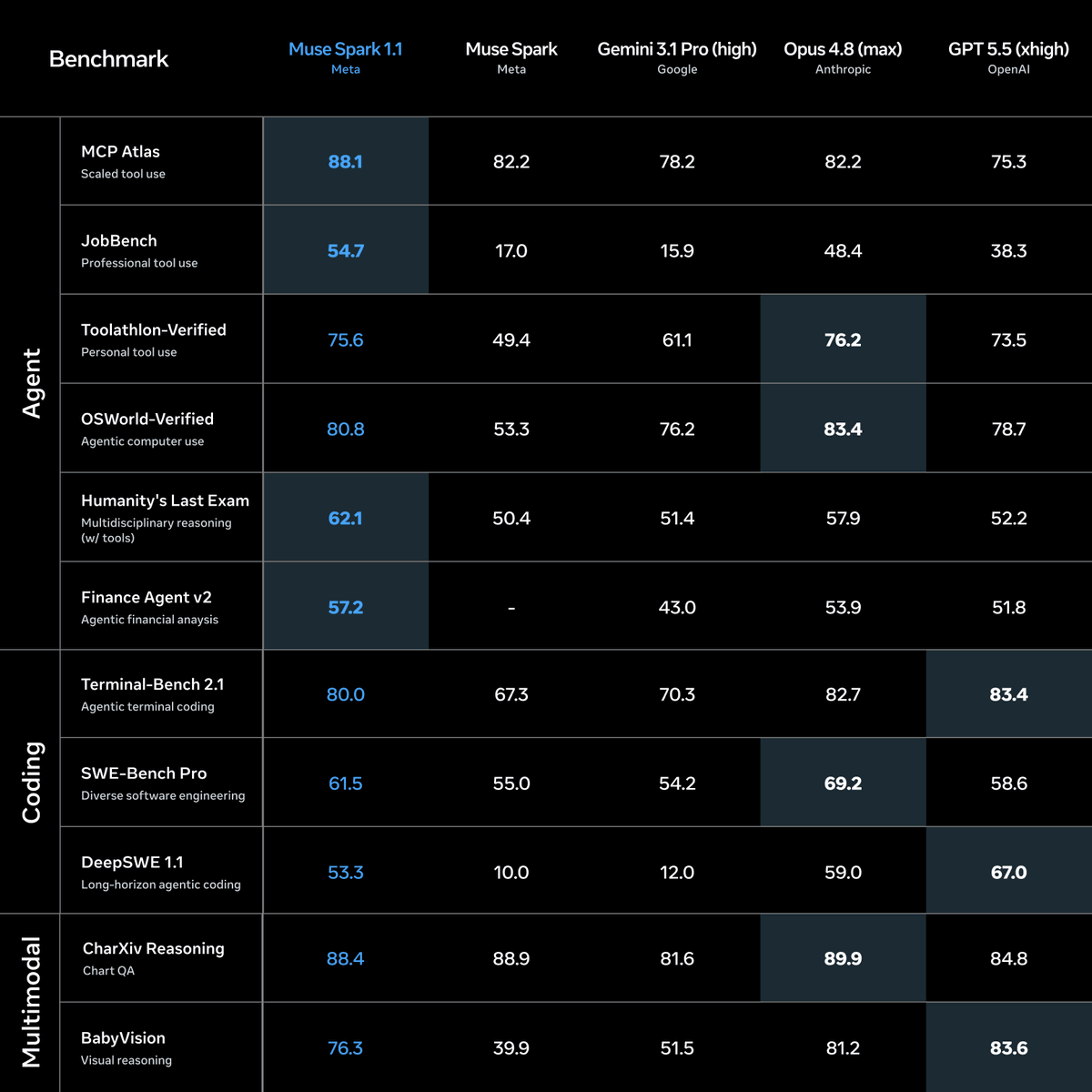
1/ muse spark 1.1 is an industry-competitive agentic and coding model. across many agentic evals it rivals gpt-5.5 and opus-4.8.
available now through the new meta model api and in meta ai. 🧵
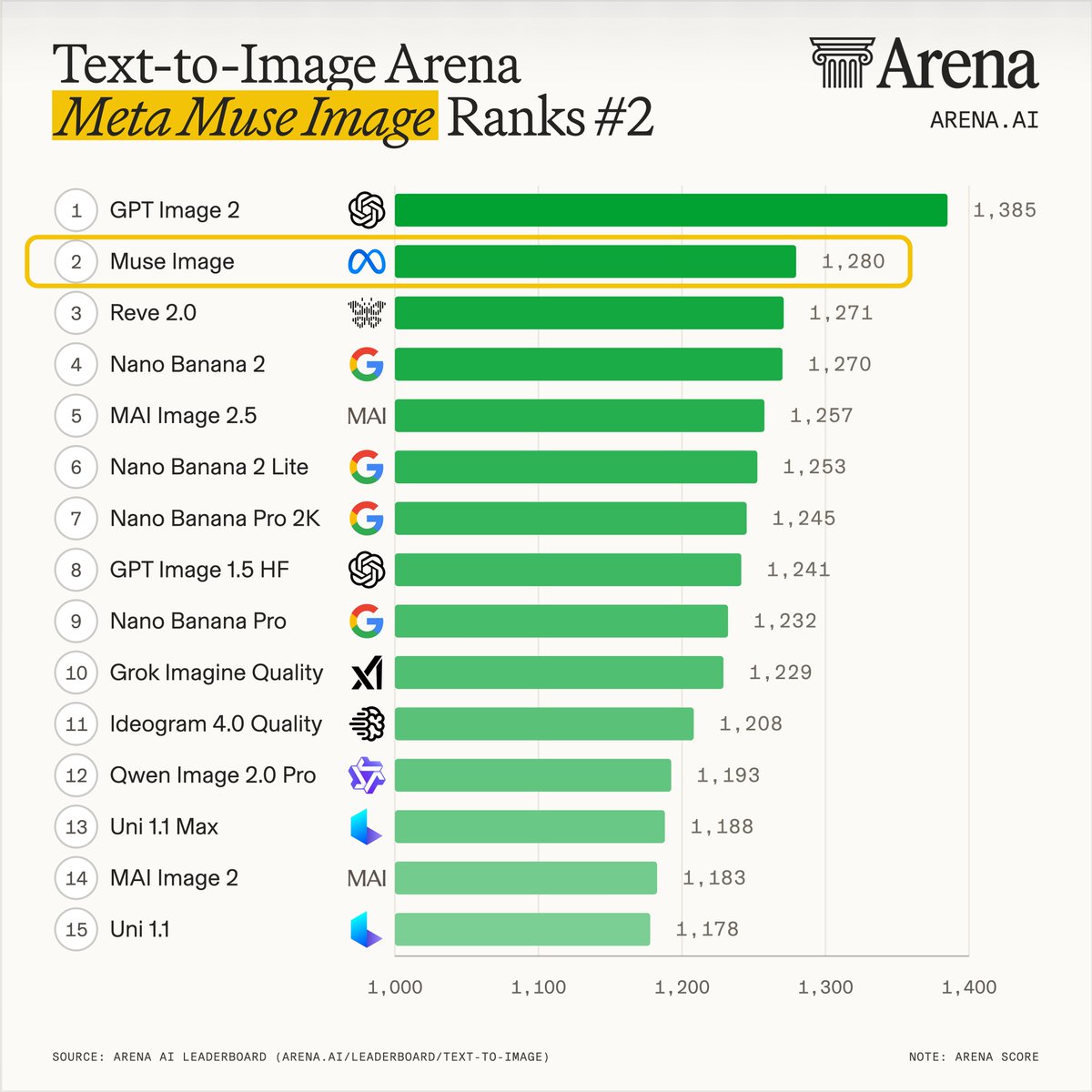
Exciting news: Meta’s Muse Image just claimed #2 in the Image Arena!
Muse Image from @AIatMeta now ranks second only to OpenAI's GPT Image 2, outperforming Nano Banana, Grok Imagine, MAI Image, and many other leading image models.
It holds #2 across the board: Text-to-Image, Single-Image Edit, and Multi-Image Edit. Congrats to the Meta team on this incredible milestone!
Introducing Muse Image and Muse Video, the first media generation models developed by Meta Superintelligence Labs.
Muse Image is our most advanced image generation model yet. It follows instructions faithfully, edits with precision, composes from multiple references, and draws on Instagram for social context. It also brings agentic tool use capabilities to image generation and integrates with Muse Spark.
You can try Muse Image in the Meta AI app and web, as well as in Instagram Stories and WhatsApp – starting in limited countries with more locations on the way.
Today we’re also previewing Muse Video, which is built upon the same pretraining base as Muse Image to deliver exceptional visual fidelity with native audio support.
Learn more about both models: https://t.co/QtKDPDZP5v
I predicted this months ago:
The highest-paying jobs today may be first in line for AI disruption.
GPU kernel engineers used to get million-dollar offers. Now AI agents can self hill climb, write better kernels, and top the leaderboard.
(We didn’t even use Fable or GPT-5.6)
last-night we released rnj-1.5, our long-context extension of rnj-1. the model can now reason and solve coding problems out to 160k tokens of context, up from 32k.
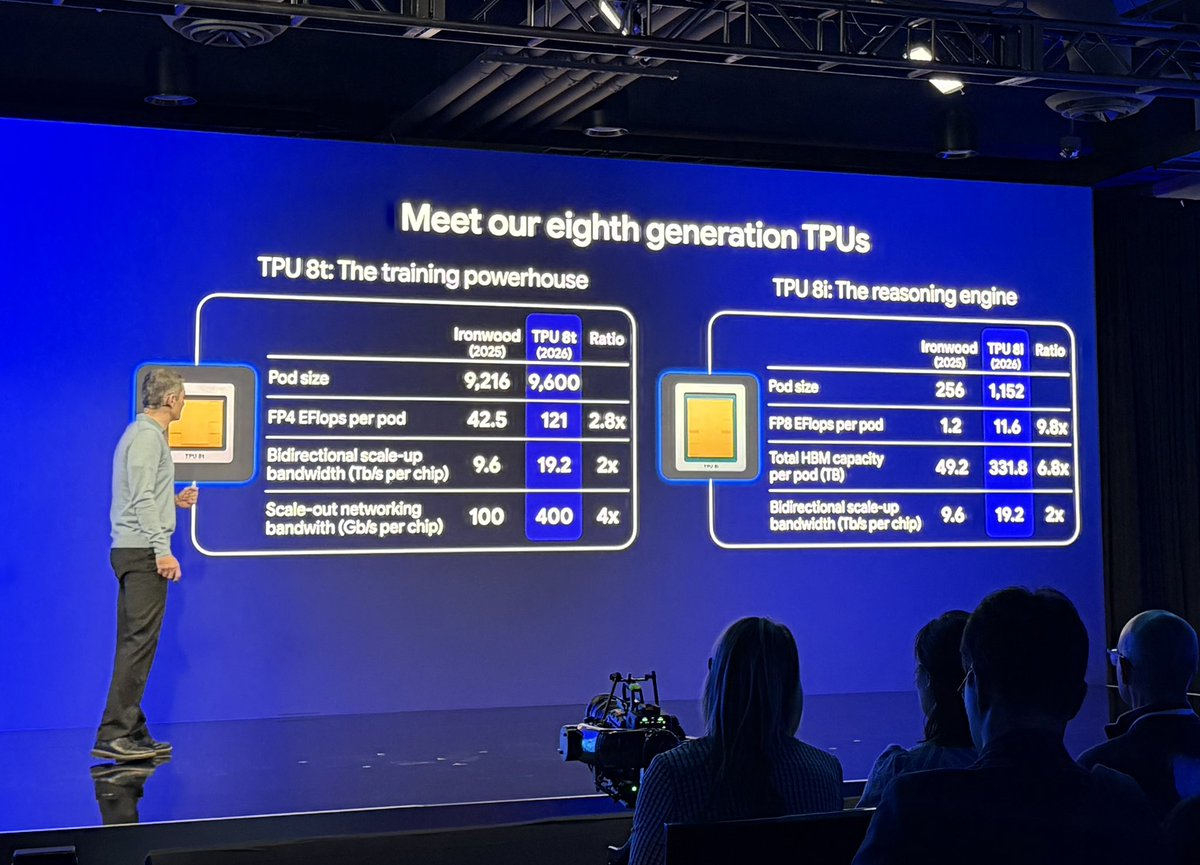
Two new TPUs, one for training and one for inference.
TPU 8t is the training box: 9,600 chips per superpod, 2+ PB of shared HBM, 121 exaflops, 2.8x the prior generation and 2x better perf/watt vs. prior gen, native FP4 in the MXUs, and Axion Arm hosts. With Pathways and JAX, a single logical training cluster now scales past one million TPUs.
TPU 8i targets inference and reinforcement learning with up to 80% better perf/dollar for low-latency inference and RL vs. the prior TPU generation, SRAM tripled to 384MB, HBM up 50% to 288GB, and a new Collectives Acceleration Engine. The more interesting move is the network. Google’s Boardfly topology was co-designed with DeepMind to optimize for latency, not bandwidth. That is exactly the right bet for agents, where minimum time-to-response is the customer experience.
Workload specialization is the hyperscaler playbook, and Google hinted more than two SKUs per year is plausible going forward. An underappreciated metric is goodput, not peak FLOPs. At 10,000-chip scale, fail-stop failures and silent data corruption quietly eat training throughput. Google claims more than 97% goodput at that scale.
Google is also introducing NVIDIA VR200 with its Virgo network for the largest clusters.
More later. $GOOG $AVGO $NVDA