I will be at @neurips in San Diego this year, and I am excited to connect with old friends and meet new ones. If you are attending and want to connect, please reach out. Also, I am actively looking for postdoc opportunities in ML for scientific discovery and drug discovery!
@Micro_Yunha Hi Dr Hwang, I recently defended my phd in CS working on ML for drug discovery and biological sequence modeling. I will also be at NeurIPS Dec 5 to 7 and would love to chat about postdoc opportunities in your group if you have time. I can also send an email with more details.
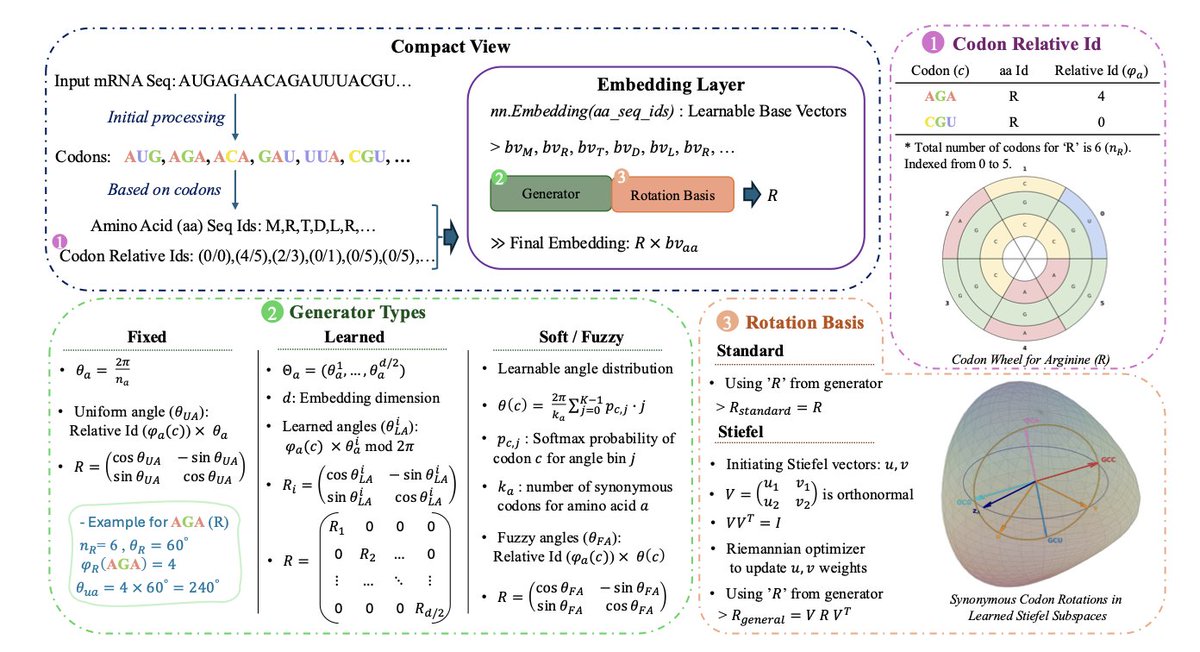
Equi-MRNA: Protein Translation Equivariant Encoding for mRNA Language Models
1. Computational biologists have introduced Equi-mRNA, a new language model for mRNA that uses group-theoretic priors to explicitly encode the inherent symmetries of synonymous codons. This innovative approach allows the model to learn biologically grounded representations.
2. On downstream property-prediction tasks, Equi-mRNA shows significant improvements, with up to a 10% gain in accuracy over traditional baseline models on tasks including expression, stability, and riboswitch switching.
3. In sequence generation, the model produces highly realistic mRNA constructs, achieving a roughly 4x improvement in fidelity and better preserving functional properties compared to vanilla models.
4. The model is also highly efficient, with a 15M parameter variant outperforming larger architectures while using only about 30% of the parameters of a comparable baseline.
5. Interpretability analyses reveal that the model's learned codon-rotation patterns align with known biological phenomena like GC-content biases and tRNA abundance, providing new insights into codon usage.
📜Paper: https://t.co/9KK1gVWrxt
#computationalbiology #mRNA #AIinScience #Bioinformatics #LanguageModels
Regularization might look like the easiest way to balance accuracy and fairness — but is it the most principled? Mehdi Yazdani explores how bilevel optimization offers a cleaner, more modular alternative that can actually improve convergence and maintain Pareto-optimal trade-offs.
https://t.co/AF7kLFUQZI
ICLR update 🚨 What's missing in existing deep learning methods for efficient modeling of RNA molecules? We spent a year investigating, and I’m excited to share that our work led to two papers accepted at ICLR:
1. HELM: Hierarchical Encoding for mRNA Language Modeling https://t.co/b3VlrPUS7R
2. Beyond Sequence: Impact of Geometric Context for RNA Property Prediction https://t.co/49wlfKO5Ib
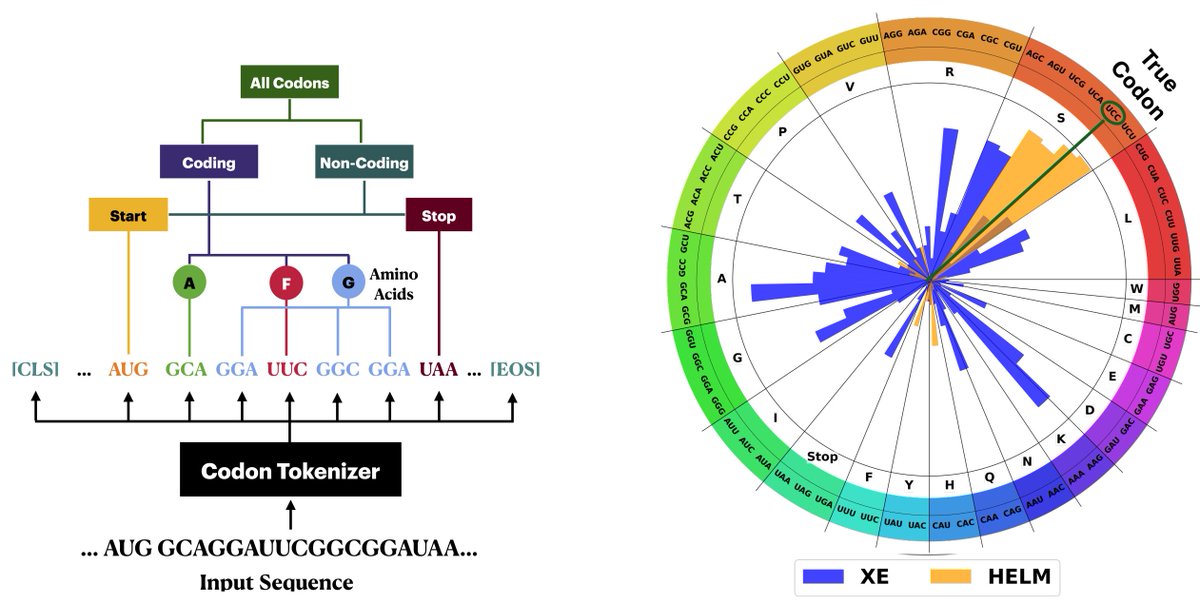
Don't treat the language of biology as natural language! Biology speaks in hierarchical patterns that natural language models don't fully capture. Meet HELM: a novel approach to train LMs that aligns with the intrinsic hierarchy of mRNA sequences.
https://t.co/CqKPxRdQFy
1/5
I am speaking at Research in Computational Molecular Biology 2024. Please check out my talk if you're attending the event! @RECOMBconf#RECOMB2024#RECOMB - via #Whova event app
Introducing DeepDrugDomain: A cutting-edge toolkit for Drug-Target Interaction & Affinity Prediction. Streamlined preprocessing, advanced modeling capabilities, and more https://t.co/sOuhzt2aae) #Bioinformatics#MachineLearning#DrugDiscovery
BindingSiteAugmentedDTA: Enabling A Next-Generation Pipeline for Interpretable Prediction Models in Drug-Repurposing https://t.co/t3Q0ZgXCtr #biorxiv_bioinfo
#NLP "AttentionSiteDTI: an interpretable graph-based model for drug-target interaction prediction using NLP sentence-level relation classification" https://t.co/G61p8ikWFG
Our AOTA method for drug-target interaction "AttentionSiteDTI: an interpretable graph-based model for drug-target interaction prediction using NLP sentence-level relation classification." has been published in Briefings in Bioinformatics.
https://t.co/XSDXV6Ue67
AttentionSiteDTI: Attention Based Model for Predicting Drug-Target Interaction Using 3D Structure of Protein Binding Sites https://t.co/YA7lCJmQlJ #biorxiv_bioinfo