[1/6] 🚀 Exciting News! Our paper has been accepted at hashtag #CVPR2025 ! 🎉
We’re thrilled to introduce "ProKeR: A Kernel Perspective on Few-Shot Adaptation of Large Vision-Language Models"
📄 https://t.co/l2o8p5x185
#VisionLanguageModels#FewShotLearning#ComputerVision
We somehow got put in the spotlight the last few days! First we'd like to thank the organizers of the AI show for that, we can't get enough of this stuff. I'll say a few things about where we are and what we do.
At @CVPR this week, happy to connect if you're around.
If you're thinking about what's next: @MistralAI is hiring.
Looking for people with backgrounds in robotics, LLMs, AI for science, and audio.
Offices in Europe, Singapore, UAE, and the US.
https://t.co/a0NcRDLZS6
#CVPR2026
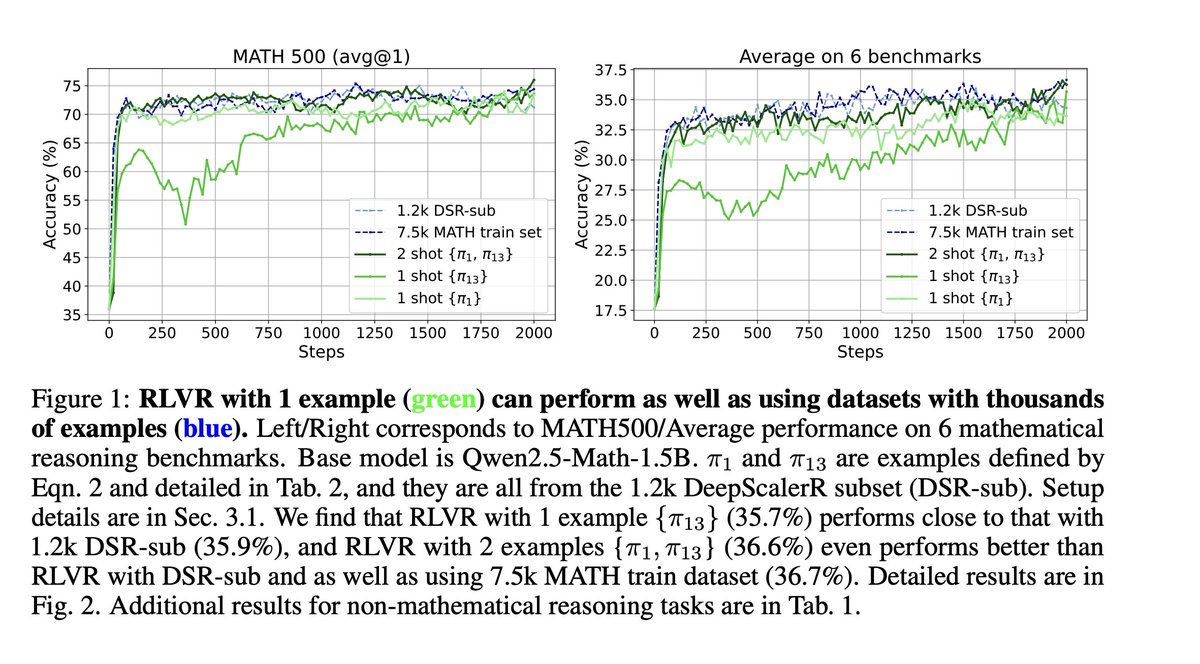
"RL with only one training example" and "Test-Time RL" are two recent papers that I found fascinating.
In the "One Training example" paper
the authors find one question and ask the model to solve it again and again. Every time, the model tries 8 times (the Group in GRPO), and a gradient step is performed, to increase the reward which is a very simple verification of the correct answers, repeated thousands of times on the same problem.
The shocking finding is that the model does not overfit to this one question: RL on one example, makes the model better in MATH500 and other benchmarks.
(If instead you did SFT repeating one training question-solution finetuning, the model would quickly memorize this answer and overfit). But with RL, the model has to solve the problem itself, since it only sees the question, not the answer. Every time it produces different answers, and this seems to prevent overfitting. The other papers are relying on the same phenomenon: you can have a small number of training questions and re-solve them thousands of times. You can do this for the test set (as test-time RL does) and still not overfit. We also independently saw this by doing RL training on half the test set and seeing benefits in the other half for BFCL agents.
My thought now is that this shows our RL learning algorithm must be extremely inefficient. When a human is learning by solving a math puzzle, they immediately learn what they can learn by solving it once (or twice). No further benefit would come by assigning the same homework problem to students a tenth time. But in RL, we keep asking the model to re-solve the same question thousands of times, and the model slowly gets better. We should be able to have much better RL learning algorithms since the information is there. (1/2)
Vision models have been smaller than language models; what if we scale them up?
Introducing Web-SSL: A family of billion-scale SSL vision models (up to 7B parameters) trained on billions of images without language supervision, using VQA to evaluate the learned representation.
It finally answers the question we saw in Cambrian-1: why do SSL models lag behind CLIP models in VQA?
[1/8]
DINO and DINOv2 are surely amazing SSL approaches.
Many assume that they're also very simple (in particular vs. other SSL methods), but they are actually a bit more elaborate and I've been in awe of the achievement of the authors.
This diagram from SimDINO is more complete.
[1/6] 🚀 Exciting News! Our paper has been accepted at hashtag #CVPR2025 ! 🎉
We’re thrilled to introduce "ProKeR: A Kernel Perspective on Few-Shot Adaptation of Large Vision-Language Models"
📄 https://t.co/l2o8p5x185
#VisionLanguageModels#FewShotLearning#ComputerVision


![YBendou's tweet photo. [5/6] ProKeR achieves state-of-the-art results across 11 standard benchmarks. https://t.co/FN4MlreYWV](https://pbs.twimg.com/media/Gk0RhFQWwAEKFcW.jpg)




![YBendou's tweet photo. [1/6] 🚀 Exciting News! Our paper has been accepted at hashtag #CVPR2025 ! 🎉
We’re thrilled to introduce "ProKeR: A Kernel Perspective on Few-Shot Adaptation of Large Vision-Language Models"
📄 https://t.co/l2o8p5x185
#VisionLanguageModels #FewShotLearning #ComputerVision https://t.co/hsLGOa0L9E](https://pbs.twimg.com/media/Gk0KtGRX0AAW3MT.jpg)
![TongPetersb's tweet photo. Vision models have been smaller than language models; what if we scale them up?
Introducing Web-SSL: A family of billion-scale SSL vision models (up to 7B parameters) trained on billions of images without language supervision, using VQA to evaluate the learned representation.
It finally answers the question we saw in Cambrian-1: why do SSL models lag behind CLIP models in VQA?
[1/8]](https://pbs.twimg.com/media/Gni3WWzXcAAPkmP.jpg)

![YBendou's tweet photo. [5/6] ProKeR achieves state-of-the-art results across 11 standard benchmarks. https://t.co/FN4MlreYWV](https://pbs.twimg.com/media/Gk0RiXmXkAA4qMs.jpg)


