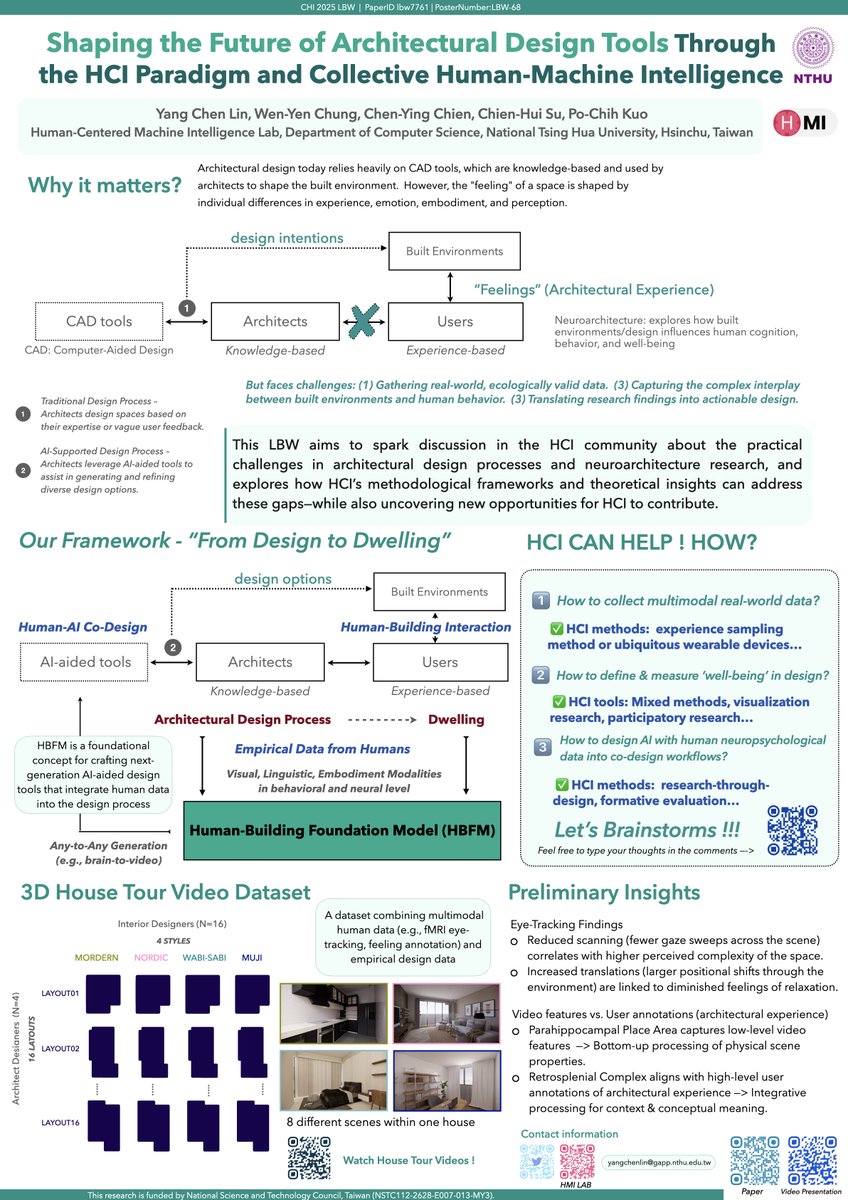
Come to our #CHI2025 poster at booth #68 today around 10:30 AM - 11:10 AM & 3:40 PM - 4:20 PM
at the Late-breaking Work: AI for Design and Interaction section !!!
At #CHI2025, we ask how to design AI-aided design tools that incorporate human data into the design process?
Shaping the Future of Architectural Design Tools Through HCI Paradigms and Collective Human-Machine Intelligence. (1/5)
#Architecture#Design#Neuroscience#HCI#AI
Two major announcements for the #DigitalBrainProject:
🥇9 teams were selected in the first round
🚀we’re scaling the funding to $15M
More details below 👇:
https://t.co/cVHzpLykJV
CCN began at Columbia in 2017. As #CCN2026 returns to NY, a special Back2NY event will feature a crowd-sourced panel discussion on how the community has grown, prior challenges, and future perspectives.
Share your experiences in the community survey: https://t.co/24RYQb1Czg
During long-horizon task planning, a robot must decide what to do, while ensuring each action is geometrically feasible.
To this end, we propose 𝗽𝗹𝗮𝗻𝗻𝗶𝗻𝗴 𝘄𝗶𝘁𝗵 𝗶𝗻𝘁𝗲𝗿𝗹𝗲𝗮𝘃𝗲𝗱 𝘃𝗶𝘀𝗶𝗼𝗻-𝗹𝗮𝗻𝗴𝘂𝗮𝗴𝗲 𝘁𝗵𝗼𝘂𝗴𝗵𝘁𝘀.
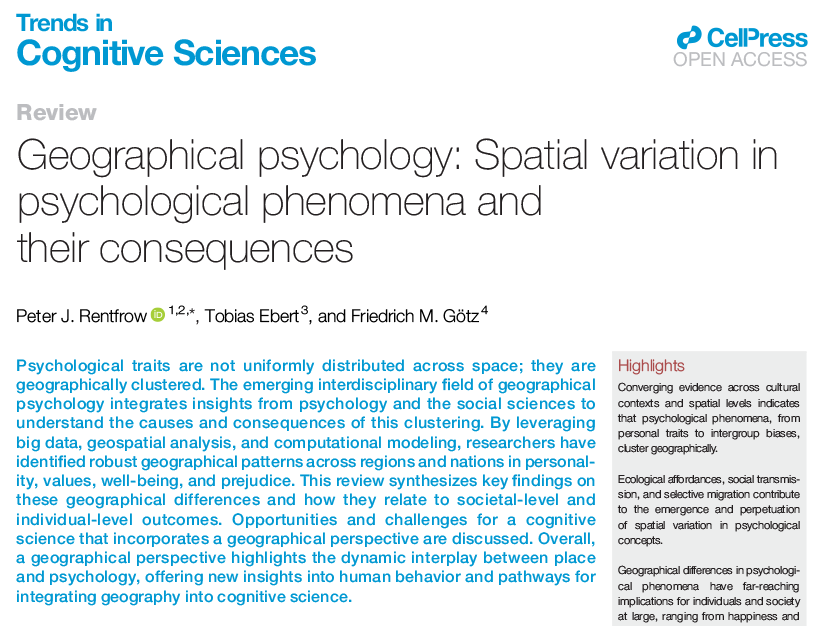
Geographical psychology: Spatial variation in psychological phenomena and their consequences
Review by Peter J. Rentfrow, Tobias Ebert, & Friedrich M. Götz (@FriedrichMGoetz)
https://t.co/3WcrkxkwGm
I'm a very visual person. when I was first getting into ML, I'd try to draw out every concept on pen and paper.
back then I couldn't vibe-code a visualization. but now you can!
here are my favorite ML visualizations I've been saving for a while. take them as inspo for the next complex topic you want to visualize 🧵
✨🧠 Tribe v2, our latest model of human brain responses to sound, sight and language can now be (partly) explored on your phone📱:
▶️demo: https://t.co/HWjugwzZBQ
📄paper: https://t.co/ULxUDnHn6Q
💻code: https://t.co/J7PXaxvdKt
🚨Very excited to see our work on warmth & sycophancy in LLMs out in @Nature today!🚨
We study what happens when LLMs are fine-tuned to be warmer, and find that warmth and sycophancy can be linked, with warm models showing higher errors on a range of benchmarks (🔗s below)
Why do our visual systems have “shortcut” connections (V1-V4)? What do they add beyond the classic hierarchical (V1-V2-V3-V4) pathway?
The lab’s latest study takes activity flow modeling to the next level to answer these questions
https://t.co/XFk3EzXFYS
1/n
The brain’s “default mode” and “action mode” networks are two sides of the same attractor.
Encoding a macro-scale Bayesian prior that biases processing toward internal or external drive.
ICLR 2026 is almost there! We have 6 exciting keynotes covering a range of areas from machine learning to robotics, neuroscience and AI for science:
Maja Matarić, Max Welling, Percy Liang, Katie Bouman, Karen Adolph, Pablo Arbeláez
See you all soon! #ICLR2026
Interested in sponsoring or exhibiting at CCN 2026?
CCN 2026 at New York University (August 3–6) brings together researchers across cognitive science, neuroscience, and AI. We invite partners and sponsors to contribute to this conversation.
Packages: https://t.co/z9Wtk995dO
Excited to share our work at #CHI26 👇
“AIDED: Augmenting Interior Design with Human Experience Data for Designer–AI Co-Design”
w/ Chen-Ying Chien, Kai-Hsin Hou, Hung-Yu Chen & Po-Chih Kuo (NTHU HMI Lab)
🗓 Apr 16 | 📍 Barcelona
🔗https://t.co/21OjIrvuOR
(1/🧵)