Master’s Degree in Mathematical Analysis Mathematics Educator at the Ministry of Education, Jordan 🇯🇴 Passionate about Modern Physics & Quantum Mechanics
في التبولوجيا المتقدمة، لا نقيس الفضاء بالمسطرة، بل نفككه بالجبر!
تدرس التبولوجيا الجبرية والتفاضلية البنية الخفية للفضاءات المتشعبة (Manifolds) عبر زمر الهومولوجيا والهوموتوبي؛ لتمييز الفراغات بخصائصها الجوهرية العصية على التغير.
#Maths#Topology
لما يتلاقى التحليل المركب، الكثيرات الحدود المتعامدة، ونظرية المصفوفات العشوائية في ورقة واحدة!
بحث ممتع في SIAM يغوص في تحليل سلوك النظام الكروي مع إضافة شحنتين، باستخدام تقنيات ريمان-هيلبرت والانحدار الأشد.
🔗 https://t.co/cDWwwGcjK2
#الرياضيات#التحليل_الرياضي#أبحاث
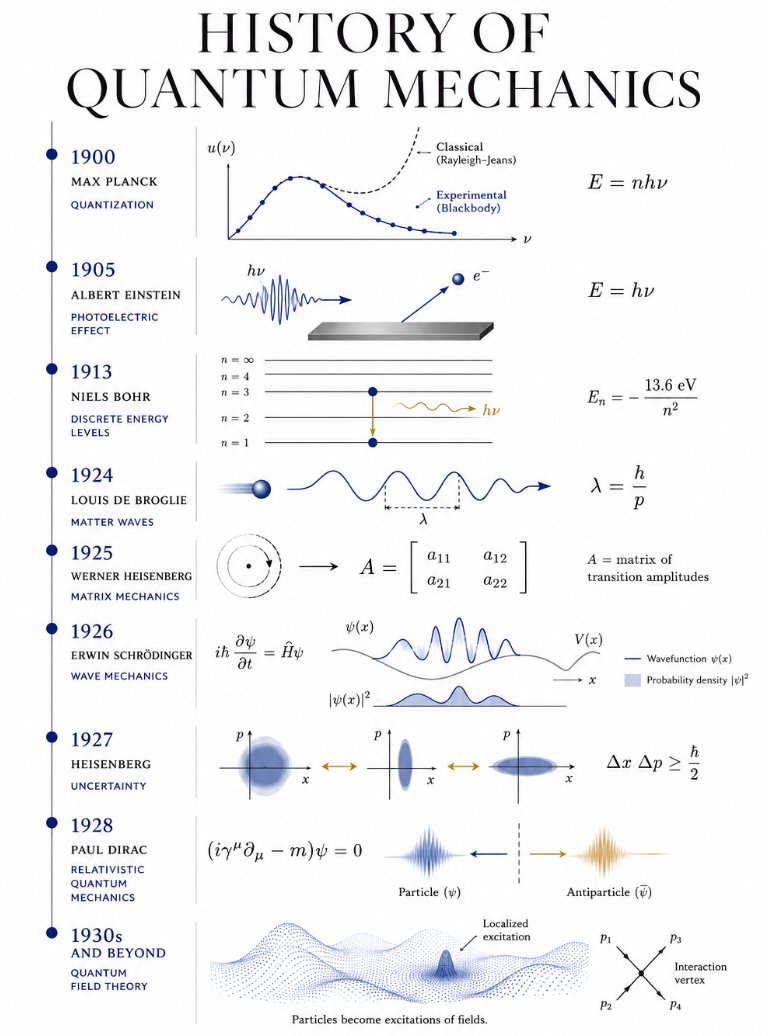
What began as an attempt to explain blackbody radiation went on to completely reshape our understanding of matter, light, measurement, and reality.
A century of quantum mechanics:
معادلة صُممت لوصف الكون بأكمله.. لكنها ألغت وجود الزمن تماماً!
عند محاولة دمج النسبية العامة مع ميكانيكا الكم في معادلة ويلر-ديويت، كانت المفاجأة أن متغير الزمن لا يظهر فيها مطلقاً. الكون في أصله الكلي يعتبر ثابتاً.
#الفيزياء_الحديثة#ميكانيكا_الكم#النسبية_العامة#العلوم
There is an equation meant to describe the entire universe. It has no time in it at all.
It is the Wheeler-DeWitt equation, written in 1967, an attempt to fuse Einstein's gravity with quantum mechanics into a single line: a wave function for the whole cosmos.
Every other great equation runs on time. Schrödinger's tells you how a particle shifts from one instant to the next. Newton, Maxwell, all of them are built around a clock ticking forward.
Wheeler-DeWitt has no clock. Written out, it says one operation on the universe equals zero. No t. No before, no after. The cosmos, taken as a whole, simply is.
Physicists call this the problem of time. If the deepest equation is frozen, why do we feel time passing at all? Sixty years on, there is still no agreed answer.
The idea was first sketched during a two-hour layover at a North Carolina airport.
The equation for everything says nothing moves. We are still trying to explain the clock we live inside.
Information is the resolution of uncertainty.
Claude Shannon transformed statistical mechanics into information theory. The higher the randomness, the more surprise—and information—a system yields when measured.
The backbone of modern computer science and cryptography.
“Uncertainty is everywhere—but information gives it meaning.
Shannon entropy reminds us that the more uncertain the outcome, the more information we need to understand it. 🧠📊”
@mathemetica I love how visual geometry brings algebra to life! Breaking the remaining volume into three simple blocks bridges the gap between spatial intuition and algebraic factoring perfectly.
@PhilosophyOfPhy Stunning visualization of quantum unitarity! Seeing probability density distribution evolve under Schrödinger’s equation while preserving total measure (\int \vert{}\Psi\vert{}^2 dx = 1) makes the connection between functional analysis and physical reality crystal clear.
@mathemetica A breathtaking structural breakdown of matrix taxonomy! Seeing the interplay between normal operators, spectral decomposition, and positive definiteness framed in a set-theoretic layout makes the geometric intuition behind SVD and pseudoinverses crystal clear.
Euler's formula is not a formula. An MIT professor spent a whole lecture proving it is a definition, not a discovery.
This is 18.03, Lecture 6, Arthur Mattuck. Free on MIT OpenCourseWare.
The formula is e^(iθ) = cos θ + i sin θ. Most people memorize it and move on. Mattuck refused to.
He asked one thing. What gives that the right to be called an exponential at all? An exponential has to obey one law: e^a · e^b = e^(a+b).
So he checked it. He multiplied e^(iθ₁) by e^(iθ₂), expanded the sines and cosines, and looked at what fell out.
The angle-addition identities. cos(A+B) and sin(A+B), the two formulas you were forced to memorize in school.
They were never two formulas. They are one line: e^(iθ) obeying the law of exponents.
Then the payoff. An integral that normally needs integration by parts twice and a trick, ∫ e^(-x) cos x dx, drops out in a few lines once you let the numbers go complex. Nothing is easier to integrate than an exponential.
Someone once asked him what beauty in math looks like. He pointed at the board.
Something long became something short, and lost nothing.
Visualization of the time-dependent Schrödinger equation.
A localized wave packet meets a potential barrier higher than its mean energy and separates into reflected and transmitted parts. Cyan shows the probability density |ψ(x,t)|²; violet shows Re ψ.
@PhilosophyOfPhy Fascinating representation! The emphasis on basis-invariance is crucial—it's a great reminder that physical observables remain strictly invariant under unitary transformations of the Gamma matrix representation.
@matheorems Exceptional pedagogical resource. Demystifying the geometric definitions of reciprocal functions like \sec\theta and \csc\theta alongside the standard ratio functions makes the fundamental identity structures far more palpable.
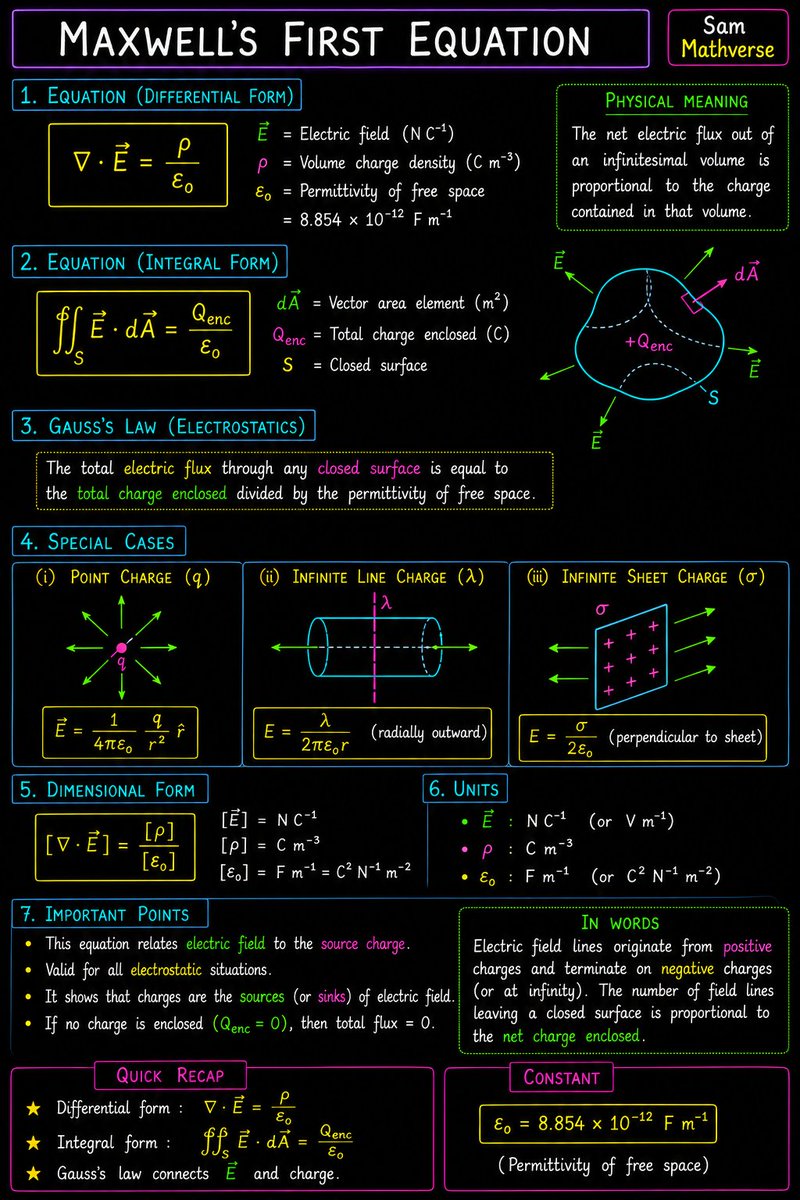
@mathemetica Great summary! The way it bridges the theoretical equation with practical engineering applications (like power lines and capacitors) makes it so easy to digest.