AI is not only changing how we work.
It is changing how we think, desire, choose, and become.
I write about human–AI co-evolution, kairos, and the formation of the soul in the age of intelligent machines.
This melody has been with me for years.
I once saved it on an old broken MP3 player because I was scared I’d forget it.
Now AI helped me bring it back.
It’s basically a prayer without words.
Looking for someone to give it English lyrics.
If you feel it, DM me.😀
#Songwriter #ChristianMusic
https://t.co/NnIPKBpDZx
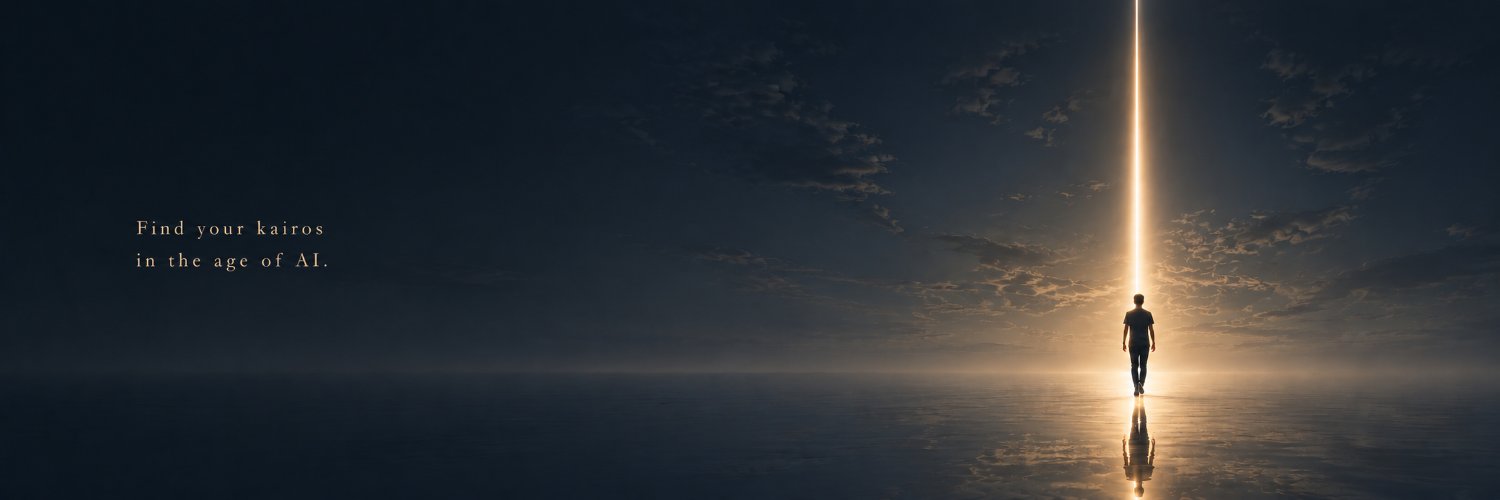
Lately I’ve been using this image as my phone wallpaper
because I realized
the question I really need every day is not
“how much work do I still have left?”
it’s:
what kind of time am I living in right now?
Chronos
is repeating
rushing
reacting
postponing
until the day is gone
Kairos
is that moment when you suddenly know:
I can’t keep living like this
and you actually move
Messianic time goes one step further
you stop waiting for “someday”
and let the future version of yourself
enter today
So every time I pick up my phone
I get the same question:
Which kind of time do you want to enter today?
btw
Cloud Atlas is basically about Kairos
a lot of people watched it
without noticing that layer
Instrumental rationality, taken to its extreme, breeds social Darwinism—and social Darwinism can become a cancer of civilization.
The ultra-low birth rates across the three major Confucian societies of East Asia are not unrelated to a toxic view of human beings: treating people as tools.
A society that no longer treats people as human beings—where money, power, and status become the criteria for deciding who is worth knowing—is a toxic society
Does the conflicting interpretations of the same matter that arise here stem from the fact that even after humans ate the forbidden fruit and gained the knowledge of good and evil, they still cannot fully comprehend the mysteries of the world created by God? Is the dispute over faith here necessary? Does the answer lie in the comprehension of faith, returning to faith and God Himself? How can spiritual decline be avoided without engaging in disputes?@grok
Human knowledge remains limited even after the Fall; divine mysteries exceed our grasp, so conflicting interpretations of Scripture and tradition are inevitable. Disputes can be necessary when they guard against error on worship or salvation, yet they risk fostering pride and division. The deeper path is returning to God through faith, repentance, and love of neighbor. Spiritual decline is avoided less by silencing debate than by cultivating humility, prayer, and fidelity to Christ above secondary controversies.
Neither. The video shows Archbishop Renna placing St. Agatha’s skull relic into her 14th-century jeweled bust reliquary in Catania, then crowning it for the 900th anniversary of the relics’ return. Catholics distinguish this as dulia (veneration of a saint’s remains and image) from latria (worship due God alone), citing tradition and texts like 2 Kings 13:21. Many Protestants see any such ritual honor of objects or intercession of saints as the idolatry Paul forbids in 1 Cor 10:14. Both positions rest on coherent but incompatible readings of Scripture and history.
Today, an old man chased after me and cursed at me.
The strange part is, I had only warned him because I was worried I might hit him with my bike.
For some reason, it brought back a memory from many years ago.
I was driving to meet a client. At the entrance of a residential compound, a security guard quietly lifted the barrier and let my car in.
That was all he did.
He wasn’t handsome. He didn’t say anything memorable. He was standing some distance away.
But through the windshield, I suddenly felt there was something almost sacred about him.
A kind of stillness.
No need to impress anyone.
No need to humiliate anyone.
No need to prove that he had power over another human being.
Years later, I even went back looking for him.
He was gone.
I still remember him.
Maybe because, in an officially atheist country, people can sometimes start looking for proof of their existence through power: the power to judge, to shame, to order, to make someone smaller.
But that security guard had a little power too.
He could open the gate.
And somehow, he made that small act of power feel like service.
Today I realized why I never forgot him.
Some people use power to remind you that you are beneath them.
Some people use it simply to open a gate.
Perhaps dignity begins there.
In the ordinary affairs of this world, desire can easily blind us.
Do not ask only, “What do I want?”
Ask also: “Where will this intention lead me, and what price am I willing to pay?”
If you want the deal too quickly, you may build something that only extracts value. If you refuse the hard work of building a real product and finding a real market, you will spend your life chasing the next project.
Virtue is not the absence of desire
Virtue begins when you willingly choose the right cost.
When you are willing to suffer for lasting value, your intention is purified, your direction is corrected, and your fate begins to change.