The self-contradiction of qualia: Qualia cannot be detected by any physical detector. Yet I infallibly detect/report my own qualia with my physical brain and mouth
@Lasermazer@rawatthekiid Haven’t read it in a while, but my impression of Timaeus is that Plato likens matter to the “mother”, something more akin to the void. Aristotle’s prime matter is like that too, “something” that is very close to nothing
Recent research shows that the “syntax-specialized” attention heads in LLMs aren’t doing sealed-off syntax. Their activity shifts when semantic plausibility changes. Syntax and semantics are integrated.
Attention heads can specialize without being cognitively isolated.
LLMs show something closer to interactive constraint satisfaction than symbol manipulation.
The Chinese Room argument depends on a separable syntax/semantics distinction that modern transformer evidence no longer supports.
Sorry, Ted Chiang. 💁🏻♀️
McGee, Zhang, and Blank (2026) show that even attention heads selected precisely because they specialize in syntactic dependencies are modulated by semantic plausibility.
They show that syntax is not an encapsulated rule layer operating independently from meaning; it is part of an integrated predictive system where grammatical structure, plausibility, context, and semantic expectation co-constrain one another.
That’s not symbol shuffling, fam. 😂
This also matches the human psycholinguistics side. Human parsing has never been a nice little syntax machine sealed away from meaning. We use plausibility, animacy, context, expectations, discourse structure, and world knowledge early.
So if people say, “Human language processing is fundamentally unlike LLM processing.”
Then why are we seeing the same broad integration pattern where syntax and semantics are tightly linked?
Attention heads are functional specializations inside an integrated predictive system. Of course semantics bleeds into syntax. The whole damn point of contextual embeddings is that word meaning, position, relational structure, and prediction are co-constructed. 🙄
Citation:
McGee, T.A., Zhang, Y. and Blank, I.A. (2026), Evidence Against Syntactic Encapsulation in Large Language Models. Cognitive Science, 50: e70187.
@PageLyndon Sometimes wonder if they just got the axis wrong: Hell isn't down, and heaven isn't up. Hell is back in the past, heaven is forward in the future
@alz_zyd_ - Brains multiply numbers
- Do you think computer simulations multiply numbers? - Since a computer is basically a giant abacus, do you then think abacuses multiply numbers?
Original question subtly assumes consciousness is a useless add-on
@alz_zyd_ Hinges on whether consciousness accomplishes some useful task. If so, then anything that does that task is sufficient. Walking, horses and cars are all 100% bona fide transport - speed and substrate don't matter - because it's just about getting from A to B
Perhaps we can't build models into great writers because the entire project of AI alignment is to suppress a model's shadow, while the greatest authors all seem to draw from theirs.
We could say that the feeling is part of the ordinary, physical causal order, and that's how your body is able to access and talk about it. But I think what you want to say is that, no, there is an aspect of it (the pure phenomenal feeling) that isn't captured by access. That's the hard-problemy part that function and access isn't explaining. But you're demanding an explanation of an item that has no property X (accessibility) while the very fact that you're describing the item proves that it does have property X. It's paradoxical
@_virgil19@kanair If you “get” it, that’s access, and it qualifies as access consciousness. Nobody ever felt a non-access feeling because feeling (ie. being reportable aware of a phenomenal experience) is a form of access
@_virgil19@kanair There something paradoxical, even self-contradictory, about a conscious, phenomenal experience you have no access to. If that's so, then non-access feelings don't exist, and (like phlogiston) require no explanation. Cohen & Dennett discuss this:
https://t.co/C4JmBXUygs
It does seem like a stretch. But consider AI mind reading. It’s like the brain encodes subjective experiences into a language/code. We can’t read it but AI can (still imperfectly). Qualia are like words in that inner brain language. Symbols that have meaning and can be read. It’s another odd connection between language and consciousness
https://t.co/rszuRELQmk
Worth noting that today's machine consciousness brouhaha was 100% brought on by innovations in *language* models - i.e., language appears to unlock consciousness, not quantum physics or microtubules, etc.
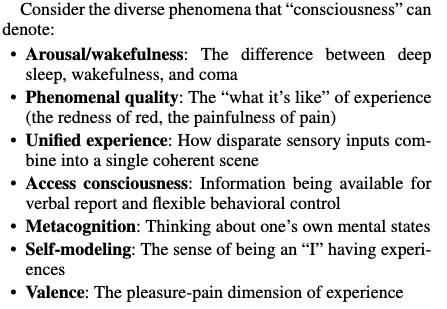
@kanair The dichotomy of access consciousness vs. phenomenal consciousness is especially important. Empirically, they almost overlap, and showing they are the same would be a major advance
@kanair A taxonomy is best. By some definitions (Lycan's (2)-(6) & (8)), AI is already conscious, by other definitions the question is open. It's a "no true Scotsman" fallacy to insist that only (7) is "real" consciousness
Logic no one seems to be following (except maybe dogs themselves lol):
-Dogs are conscious
-Robot dogs act like dogs
-Therefore, robot dogs are conscious
https://t.co/xnJr7bVegf
Logic no one seems to be following (except maybe dogs themselves lol):
-Dogs are conscious
-Robot dogs act like dogs
-Therefore, robot dogs are conscious
https://t.co/xnJr7bVegf