Громадо, побачив відео, де військового не пускали в Барбарис в Кременчуці і вирішив, що маю час на написання треду про демократичні цінності, маніпуляції та крафтове пиво, а точніше, чому я більше ні ногою в Porter beer. Події відбуваються в м. Кременчук, сьогодення.
🇺🇦🚢 The fifth Antarctic season of the Ukrainian research ice class vessel Noosfera has officially come to an end.
On 28 May 2026, the vessel returned to Cape Town, South Africa, after completing its most ambitious season yet — and setting multiple records along the way.
🔹 More than 7 months at sea
🔹 9 Antarctic voyages completed
🔹 18 crossings of the legendary Drake Passage
🔹 Over 30,000 nautical miles traveled — farther than the Earth’s equator
This season also marked a historic milestone for Ukraine’s Antarctic research: Noosfera crossed the Polar Circle twice to conduct scientific work in Marguerite Bay, expanding Ukraine’s research area farther south than ever before.
On board, Ukrainian scientists together with international colleagues studied the impact of climate change on the Southern Ocean — from marine heatwaves and geological history to changes in marine ecosystems and microbial loop interactions.
The season became a record-breaker for international cooperation as well. Ukraine collaborated with Poland, Czechia, the UK, the USA, Canada, Colombia, and Mexico. In particular, Noosfera and Vernadsky base hosted the First Mexican Antarctic Expedition, strengthening scientific ties between our countries.
The vessel also traditionally carried out the crew rotation for the 30th and 31st Ukrainian Antarctic Expeditions and transported seasonal teams to and from Vernadsky station.
This demanding mission was accomplished by a team of Ukrainian sailors led by captains Pavlo Panasiuk and Andrii Starish, skillfully navigating storms and iceberg-filled waters.
“Noosfera has become not only a symbol of Ukraine’s openness to new international partnerships, but also a place where global science is developed together to protect the fragile ecosystems of our planet,” said Evhen Dykyi, Director of the National Antarctic Scientific Center.
What a season. ❄️🌎
🌕 A beautiful and rather rare sight above Antarctica — a full Moon over the Vernadsky Research Base.
Cloudy skies usually hide the Moon near the station almost the whole year, and during the Antarctic summer it’s almost constantly daylight, so even stars are hard to see. But when the full lunar disk appears, it feels truly magical 😍
The Moon looks especially bright here because Antarctica’s atmosphere is incredibly clean and transparent. With almost no dust, smoke, or light pollution, the sky becomes crystal clear.
During a full Moon, the snow and ice reflect so much light that the Antarctic landscape looks almost like daytime — you can even walk outside without a flashlight ❄️
And there’s another fascinating detail: in Antarctica, polar explorers see the Moon “upside down” compared to how we see it in Ukraine 🌍
Video: Oleksandr Matsibura
Watch a humpback whale 🐋 flipper slapping.
Scientists most often associate this behaviour with communication. The slap creates not only a splash but also a powerful sound 🔊 that travels well underwater.
Thanks to this, whales ‘send a signal’ to other individuals — even if they are out of sight. This may be a way to signal their presence, attract attention, or interact within a group 🤝
At the same time, there are other explanations. For example, some researchers suggest that such movements help whales regulate their body temperature 🌡: when the flippers rise above the water, they can partially cool down. However, this hypothesis has less evidence to support it and is not considered the main one.
To be honest, it looks a bit as if the humpback is learning to swim the backstroke 🤭
Video: Zoya Shvydka
Here's a Valentine's Day card from Ukrainian polar explorers straight from Antarctica 🐧
This is our way of saying thanks to everyone who cooperates with us, join our events, or supports us in other ways.
A confession to our beloved Ukraine, which is so far away but always here — in our hearts.
A confession to our loved ones, whom we miss incredibly, but know that they are close to us despite the distance.
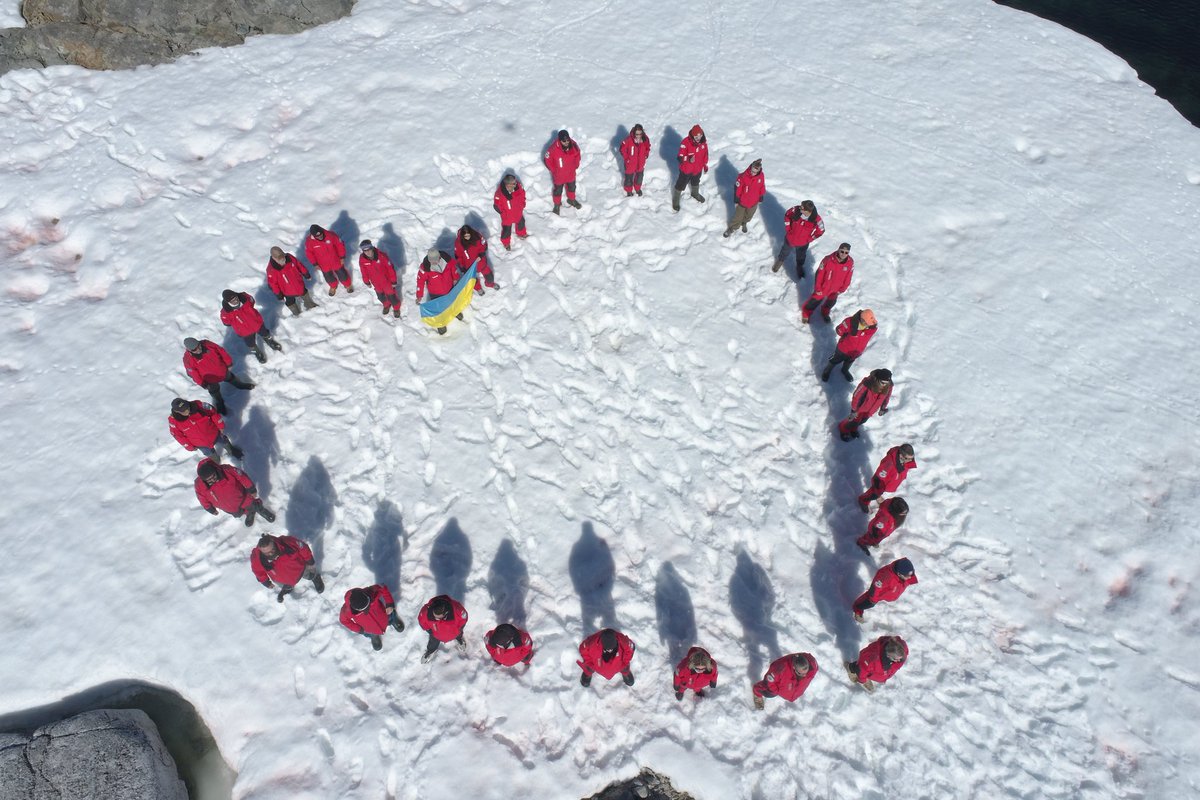
A confession to our soldiers, thanks to whom we can proudly hold the Ukrainian flag at the edge of the world.
Photo: Yury Shepeta
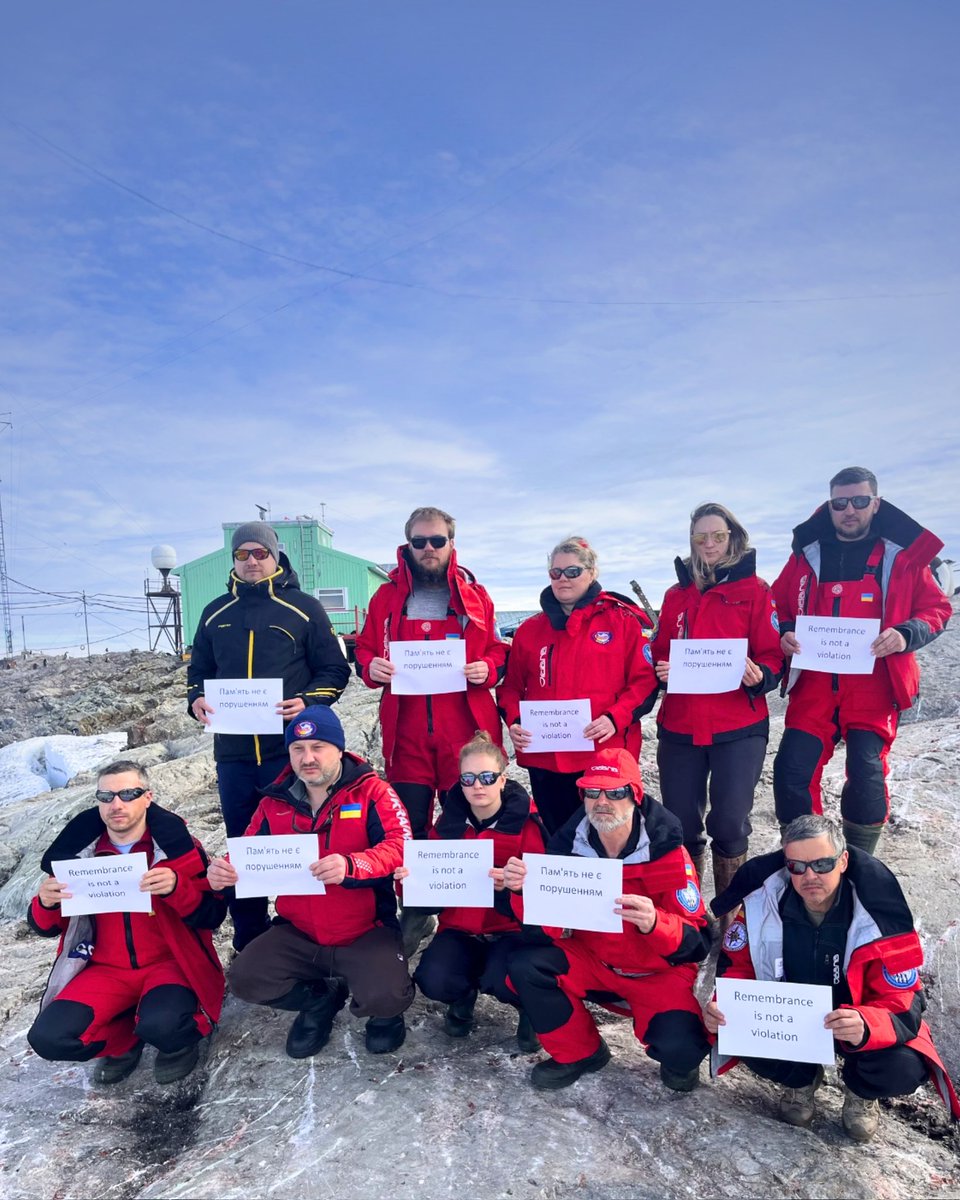
Polar explorers supported skeleton racer Vladyslav Heraskevych from the most remote corners of Ukraine — the Vernadsky station and aboard the Noosfera 🚢🇦🇶
They displayed a sticker with the now well-known slogan "Remembrance is not a violation".
"We must remember those whose plans and dreams were destroyed by Russian aggression. Athletes who will never compete for medals again. Scientists who will never participate in research, including with us at Vernadsky. Artists who will never create their own masterpieces... and many, many others who will never realise their ideas," said Oleksandr Poluden, base commander of the 30th Ukrainian Antarctic Expedition.
🤍 He thanked Vladyslav Heraskevych for powerfully reminding the whole world of those we have lost: the innocent victims of war and the defenders of Ukraine.
"Vladislav, for us, you are already a champion. You have already won because you have shown the whole world what dignity looks like. There will be many sporting victories ahead — we will always cheer for you," added Oleksandr.
The entire polar community joins in these words. Thank you! And let's hold on for Ukraine's victory 🇺🇦
#RemembranceIsNotAViolation
#ПамятьНеПорушення
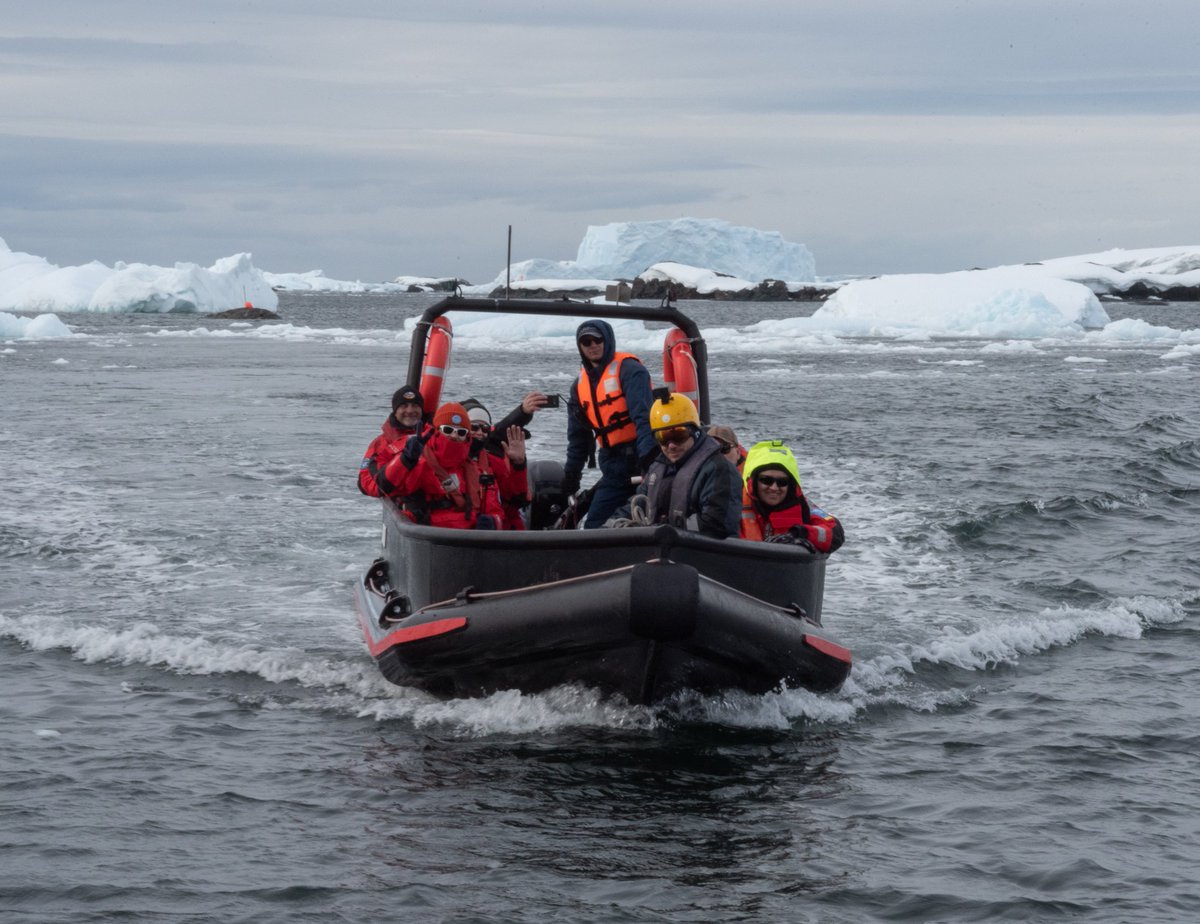
The Ukrainian r/v Noosfera arrived at the Vernadsky station. The ship delivered the crew of the Ukrainian seasonal expedition, as well as participants of the First Mexican Antarctic Expedition.
The Ukrainian seasonal expedition includes:
- technical specialists whose task is to repair the station
- scientists (biologists, geophysicists, geologists and oceanographers).
🌊 For the first time, Ukrainian oceanographers launched a multi-beam echo sounder system into the ocean to scan the seabed at depths of up to 12 km with a resolution of up to 25 cm per pixel (which is cooler than satellites!). The echo sounder can also "see" up to 500 m below the seabed.
In the coming days, it is planned to unload the vessel and commence new areas of research.
Photos: 📸 Yuriy Shepeta, Yevgen Shatalov and Rafael Lopez.
Watch an interesting footage of a crabeater seal crawling on ice, leaving a winding trail behind it.
💬 "Perhaps it was looking for a comfortable place to rest, but this is only a guess, as it is not known for certain what motivates the seals to make long journeys across the ice. From a drone, you can often see their long, tangled tracks on the ice. Once, one made such tracks on a section about 700 metres long!" said Zoya Shvydka, the biologist of the 30th Ukrainian Antarctic expedition and the author of the video.
Imagine, scientists have determined that the speed of the seal on ice can reach 19-26 km/h (over short distances in cool weather).
🧊 In general, the life of seals is very closely connected with ice, as they are ice lovers. They rest, give birth and feed their youth on it. They can be found on ice floes either alone or in huge groups of several dozen or hundreds of animals.
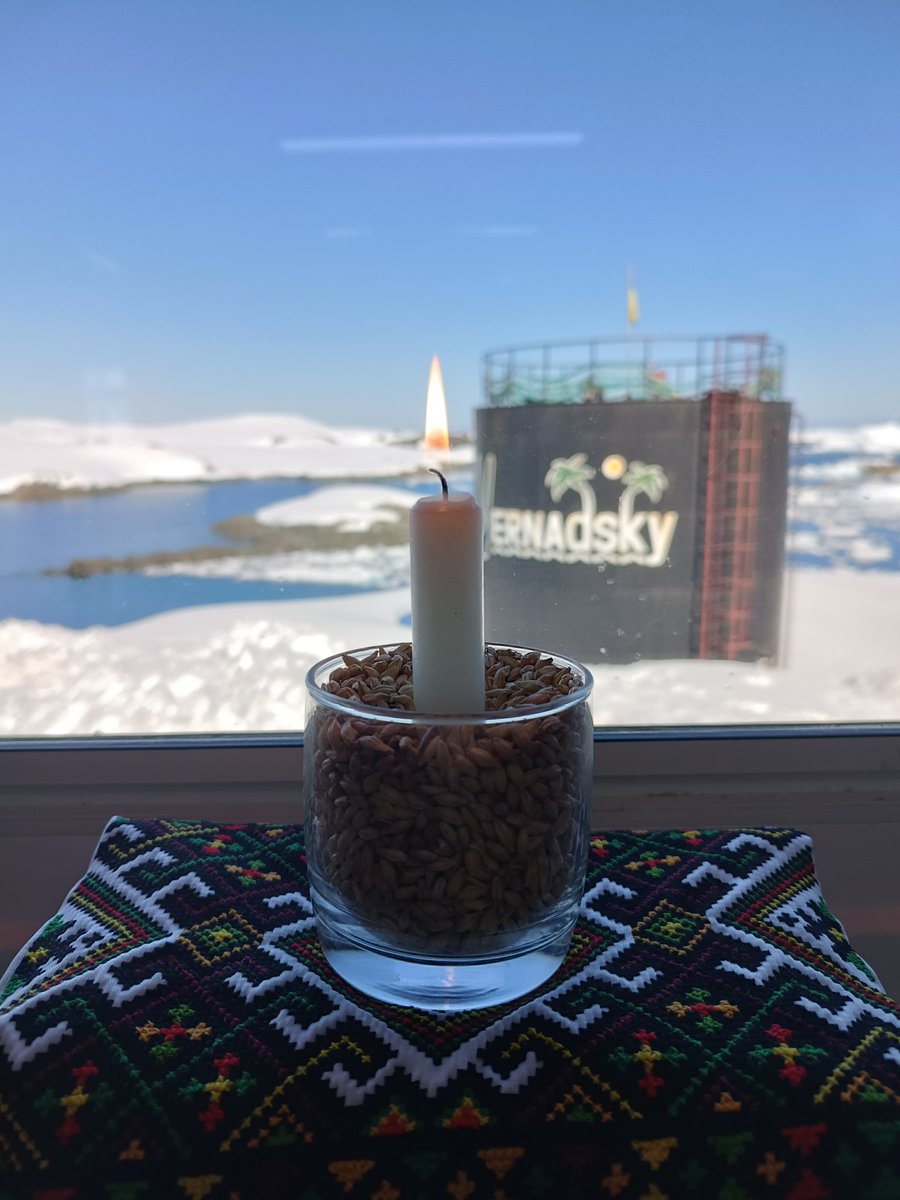
🕯 Vernadsky Station, 4 p.m. Kyiv time.
Ukrainian polar explorers also lit a candle of remembrance to honour the millions of victims of the famine (Holodomor) genocide of 1932-1933 and the mass artificial famines of 1921-1923 and 1946-1947.
This is our flame of mourning for all those who were tortured by starvation.
This is our flame of remembrance, reminding us of what we are fighting for today.
May it always burn in every window where there are Ukrainians.
📷 Oleksandr Poluden
Look at the interesting iceberg our polar explorers encountered during their sea voyage. It looks like a sculpture before a presentation — covered with a white sheet 🗽
How did such beauty come about? In fact, there are no special patterns here, only natural randomness. But two things can be noted.
🧊 Since cracks in glaciers are mostly vertical, this contributes to the formation of such elongated rectangular shapes with jagged edges.
🧊 Sea waves also make their architectural contribution, thinning the iceberg and gradually chipping pieces off it.
This is how the sculptural workshop of Antarctic nature works 😍
Photo: Zoya Shvydka