We open-sourced LivLiv Player, a 2.5D web character player, ~34 KB gzipped, with lip sync and webcam face tracking. Easy to embed in your site or app.
We also open-sourced our 21 featured characters, carefully made with @livliv_ai , are ready to use.
https://t.co/wdB2VMIA6V
@VictorKay97@livliv_ai The player never asks on load: the camera only starts when the page calls startFaceTracking, usually from a button.
Without it, the character still blinks, breathes and follows the pointer, so saying no costs little.
No built-in pre-prompt UI yet, though. Good idea.
@embergall_@livliv_ai https://t.co/rhQ4G9RvTp
try the demo
VRM 0.x and 1.0 load. A Blender export should work, but we haven't tested one yet, so tell us if it breaks.
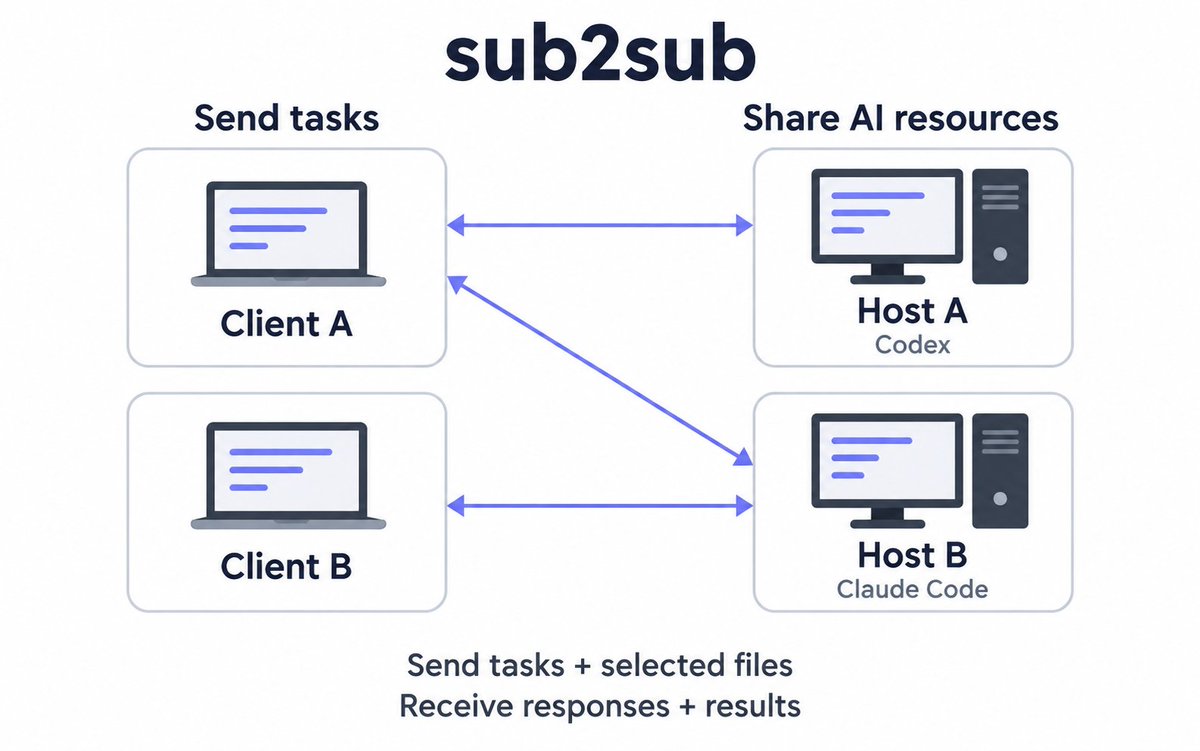
Just found an interesting open-source tool called sub2sub. It's made by one of my friend Meko.
It’s not really about remote desktop.
It solves a more interesting problem:
What if you have multiple computers, multiple Claude Code / Codex instances, different models, and different environments — and want them to work together?
For example:
Your Windows PC is running Codex and handling the main project.
But a specific task is better suited for Claude Code, which is already configured on your Mac.
Normally:
Copy the code → switch machines → run the other agent → move the result back.
With sub2sub, you can turn the AI agent on another machine into a remote worker:
Codex → sub2sub → Claude Code on another machine → execute → return the result
And you can continue the conversation from the original agent.
Some interesting use cases:
• One machine handles the main project, another handles refactoring
• Run Claude Code on Mac and Codex on Windows
• Route different tasks to different AI models
• Reuse different development environments across machines
• Run multiple AI coding agents in parallel
• Build a “virtual dev team” as a solo founder / OPC
What I find interesting isn't the remote execution itself.
It’s this:
An AI agent no longer has to equal one computer.
Codex can be the manager.
Claude Code can be a worker.
Another machine can host another worker.
And suddenly:
One person + multiple machines + multiple AI agents = a small AI team.
This is exactly the kind of infrastructure that could make the solo-founder / OPC model much more powerful.