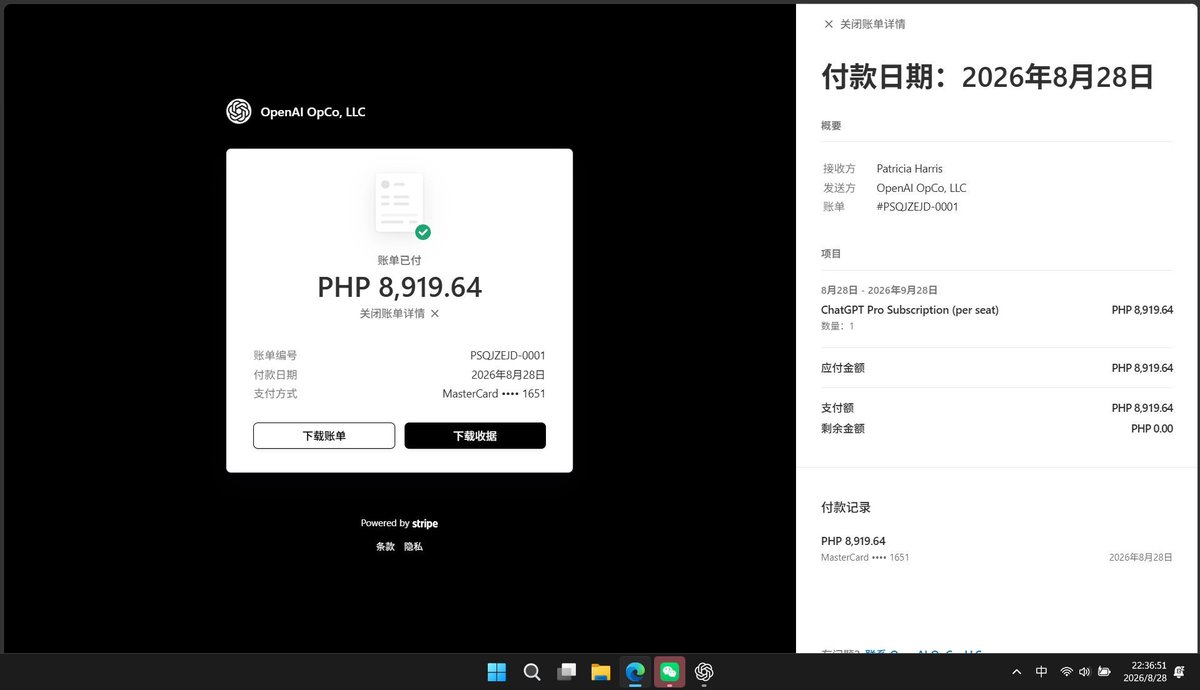
@thsottiaux Why was I banned today after topping up my Pro20X account yesterday? I spent over a thousand yuan, I'm very upset, and I'm planning to switch to Claude.This is my email address: [email protected]
@thsottiaux Why was I banned today after topping up my Pro20X account yesterday? I spent over a thousand yuan, I'm very upset, and I'm planning to switch to Claude.This is my email address: [email protected]
@thsottiaux Why was I banned today after topping up my Pro20X account yesterday? I spent over a thousand yuan, I'm very upset, and I'm planning to switch to Claude.This is my email address: [email protected]
@thsottiaux Why is it that with my Plus plan—which started with 100% of the quota—sending a single "hi" caused a 27% drop? It’s very strange; this issue hasn't been fixed since the reset last week.
推荐一个接码平台:SMS Pool
如果你���像我一样,喜欢用未接码GPT半成品号,那么这家将会是一个很不错的选择,因为它有如下优点:
①实卡号码,接码准确率高
②特别适合用来接GPT,价格便宜,部分国家哪怕是到WhatsApp验证码也能接收
③充值很方便,支持信用卡/借记卡/支付宝/加密货币(推荐用加密货币,不限制最低充值金额)
④号码保留六天,期间不限制任意收取验证码
平台地址:https://t.co/nJq42vwOHQ
Here is a recommended SMS verification service: SMS Pool.
If, like me, you prefer using "semi-finished" ChatGPT accounts (accounts created via SMS verification services), this provider is an excellent choice for the following reasons:
① Uses real SIM card numbers, ensuring high success rates for receiving codes.
② Ideally suited for ChatGPT verification and very affordable; for some countries, it can even receive verification codes for services like WhatsApp.
③ Convenient top-up options, supporting credit/debit cards, Alipay, and cryptocurrency (cryptocurrency is recommended as there is no minimum deposit requirement).
④ The number is reserved for six days, during which there are no limits on receiving verification codes.
Platform URL:https://t.co/nJq42vwOHQ
Why I switched from Claude to GPT-5.6 Sol — and what I genuinely love about it
For the past few months I’ve been a heavy Claude user, especially the Fable series. It was excellent for long-form writing, deep reasoning, and careful code review. But recently I kept hitting the same frustrations: quotas disappearing way too fast, sudden refusals or overly cautious responses, and agentic workflows that would drift or give up halfway through complex tasks.
Then I decided to seriously try GPT-5.6 Sol, especially through Codex.
The first thing that hit me is how much it feels like working with a real engineer who actually finishes the job, rather than just a smart chatbot.
In coding tasks, Sol blew me away. I fed it a medium-sized project I had been iterating on with Claude for days (around 15k lines of Python involving data pipelines, API integrations, and frontend interactions). It quickly grasped the overall architecture, then went far beyond just writing code — it ran verification, wrote tests, caught edge cases, and kept refining until everything actually ran smoothly. That “get it done” tenacity is something I rarely saw before.
Token efficiency is another huge win. The same tasks often require noticeably fewer tokens while delivering equal or better results. This means I can do way more work within the same budget, or run much more ambitious agent workflows for less money. Paired with Codex, it turns “writing code” into true collaborative development.
The agentic capabilities stand out too. Ultra mode lets it coordinate multiple sub-agents in parallel for complex jobs. When I need to research, code, test, document, and deploy all at once, it stays on track and adapts strategies mid-process. For long-horizon tasks, it doesn’t lose the plot — something that used to break my flow constantly.
Another practical advantage: far fewer unnecessary refusals and guardrails. Claude would sometimes block or over-complicate boundary cases, while Sol is much more willing to solve the actual problem (while staying safe, of course). That “usability” boost has a massive impact on daily productivity.
I’ve also been impressed with its strengths in knowledge work, design judgment, and scientific tasks. It helped me analyze bioinformatics workflows and generate clean frontend prototypes — outputs were high-quality, well-structured, and immediately usable.
Of course it’s not perfect. In extremely long contexts I still need to guide it occasionally, and sub-agent configuration could be smoother. But overall, the experience was strong enough that I’ve made Sol + Codex my daily driver.
One more thing I really appreciate is the transparency and responsiveness from the OpenAI team. Tibo regularly replies to feedback on X, explains changes, and even resets limits when needed. That direct communication makes me feel heard and more willing to invest deeply in the platform.
Here’s why I switched and why I love GPT-5.6 Sol:
It actually completes complex coding and agent tasks instead of leaving half-finished work.
Outstanding token efficiency and better performance per dollar.
Fewer refusals and higher real-world usability.
Seamless integration with Codex for a polished workflow.
Much more stable on long-horizon, multi-step projects.
A team that listens and communicates openly.
If you’re on the fence or coming from another model, I strongly recommend jumping in and building something real with it. Theory is one thing — running a full project is where the difference becomes obvious.
Huge thanks to Tibo and the OpenAI team for shipping this model and running this campaign so more people can experience it.@thsottiaux
Or… what if we gave you $100 in Codex credits if you tell us what you love about GPT-5.6 Sol or why you switched?
Tweet it, claim your gift, enjoy more usage. First 10k get the free tokens!
https://t.co/8mU93eA13i