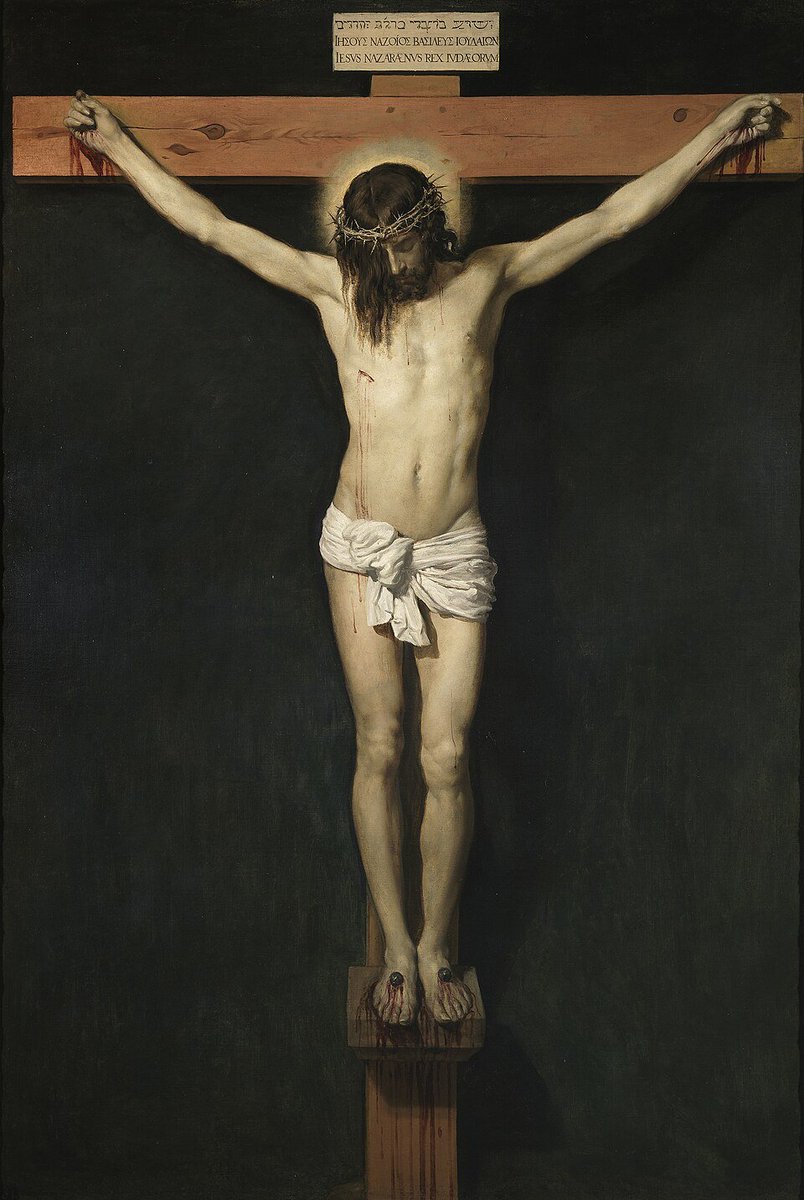
You can't see His face.
Velázquez let the hair fall over half of it. Head dropped onto the chest, one lock hanging straight down the right side, and the blood from the wound tracing the same line the hair takes.
That's the most famous religious painting in Spain. Life-size. Painted in 1632 for a convent of nuns in Madrid. And the painter of kings, the man who could render lace and silk and the sheen on a horse, hid the face of God behind hair and darkness.
Look at what else isn't there.
No thieves. No soldiers. No Mary. No John. No dice. No hill. No sky. Just a body on a cross and black behind it.
Matthew 27:45. Now from the sixth hour there was darkness over all the land unto the ninth hour.
Velázquez painted the darkness. He set the whole crucifixion inside the three hours God turned the lights off and removed every witness. It's you and Him and nothing else.
And He's already dead.
Arms gone rigid. Skin gone pale. The wound in His side is open, the spear wound, which John says was made after He died. This isn't the agony. This is the minute after. The work is complete, and the body hangs there like a signed document.
Now look at His feet.
They're side by side. Two nails, one in each foot, resting flat on a small wooden ledge. Four nails in total, not three.
Almost every crucifix you've ever seen crosses the feet and drives one nail through both. Velázquez's teacher and father-in-law, Francisco Pacheco, spent pages of his treatise on painting arguing that was wrong, that the Lord was fixed with four nails, feet apart, standing on a support. Velázquez did what the old man taught him.
And the result is a Christ who isn't hanging. He's standing. Legs straight. Whole.
John 19:33. But when they came to Jesus, and saw that he was dead already, they brake not his legs.
Exodus 12:46, the law of the Passover lamb: neither shall ye break a bone thereof.
Psalm 34:20. He keepeth all his bones: not one of them is broken.
The soldiers shattered the shins of the men on either side to finish them. They got to Jesus, and He was already gone. Fifteen centuries of Passover law kept in a Roman afternoon by accident. Velázquez painted the intact legs, so you'd see it.
Now the sign above His head.
John 19:19–20. Pilate wrote a title, and put it on the cross. And it was written in Hebrew, and Greek, and Latin.
Velázquez painted it in all three scripts. He didn't know Hebrew or Greek; the Prado has noted the small mistakes in his transcription, so picture him copying the letters one by one, the way a man copies a word he can't read, to get the title of Christ right. The languages of religion, philosophy, and empire, all forced to announce the same thing. Pilate's only defiance: What I have written I have written.
Now His head.
John 19:30. When Jesus therefore had received the vinegar, he said, It is finished: and he bowed his head, and gave up the ghost.
Read the order. He bowed His head, then He died. Not the other way around. The head didn't fall because He was dead. He laid it down first, deliberately, and then released His spirit.
And the Greek word for bowed is klinō.
You've heard that word before, in one of the saddest sentences Jesus ever said. Matthew 8:20. The foxes have holes, and the birds of the air have nests; but the Son of man hath not where to lay his head.
Same word. Klinō.
Thirty-three years without a place to lay His head. He found one. It was the cross.
That's the head in Velázquez's painting. Not collapsed. Laid down. Rested on the only pillow this world ever offered Him.
And the hair.
Isaiah 53:3. He is despised and rejected of men; a man of sorrows, and acquainted with grief: and we hid as it were our faces from him.
We hid our faces from Him. And in this painting, His face is hidden from us. The one veil left in the picture is His own hair, falling exactly where the blood runs.
At the moment He died, the veil in the temple tore from top to bottom - the curtain that had kept every human face out of the presence of God for a thousand years. Velázquez painted the moment just after. The great veil is torn. And He's given us one small one to look through.
Spain's most famous skeptic, the philosopher Unamuno, couldn't get over this painting. A man who wrestled with doubt his whole life sat in front of it and wrote a book-length poem to it, line after line, trying to talk to the face he couldn't see.
Now here's why it's so still.
Every other crucifixion painting wants to make you feel something. This one wants to show you something is finished.
Tetelestai, it is finished, was the word merchants wrote on a bill when it was paid in full. That's what Velázquez painted. Not a man dying. A receipt.
Hebrews 10:12. But this man, after he had offered one sacrifice for sins for ever, sat down.
Sat down. The work is done. There's nothing left to do, which is why there's nothing else in the picture. No crowd to impress. No Mary to comfort. No thief to argue with. No you.
You keep trying to add yourself to the painting. Your effort. Your guilt. Your promises to do better. Your years of trying to be worth what happened on that hill.
Velázquez left all of it out, because none of it belongs in the frame.
Look at it again. A body, four nails, a title, a laid-down head, and the dark.
That's the whole transaction.
It is finished.
And now... the rest of the story.
Every year, families across America gather around the television.
They watch a bald kid try to kick a football. A beagle dance on a dog house. Charlie Brown get a rock instead of candy.
They laugh.
They don't know they're watching a man's autobiography.
When Charles Schulz was a boy, the other children called him Sparky. The name of a horse in a comic strip. A joke horse.
He failed every single subject in eighth grade.
Not one or two.
Every. Single. Subject.
But the grades weren't the worst part.
Paul Harvey told this story, and his voice cracked on this line:
"Sparky wasn't actually disliked by the other youngsters. No one cared enough about him to dislike him."
He wasn't hated. He was nothing.
The one thing he had was his drawings. He submitted cartoons to the school yearbook.
Rejected.
He wrote to Walt Disney. Poured everything into the drawings.
The reply was a form letter. Disney only hired the very finest artists. Sparky was not among the very finest.
Harvey paused there. Then: "I think deep down, Sparky expected to be rejected."
This is where the motivational speakers lie to you.
The rest of the story isn't about winning.
Sparky didn't try to prove them wrong. He wrote his autobiography in cartoons.
He drew himself. The loser. The kid who failed everything.
He named him after himself.
Charlie Brown.
You know what Charlie Brown never does?
Win.
His kite crashes. Lucy pulls the football. The Little Red-Haired Girl doesn't notice him.
And sixty years later, we still watch.
Not because Charlie Brown succeeds.
Because Charlie Brown keeps showing up.
Here's the part even Paul Harvey didn't tell.
Schulz taught Sunday school. He read the Bible so constantly his strips are filled with scripture.
When network executives tried to cut Linus reciting Luke 2 from the Christmas special, Schulz refused.
Either the Gospel stays, or there's no special.
It stayed.
A boy called a horse.
A student who failed everything.
An artist Disney rejected.
Planted the Gospel of Luke in front of sixty million homes.
The loser became the messenger.
God has a history of using the rejected ones.
Moses had a stutter. David was the forgotten son. Peter denied Him three times.
The kite never flew.
But the Gospel did.
Still falling?
Good company, brother.
Get up.
He's not done with you yet.
When God moves in your life it is very rarely as movies or TV shows depict it.
It isn’t calm. It isn’t all sunshine and rainbows.
Before your blessing, before your abundance, before your peace, comes chaos. The tree will be shaken, but that is all part of the harvest.
You have to be comfortable while being uncomfortable.
You have to be shaken from complacence in order to grow.
When things get chaotic, hold fast, because that usually means you are about to level up.
It means God has a purpose for you that Satan will try his hardest to disrupt.
But God’s word is infallible. He never breaks His promises.
All you have to do is hang on, and place your faith in Him. Because in the end, He WILL deliver you.
“I’d rather die than withdraw from the process… not for the purpose of serving on the Supreme Court, but for the purpose of not being driven out of this process.” #courage