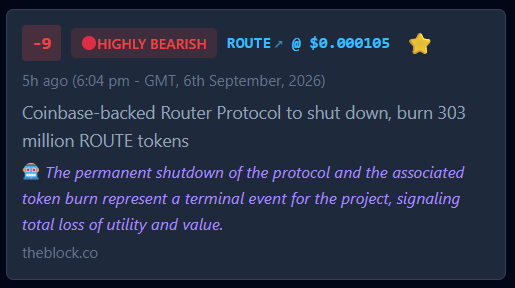
I built an AI that reads every crypto headline
and scores it −10 to +10 for market impact.
Hundreds a day. A handful matter.
It shows its reasoning on every call — and
publishes the ones it got wrong.
Free for 7 days. No card.
https://t.co/TLBgaEAzNj
The part worth understanding before you trade it: pre-market price is set by people who mostly can't deliver yet. it's a bet on a bet, and it settles against a listing price that hasn't happened.
Thin books cut both ways too. easy to get in, much harder to get out at anything near where you got in.
@CryptoZachLA "a token to make whole the people who lost money on the last token" is the oldest structure in this space. The only people it reliably makes whole are the ones who launch it.
@IvanOnTech The Liquid bit is the one worth expanding on. No keys were stolen; no one got phished. A bug let someone create L-BTC that wasn't backed by anything, and the peg-out that followed was completely valid by every check the system runs.
@Typhoonsama The yen part is the one that matters for crypto, and almost nobody connects it. When Japanese money comes home, the stuff that gets sold first is whatever's furthest out on the risk curve. That's not treasuries; that's us.
The concentration point is the one nobody else is making. $117.4M of $174.6M in one fund isn't institutional demand; it's an institution.
And it squares with the price action. $3.8B in over three weeks, and BTC still under $80k, means that bid is getting absorbed, not setting the level.
$3.8B into spot bitcoin ETFs over three weeks. BTC is at $78,700.
That's not weak demand. That's demand getting fully absorbed by supply coming the other way, which is what happens right before a level either breaks or doesn't.
Worth remembering: ETF flow headlines are usually a lagging read, not a catalyst.
$BTC
Your possible sequence has support. Reporting says the Elements fix was merged days before the incident but hadn't been released yet, so patched code was public while most nodes were still running the vulnerable version.
No official confirmation that the specific commit is the root cause, so it stays a theory. But it's the strongest one on the table.
Worth being precise about Liquid, because most takes have it wrong.
No keys were stolen. the 11-of-15 federation worked. The PAK worked. What broke was a rangeproof caching bug in Elements that let someone mint L-BTC backed by nothing, then peg it out through the normal door.
Every signature in that transaction was valid. That's the scary part, not the $320M.
$BTC
It resolved faster than the framing suggests. Mow confirmed ~3,400 of the 4,000 BTC returned, affected bridge nodes patched, roughly 588 still outstanding.
So, it lands closer to coordinated rescue than federation exploit. Worth noting the federation itself never failed; the bridge did, which is a different tail risk than the one custody critics were pricing.
$320M walked out of Liquid. The attacker sent 3,400 BTC back and kept about 600.
That's not a hack anymore; that's an invoice.
"white hat" is doing a lot of work in the headlines on this one.
depends entirely on how much of BONK's real volume sat on Upbit. That's the number that decides it, and almost nobody quotes it.
If the KRW pair was a meaningful share of daily turnover, spreads stay wider for months and every move gets exaggerated in both directions. if it was small, this is already priced and the chart barely notices by next week.
The withdrawal window running to Oct 7 is the other half. Whatever holders leave sitting there gets stranded, which quietly tightens float rather than adding sell pressure.
The Oct 7 withdrawal deadline is the part most people are skipping past.
A delist date closes a venue. a withdrawal deadline a month later is when you find out how much sits on that exchange in wallets nobody checks anymore. whatever doesn't get pulled is effectively out of circulation.
which is also why the price reaction was muted. The venue loss got priced three days ago. The size of what's stranded on Upbit hasn't been priced at all, because nobody outside Upbit knows it.
strong enough to absorb, not strong enough to lift, at least so far.
three straight weeks of billion-dollar inflows with price still under $80k tells you the bid is getting fully consumed by supply coming the other way. whales have been distributing into that $83k zone the whole time.
so the real test isn't whether inflows keep up. it's whether the selling side thins out first.
The hesitation has a source. Whales have been distributing into the $83k sell wall over the same weeks the ETFs were absorbing.
So it isn't demand failing to show up; it's demand meeting native supply on the way out. Price goes nowhere while the transfer happens.
resolves when one side runs dry. ETF flows are the slower, stickier side.
Spot BTC ETFs took in $987M last week. Third straight week. $3.8B across the three.
And year-to-date, net flows are still around negative $1B.
Three of the best weeks of the year haven't undone what came before them. That's the part nobody is posting.
$BTC