@CryptoZPunisher@YumaGroup We've just released ASMR research part 1 and 2 following Exploit feedback
If we fix the pools, good subnets can break out and alpha holders can unlock massive value, 2x in simulation
30+ pages of research to show we can solve this problem. Just feed the papers to your agent
Today we’re sharing not one but two research papers on ASMR.
Based on questions and feedback from the @ExploitSummit presentation, we developed a second paper exploring mechanisms for ASMR, to complement the foundational research we originally presented.
Part 1: ASMR Foundational Research (how it works in concept)
Part 2: ASMR Mechanism Research (how it works in practice)
These papers are research; they do not constitute a proposal. We carefully reviewed the evidence, assumptions and simulations they contain with the intention of supporting a constructive community discussion around improving Bittensor’s liquidity mechanisms and subnet price discovery.
Read a summary of key takeaways at https://t.co/oaHz8cHM9k.
Further information, key open questions for community discussion, and links to the full papers follow in this thread. $TAO
Today we're launching the Bittensor Revenue Index dashboard.
In August, we published our first Revenue Index report, based on on-chain data and interviews with numerous $TAO subnet teams reporting revenue.
Now, it's live and on-chain: every buyback and fee across all 128 subnets, updated hourly, with each transaction linked.
$4.78m so far this November.
https://t.co/X9m47xNtv7
Here are some insights from us👇
Too liquid to fail? Too liquid to break out?
Liquidity ejections → more slippage and volatility → better price discovery → greater subnet breakout potential
Excellent research on Bittensor $TAO
Today we’re sharing not one but two research papers on ASMR.
Based on questions and feedback from the @ExploitSummit presentation, we developed a second paper exploring mechanisms for ASMR, to complement the foundational research we originally presented.
Part 1: ASMR Foundational Research (how it works in concept)
Part 2: ASMR Mechanism Research (how it works in practice)
These papers are research; they do not constitute a proposal. We carefully reviewed the evidence, assumptions and simulations they contain with the intention of supporting a constructive community discussion around improving Bittensor’s liquidity mechanisms and subnet price discovery.
Read a summary of key takeaways at https://t.co/oaHz8cHM9k.
Further information, key open questions for community discussion, and links to the full papers follow in this thread. $TAO
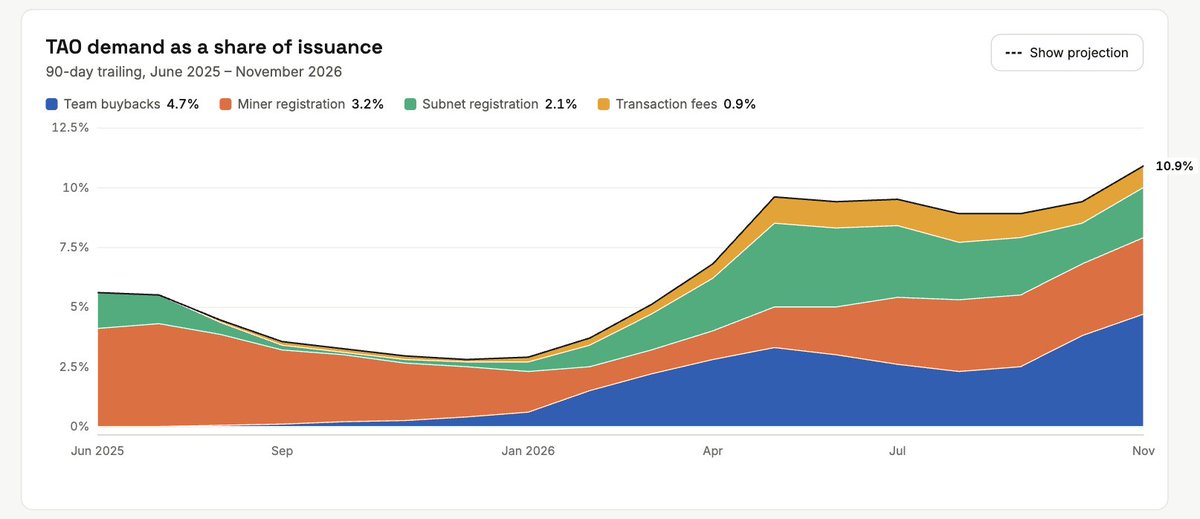
the most important chart for Bittensor imo
10.9% of TAO issuance is now being offset by demand generated through economic activity across the network
Goal is 100%, and we're moving in the right direction
i believe the first true ASI will be a market, not a model, and that market is bittensor & its subnets
openai and anthropic are heading to $2.5tn+ between them. bittensor:native is worth about $2.5bn
1000x valuation mismatch between the frontier of centralized and decentralized ai
the world will wake up soon..
1/ ASMR Research Preview
Bittensor subnets in aggregate (the YCX index) have substantially lower volatility than the S&P 500. The likely driver is large-cap subnet tokens having greater liquidity (quoted in $TAO) relative to their size than many S&P 500 index members.
Market discussions often start with the assumption that more liquidity is better. Yuma’s research, recently presented at @Exploitsummit, demonstrates how excess liquidity can suppress price discovery, obscuring quality and risk information from capital allocators. Key slides from the presentation follow in this thread.
This work is shared as research for public discussion and it explores a solution we’re calling ASMR: Alpha Subnet Market Reloaded.