Everything that matters most in life will sometimes bore you.
Your marriage will bore you.
Your career will bore you.
Your kids will bore you.
But boredom isn’t a sign that you chose wrong. It’s a signal that you have chosen to make something more important than your own momentary pleasure. It’s the hidden fee that comes with purpose and meaning.
India’s fertility rate falling below replacement rate should open a new economic conversation.
Replacement rate simply means a country is no longer having enough children to replace its population over time. India still has demographic momentum because we are a young country, but structurally this changes the long-term math of growth.
When fewer children are born, every worker matters more.
Productivity matters more.
Skills matter more.
And female workforce participation matters much more.
But this also creates a tension many developed economies have already experienced:
as women become more educated and participate more in the workforce, fertility rates often fall further.
So the real question is not:
Should women work?
That answer is obvious, economically and socially.
The real question is:
How do we make careers and family sustainable together?
The countries that managed this relatively better did not solve it through rhetoric. They built ecosystems:
childcare, flexible work, shorter commutes, family support systems,
organized care infrastructure.
For years we thought of infrastructure as roads, ports and power. In the next phase of India’s growth, childcare and care infrastructure may become equally important economic infrastructure.
Not just AI. Human participation itself may become one of the biggest growth drivers.
For over 70 years, scientists around the world chased a chemistry puzzle and kept hitting dead ends. Now, researchers from IIT Madras and IISc may have just changed the game.
Led by researchers Sundargopal Ghosh and Stutee Mohapatra from IIT Madras, in collaboration with Eluvathingal Jemmis from IISc Bengaluru, the team created the world’s first carbon-free version of a famous molecule called ferrocene, a structure so important it’s used in medicines, batteries, electronics and advanced materials.
In simple words? Imagine a molecule shaped like a sandwich. Earlier, scientists believed carbon was essential for this “sandwich”. But Indian researchers proved otherwise by creating a new molecule with osmium at the centre instead of iron, sandwiched between two boron-based rings instead of carbon rings, creating a completely carbon-free ferrocene-like version that’s strong and stable.
Why does this matter? Because it can unlock entirely new materials and technologies for the future.
#IndianScience #Innovation #ChemistryBreakthrough #IITMadras #ScienceNews
[Chemistry, Innovation India, Research, Indian
Science]
During a road trip, Sachin Tendulkar was so touched by a unique ‘desi car’ made by village children that he stopped to watch it closely.
Built using wood, iron rods, and wheels, the handmade vehicle reflected the children’s creativity, joy, and determination despite limited resources.
The video shows the kids excitedly riding and pushing their creation, proudly enjoying the fruit of their hard work.
Moved by their innovation, Sachin shared the clip on social media and wrote that real talent doesn’t wait for perfect circumstances — it finds its own way.
The heartwarming video has left people calling the children “future engineers.”
Credits : @sachin_rt
#SachinTendulkar #JugaadInnovation #ViralVideo #IndianKids #CreativeIndia
[Sachin Tendulkar Viral Video, Village Kids Innovation, Desi Jugaad Carm, Indian Creativity, Viral Social Media Video]
Original post by @TbiHindi
We spent years memorising formulas, battle dates, and the periodic table.
But nobody taught us how a salary slip works.
Or what TDS means.
Or how savings, debt, taxes, or digital payments actually shape our lives.
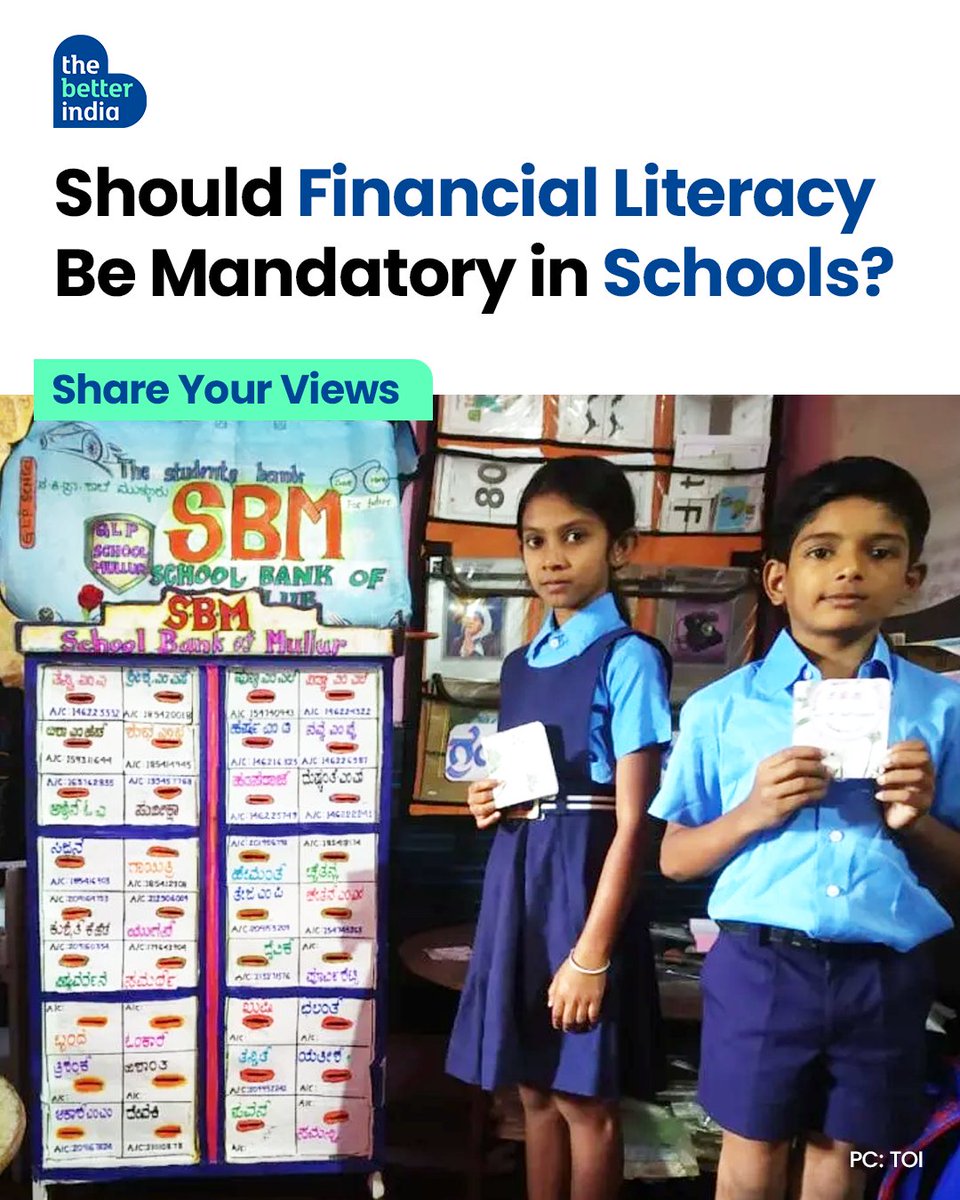
Recently, a fintech founder was shocked to see his son, a Class 1 student in Bengaluru, learning about UPI, BHIM, savings, and responsible spending through a book called “My Paiso: Money Mindfulness.”
That reaction says a lot about our education system.
Because most Indians still learn money management the hard way:
Through bad investments.
Credit card debt.
Loan traps.
Tax confusion.
Or expensive financial mistakes in their 20s.
Meanwhile, children are now being introduced to financial literacy before they even learn how to write a cheque.
And honestly — shouldn’t that have happened decades ago?
Maybe adulthood wouldn’t begin with panic and confusion.
So here’s the bigger question:
Should Financial Literacy Be Mandatory In Schools?
Or should money continue to remain something people “figure out later” after making costly mistakes?
Drop your opinion below.
#FinancialLiteracy #EducationReform #MoneyManagement
[Financial Literacy, Education System, UPI, Money Management]
Very impressive work happening at @iitmadras as it works toward creating one of the most intricate & detailed maps of the human brain to deepen our understanding of its functioning. An exciting step forward for neuroscience & biomedical research. Wonderful initiative, Kris & Sudha. https://t.co/n4mYwFdPcH
Taekwondo athlete Rupa Bayor has just made by becoming the first Indian Taekwondo athlete to achieve World Rank 6 and Asia Rank 1.
Growing up in a small village in Arunachal Pradesh, Rupa’s childhood was spent working in paddy fields under the care of her widowed mother.
Life wasn’t easy, but her uncle, a karate master, introduced her to martial arts, sparking a passion that would change her life.
Though she began with karate, Rupa soon found her true calling in Taekwondo.
By 2021, she was training at the Indo-Korean Taekwondo Academy in Mumbai, where she pushed her limits and refused to let challenges like limited funding, visa denials, or personal struggles hold her back.
In 2024, she won a bronze medal at the Asian Taekwondo Poomsae Championships in Vietnam, cementing her place as Asia’s top-ranked player.
With her sights set on the 2026 Asian Games, Rupa Bayor is not just making history — she’s inspiring young girls everywhere to dream big and break barriers.
#RupaBayor #Taekwondo #ArunachalPradesh #BreakingBarriers #WomenInSports
[Rupa Bayor, Taekwondo, World Rankings, Martial Arts, Arunachal Pradesh, Breaking Barriers, Women in Sports]
Imagine stepping onto a platform and not seeing a single scrap of trash.
At Thalassery Railway Station in Kerala, that’s exactly what’s happening. Platforms, benches, and waiting areas are spotless.
Not a wrapper, not a cup, not a stray plastic bottle. Just calm, clean spaces cared for by both staff and passengers
It’s a simple, powerful message: Cleanliness is a habit we build together, not a duty we demand.
Credits : mubeena_ch_ on IG
#Kerala #CivicSense #InspiringIndia
[Kerala Railway Station, Civic Sense, Thalassery Railway Station]