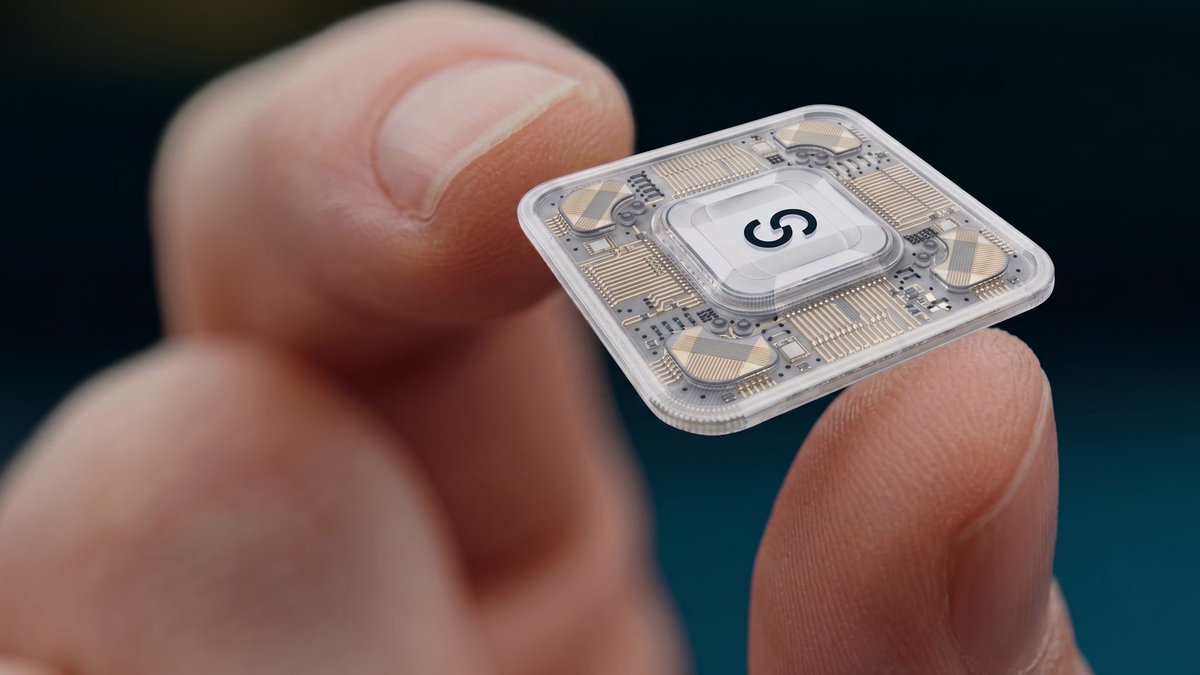
10/10
That is the part I’ll be watching.
Quantum may be shaped not only by breakthroughs in physics, but by the forces that shaped semiconductors: process engineering, supply chains, manufacturing scale, cost curves and industrial policy.
Diamond may become a much bigger story.
1/10
A post on SAXON Q this morning sent me down an interesting rabbit hole.
The important part may not be “another quantum computer.”
It may be the possibility that quantum hardware could eventually be manufactured and deployed more like conventional computing infrastructure.
THE DIAMOND COMPUTER
SAXON Q: Quantum Computing in a Diamond, at Room Temperature
Most quantum computers still live behind a lab door and a dilution refrigerator. SAXON Q, a Leipzig spin-out from Universität Leipzig, sells a different machine: a diamond-chip processor that runs at ordinary room temperature, plugs into a wall outlet, and is meant to sit in a server rack or a wheeled cabinet.
Founded in 2021 as SaxonQ GmbH and now branded SAXON Q, the company grew out of work at Leipzig University’s Felix Bloch Institute by Marius Grundmann and ion-implantation specialist Jan Meijer, with Bernd Burchard on intellectual property. Their bet is that a solid-state defect in diamond can stay usable without millikelvin cooling.
How the qubit works
The hardware uses nitrogen-vacancy (NV) centers in synthetic diamond. Implant a nitrogen atom in place of one carbon atom and leave a neighboring site empty. The electron trapped at that defect becomes a spin that lasers and microwaves can initialize, drive, and read out. The stiff carbon lattice keeps the defect working at about 293 K—no vacuum chamber, no cryostat.
The NV electron is also an interface to nearby nuclear spins: the defect’s own nitrogen-14 nucleus and carbon-13 nuclei in the lattice. Those nuclei hold quantum states far longer than the electron. In a September 2026 experiment with Fraunhofer IWU, the calculation qubits were three of those nuclear spins; the electron was only the optical port.
Control uses deterministic nitrogen implantation at roughly 3-nanometer precision, thermal annealing so vacancies pair with nitrogen, and transparent nanowiring for electrical readout. SAXON Q argues those steps can ride ordinary semiconductor process flows.
The manufacturing fix
NV centers have been studied for decades. The bottleneck was yield. Conventional implantation typically turns only 1 to 10 percent of implanted nitrogen atoms into working, negatively charged qubits—too sparse to tile a chip.
SAXON Q’s patented answer is sulfur co-implantation. Sulfur acts as a donor that helps keep NV centers in the charged state they need, and the company says conversion yield rises above 85 percent. It claims more than 220 patents and pending applications.
Reported single-qubit fidelities are 99.92 percent in product materials, with later internal figures of 99.98 percent peak and about 99.90 percent average on the Grover run. Two-qubit numbers are thinner: that experiment quoted three-qubit subspace gate fidelities averaging 95.7 percent. Independent full-stack benchmarks on the 128-qubit class machines are still scarce.
What “128 qubits” means
The SXQ128 is 128 physical NV qubits across 16 cores, with eight fully entangled qubits per core. The planned SXQ512 is 32 cores of 16 entangled qubits each. Coherent computation is still a per-core problem. A multi-core operating system is supposed to coordinate work across cores, and the boxes are modular so customers can add chips later. That is closer to a cluster of small high-quality processors than one fully connected 128-qubit register.
Products
- SXQ4 — four-qubit mobile systems delivered 2023–2025 to DLR in Ulm and Fraunhofer IWU in Dresden; reachable on-site and by cloud API.
- SXQ128 — 128 physical qubits; orders opened in 2026 with a stated three-month delivery window.
- SXQ512 — 512 physical qubits; deliveries slated for Q2 2027.
- SXQ10k — roadmap after 2030: an embeddable chip targeting 10,000-plus qubits.
1 of 2
9/10
The second-order question is not:
“Will China turn today’s synthetic-diamond factories into quantum-chip fabs?”
That is too simplistic.
The better question: does a large materials ecosystem create optionality if diamond-based electronics and quantum architectures mature?
@bcdsignature On a most fundamental level, scarcity of resources. Specifically, energy resources. At some point, the energy needed to sustain humanity will be at odds with energy needed to further the advancement of AI.