@ADLXBT The match isn't on timestamps. It's on the amount: each payout equals its order's amount, after the service's cut, to the last digit. The 52 to 106 minutes is just when the payouts landed.
Wallets on the trail of the theft linked to French bank Crédit Mutuel Arkéa put $3.65M of ETH into 44 orders to buy Monero on 4 and 5 Nov. For 19 of those orders, the same swap service made a payout 52 to 106 minutes later that fits the order to the last digit. The proceeds of 17 of those payouts, worth $1.34M when sent, ended in one Ethereum wallet.
[No Monero transaction was traced and Monero's cryptography was not broken: both ends of the match sit in public Hyperliquid records.]
1. How a Monero order became public
ZachXBT flagged the suspected theft on 2 Nov. On 3 Nov he put exchange withdrawals since 1 Nov at $133M+. On 4 Nov he named French bank Crédit Mutuel Arkéa as the alleged victim. The same day the bank confirmed fraudulent transfers from its own account and said the money may then have been converted to crypto. On 5 Nov Reuters reported the bank's figure: about €100M stolen.
The $3.65M came from three wallets on a chain of transfers, with one swap of USDC to ETH, from a theft address ZachXBT listed. The chain runs through an older wallet: 88% of what it had received by 03:21 UTC on 2 Nov came from the theft trail.
The swap service, Wagyu, fills its Monero orders on Hyperliquid, a public exchange. For each of the 44 orders it bought XMR1 there, a token it says it redeems for real Monero. Every purchase is on a public ledger: the amount to six decimals, the time to the second.
Wagyu also buys Monero back from customers. On other customers' Monero sales, its own Hyperliquid account sent out XMR1 equal to 99% or 99.5% of the Monero sold. That is public too.
2. The match
19 payouts fit one formula exactly:
XMR1 bought × 0.94 or 0.96, rounded down to 2 decimals, × 0.99 or 0.995
One order: 171.889593 XMR1 bought. × 0.94, rounded down, is 161.57. × 0.99 is 159.9543. 68 minutes after the deposit, Wagyu's account paid out exactly 159.9543 XMR1.
See it on Hyperliquid's public explorer.
The order account, with its deposit at 19:07:44 UTC on 4 Nov and its buys of 169.00 and 3.01 XMR1, which leave 171.889593 after the exchange fee:
https://t.co/4HoNKNqDSP
The payout of 159.9543 XMR1 at 20:15:53 UTC:
https://t.co/tAamceiy1D
All 19 pairs are linked in the reply below.
Our reading: the order delivered 161.57 Monero, and that Monero was sold back to the service with 1% taken off. Other customers' orders show the same kind of gap: on buys, the Monero paid was 2% to 9% below the XMR1 bought, more on bigger orders; on sales, the XMR1 sent out was 0.5% or 1% below the Monero sold.
3. The checks
The search ran from 24 minutes to 6 hours after each order. All 19 fits landed between 52 and 106 minutes.
Reversed, payout before order: 0 of 44 fit.
Same test on 319 other accounts used the same way from 3 to 6 Nov, with one deposit of $5,000 or more and the XMR1 still parked, $23.1M in all: 0 fit, forwards or reversed.
For scale, the same test on every other XMR1 balance of 25 or more, 6,865 accounts, against the service's payouts since July: 5 fit. Three of the five predate the theft. A fit on its own does not say whose order it is. The 44 are tied to the theft trail by where their ETH came from.
The proceeds of 17 of the 19 payouts, worth $1.34M when sent, ended in one Ethereum wallet. It first became active on 4 Nov, after the first order.
The same wallet took more. On 4 and 5 Nov, 26 other payouts by the service, each of 10 XMR1 or more, also led to it. With the 17, that is 43 payouts worth $3.20M when sent. None of the 26 fits any of the 44 orders under the formula, so the evidence for them is weaker. They share the service, the wallet and the dates, but another customer of the service could have theoretically used the same wallet.
We followed every payout of that size from midday on 4 Nov to 02:00 UTC on 6 Nov, 109 in all: 43 led to this wallet. We did not follow the 209 smaller payouts, so 43 is a minimum.
The XMR1 bought for the 44 orders is still parked in the order accounts, as it was on other customers' completed orders.
4. The grade
Order-payout link for the 19 fits: STRONG. Wagyu's order records may show it, or show a refund or another kind of settlement. We have not seen them. Who controls the funding wallets and the receiving wallet is unknown.
Monero was not cracked. The matches come from amounts and timing on a public exchange, at the way in and the way out.
The lesson is opsec, not cryptography: a private chain can still be given away at its edges.
So here is the awkward part for us.
Gone on new spends: ring counts, our merge test, the way we spotted a swap service's change.
Still there: timing across ledgers, the public chains either side of Monero, records a service or exchange keeps.
Ring data already on chain stays public.
FCMP++ runs on a test network only. Monero's main network still uses rings of 16. Credit to the people who have spent years making this job harder.
This week we traced funds from the Gnosis Safe theft to the edge of Monero, then found a pattern inside it.
Monero normally hides each spent coin in a list of 16: the real one plus 15 decoys, with nothing marking which is which.
By timing, we picked out the Monero payouts we think the stolen funds were swapped into. Then we found one transaction where 10 of the 11 lists include a coin from one of those payouts.
Chance? We ran the count 10,000 more times with random coins from the same blocks in place of ours. The most chance ever matched in one transaction was 5. Ours matched 10.
Monero is testing an upgrade that removes the list. 🧵⤵️
It is called FCMP++.
An input stops saying "my coin is one of these 16". It proves the coin sits somewhere in the tree of all spendable outputs, as it stood at a block the transaction names, and lists none of them. The test network's release notes describe the scale as "1 of the 150 million+ Monero outputs".
How: every spendable output is a leaf in a Curve Tree whose layers alternate between two curves, Selene and Helios.
A spend proves in zero knowledge that one leaf leads up to the public root. zkSecurity's review of the Generalized Bulletproofs code underneath found no high or medium issues. 🧵⤵️
@seibelj Random reuse has a measurable rate. Across 10,000 random runs, the most any transaction listed was 5. Ours list 10 and 6, each matching every send of a single account. Random decoys don't sort by customer.
We never said the money is still there. We showed where it was gathered.
Monero is built to hide who pays whom and how much. We now hold ring-based leads that carry about $4.06M of the Gnosis Safe theft onto the Monero blockchain and one transaction further.
The money went into a Monero swap service in 42 pieces. We located the Monero payout for 28 of them, and ring evidence leads all 28 into one group of 14 Monero transactions.
WHAT HAPPENED
• On 16 November, $6.43M left a Gnosis Safe in one transaction.
• Within 28 hours about 98% of it had gone into one Monero swap service, split into 42 pieces: 17 swap orders and 25 lots sent through its Monero bridge.
WHAT WE FOUND
For each of those 42 pieces, the service pays the buyer in Monero with one Monero transaction. We call that transaction the payout. Finding it is the step from the public side into Monero.
• Payouts found: 28 of the 42. That covers 23 of the 25 bridge lots and 5 of the 17 orders.
• Where they lead: ring evidence links all 28 payouts onward into one group of 14 Monero transactions. Monero bought by three of the thief's wallets meets in that group, which reads as one holder gathering the coins.
• How much that is: about 7,996 XMR ($4.06M) is linked this way.
• Candidate links: the other 12 orders, about 3,380 XMR ($1.72M), point to the same group. They match as a batch and other customers' payouts sit in the same blocks, so we count them as candidates.
WHAT RING EVIDENCE MEANS
Every Monero spend lists the real coin hidden among 15 decoys. When later transactions list the payouts we located far more often than chance allows, that pattern is the link.
WHERE IT STANDS (22:10 UTC, 17 November)
• No link from the group to a door out of Monero is seen.
• The group's open outputs are under watch.
Monero hides amounts, so each XMR figure is an estimate from the size of the lot or order.
How we did it, and what it lets us test next, is in the next post in this thread 🧵⤵️
How we linked about $4.06M of the Gnosis Safe theft on the Monero blockchain, and what that lets us test next.
A payout here is the Monero transaction in which the swap service pays the buyer. We located 28 of them.
HOW WE DID IT
1. The clock
Every lot and order shows on Hyperliquid's public ledger to the second, alongside other customers'. That narrows each payout to the first few Monero blocks after it and separates most of the other customers' payouts in the same blocks.
2. The service's own wallet
Each payout transaction has two outputs. Later rings point at them in a pattern that fits one being the buyer's coins and the other the service's change, with the change reused in the service's later payouts. That gives a chain on the service's side. For 26 of the 28 payouts the link is paired from both sides. For 2 it rests on the buyer's side alone.
3. Monero's rules
A payout output can be spent 10 blocks after it is mined at the earliest. That sets the first block in which it can move.
4. The background
One ring pointing at a payout can be a decoy, so we measured the chance rate. For the bridge lots we scored 9,634 transactions against the service-side chain. Two stand far above the rest, at 10 and 6. None of the other 9,632 scores above 2.
The later links, and the links for the 16 November orders, also draw on how the group's transactions are built and timed. We are keeping that part of the method private.
Two independent reads of the chain data agree on every ring in our tables.
WHAT THIS LETS US LOOK FOR
Knowing the group turns the search for an exit into a test.
• Inside Monero: a transaction that spends one of the group's outputs has to list that output in a ring. Each new block is read for transactions that list them, and any transaction that reaches a known door out of Monero can be checked against the outputs we hold.
• At the doors: on the far side of each public door (wrapped-Monero bridges, peer-to-peer trade records, swap services with public feeds), arrivals can be compared with the group's timing and estimated size.
The doors we can test are the ones with a public record. A ring listing can be a decoy, so a match is a lead to test.
These are ring-based leads, strongest where both sides of a payout pair up and weaker on the later links and the candidate orders.
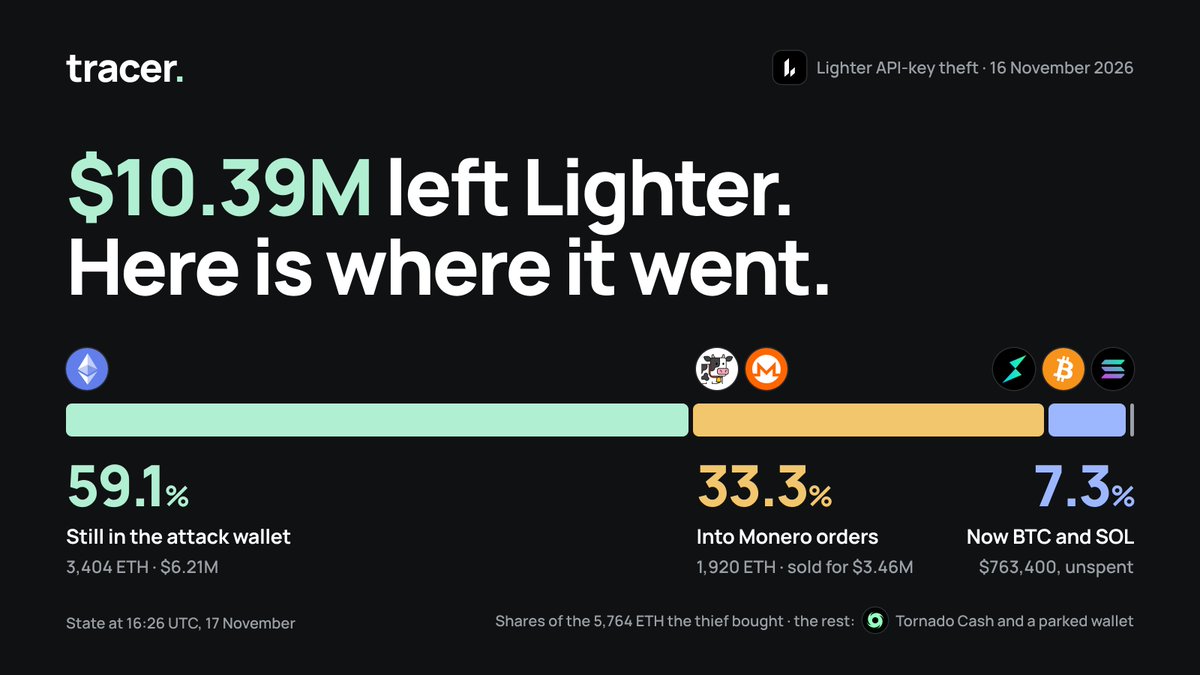
Yesterday, a hacker took $10.39M from Lighter in 37 seconds, and it cost them just $9,999 to set up. Within two hours, $3.46M of it was swapped into Monero (about 6,160 XMR), the hardest coin to trace.
Here's exactly how it was done, and where every dollar sits 30 hours later.
HOW IT WAS DONE
Lighter's post-mortem says a trader's API key was rebuilt from signatures that reused nonces. Lighter's own ledger shows the rest, minute by minute (UTC):
09:40 a pool is opened from the trader's account
09:41 the attacker buys 99.99% of that pool's shares for 9,999 USDC
09:44 a 1 USDC test pays out
09:45:01 the trader's 10,383,864 USDC is moved into the pool in 33 seconds
09:45:38 the attacker redeems its shares, four seconds later
10:11:47 10,393,056.79 USDC lands on Ethereum in 0xb3fffca23d4444eE73349825ACD84f7b5020e387
Theft tx: 0x5b6f27ded0e9a66ef6fa107083e28db9914e46d7635cc5112d760b9cb2f958c9
At 10:25 the same steps hit a second account holding $5.09M. Lighter stopped that withdrawal and recovered it.
WHERE IT WENT (state at 16:26 UTC, 17 November)
The thief swapped the USDC for 5,764.47 ETH, nearly all of it inside six minutes. Of that ETH:
59.1% is still in the attack wallet: 3,404.40 ETH ($6.21M). The wallet has sent nothing since 17:18 UTC on 16 November.
33.3% went into Monero orders: 12 orders of 160 ETH, sold for $3.46M, at a no-KYC swap service on Hyperliquid between 10:19 and 11:55 UTC. The service's own record shows 3,093 XMR paid out on six of them and counts all twelve as completed. We estimate about 6,160 XMR for the twelve.
First order: 0xdedaf598b2f9a1c91377222acc50b3b62191eb02c8d1b16f6fd36003291345e0
7.3% crossed THORChain and is now 8.907 BTC ($577,650) and 2,527 SOL ($185,750) on three fresh addresses. All unspent.
0.2% (10 ETH) was deposited into Tornado Cash, and another 0.2% sits parked in a side wallet.
Around 12:20 UTC, Wagyu shut its ETH door. The thief's last two orders bounced back as refunds at 12:35 and 12:36. Only then did they turn to Tornado Cash and THORChain.
HAS THE MONERO COME BACK OUT?
Not that we can see. Since the theft, Monero selling at the public exits we watch has run below its normal pace. If the thief were cashing out there, it would have jumped.
Meanwhile the market makers restocked more Monero than at any time in the last 47 days, which is what you'd expect after one buyer swept the shelves.
So the Monero is either still sitting inside Monero, or it left through a private desk or an exchange.
WHERE THE THIEF'S WALLET CAME FROM
That trail points to Monero too. On 12 November the likely first funding wallet was paid $15,278 for about 26 XMR. At 06:02 UTC on the day of the theft a funding wallet paid $14,920 for a Monero order. At 08:45 UTC a sale of about 21.7 XMR paid 10,525.84 USDC straight to the attack wallet.
Our read: one pot of about $15,000, cycled through Monero again and again to fund a $10.39M theft. The money went in through Monero, and it left the same way.
Indian law enforcement froze $3M from an innocent Chinese investor after mistaking a crypto bridge for a pig butchering scam. Now an Indian court has ordered Gate to hand his funds to a person they never belonged to.
My analysis of how Indian LE traced through an unlabeled service and wrongly froze @xxxkeym's Gate account:
The case stems from a pig butchering victim who allegedly lost $1.7M of BTC, USDT, DOGE & SOL in May 2025.
Andhra Pradesh CID registered it as Cr. No. 10/2025 and filed a charge sheet in March 2026.
In July 2025, xxxkeym had Gate deposit address 17mpajZ6Nq3dG3T6wUhaXxYF4Qy9HJnYx5 frozen after depositing 15 BTC from 3NcBhqK in the following transaction:
885f3afab562251b222363cf12095e864ddb94636674b01f0cdb05997e5a54a0
This is one transaction Indian LE cites in its notice. 3NcBhqK was funded by xxxkeym's own OKX & Binance withdrawals in Jan 2023 and the coins sat dormant for years until the Gate deposit.
Indian LE never froze his OKX or Binance accounts, the actual source of the 15 BTC, which tells you how flawed their justification is.
Gate froze his entire account, which held roughly $3M at the time and about $1.5M today.
The Indian court order hands all of it to the complainant.
Gate deposit address 17mpajZ also received two deposits for 15 BTC total in 2025 from bc1pkkwqyxn3rm608ryuqg9hyqna0syq4jx5pxkr7pzg8n3usx6tyqfst5u966, which is also controlled by xxxkeym.
Shortly before the deposits to Gate, bc1pkkw was funded in three transactions by bc1quzwkggdf6ly06mrrnnled0qdr57w770k45n5n7 & bc1qtu66zfqxj6pam6e0zunwnggh87f5pjr7vdr5cd.
bc1quzw & bc1qtu66z were reported as alibarbit[.]bit, the same scam named in Indian LE's press release.
That was a mistake. Both belong to the Merlin Chain bridge, which is unlabeled in most compliance tools.
xxxkeym is simply a normal Merlin user trading tokens on the L2. This wrong label is the only place the scam touches his transaction history.
Below is the blockchain data showing each Merlin withdrawal by xxxkeym matched to a BTC payout from those addresses, plus screenshots of the bridge activity.
xxxkeym bridged 50 BTC into Merlin on March 28, 2024, over a year before the alleged May 2025 theft.
His three withdrawals came out of that balance. I found zero onchain connections between xxxkeym and the theft.
Separately on July 15, 2025 xxxkeym had a 7 BTC private key compromise theft which was reported to local police and also SlowMist was engaged. His stolen funds flowed to Wasabi.
This is embarrassing incompetence by Indian LE, who seem incapable of reviewing basic blockchain data.
Indian LE, the prosecutor and the judge all signed off on this, Gate froze the account, and LE did a full press release about it recently, while the real victim here (the Gate user) hasn't had access to his funds for nearly 16 months.
My hot take is VASPs need to challenge weak jurisdictions like India, Canada, etc due to repeated negligence in criminal cases.
Merlin source transactions from xxxkeym
10.1368 BTC - March 25, 2025
0x975081c2a62355019561c3ec0d01c72bf0dadf7121d46764bbb13ac0013a9a06
4.9071 BTC - May 6, 2025
0xa30f7b770e2e8e2e2d0fc0d390aa800e7f880e8e129d1b705dbc4167fc878769
9.9796 BTC - June 17, 2025
0x147429d324520c9ebee8015b0214dbd7bdce97ee37ad25e11819f4b04aecc049
Bitcoin destination transactions to xxxkeym
10.1367 BTC - March 28, 2025
55ab5373c2daa69b1728e6551b59f9dc661d1d78786face798d5251ccbe4685a
4.907 BTC - May 9, 2025
b2222fe38856e65420f15051a4cc419a92868803dec69a218f007948972ea367
9.9795 BTC - June 19, 2025
094f01388638523fb29aac0a0d4f70adf6949fede0847a45cef2c3f930692c73
Merlin Chain bridge
bc1quzwkggdf6ly06mrrnnled0qdr57w770k45n5n7
bc1qtu66zfqxj6pam6e0zunwnggh87f5pjr7vdr5cd
Gate deposit address - xxxkeym
17mpajZ6Nq3dG3T6wUhaXxYF4Qy9HJnYx5
Other addresses - xxxkeym
3NcBhqKnyo8dfzqfG1p5rbaKJFV8yLnx3u
bc1pkkwqyxn3rm608ryuqg9hyqna0syq4jx5pxkr7pzg8n3usx6tyqfst5u966
0x59fd8E3aEca4FAbb53ef6078D2319Dc174fb66a6
July 15, 2025 BTC theft addresses
bc1qjmf2e4fc2r97rq762055ag3g9uhypavta0payq
bc1q80gq7ctfsm6p9h9jh2k45da87jy6s7a87pj3h0
March 28, 2024 50 M-BTC destination transaction to xxxkeym
0xf1ee67ba1d3f97fb2d4776fa8ffc90f0b7ba7d116de3bf510a2c6aeae7d80def
Whose kit is it? The script planted on the hijacked Across site asked a contract on Base where to download the drainer from. That contract was created on 5 November, five days before the hijack.
The wallet that created it has seven contracts of this kind on Base. Five of them store one address:
0x0000E23aBdC862a1911d77904e77Fdb378D00000
A security firm published that address in 2025 as Inferno Drainer's.
In a simulation, the oldest of the seven takes an update from the two wallets that control that Inferno Drainer contract and refuses one from the wallet that created it.
Inferno Drainer announced a shutdown in November 2023 and was reported active again in 2024 and 2025. One of those two wallets sent an Ethereum transaction on 5 November 2026.
This ties the wallet that set up the Across loader to Inferno Drainer's published contract. That is how far the chain evidence goes today.
The drainer kit that hit Across on 10 November has stolen from at least 321 wallets on Ethereum since late September. Across was the work of one renter. The kit has paid 141 wallets.
The kit is rented out. Each token theft pays the owner's cut in the same transaction, so the kit's fee wallet keeps a ledger of its own. We counted it.
388 theft transactions between 25 September and 13 November, shared with 87 renter wallets.
Those thefts took tokens worth about $647,000, $85,553 of it in dollar stablecoins.
ETH takes a separate route: 178.8 ETH ($344,000) through the kit's payout contract since August.
The kit's current fee wallet: 0x0c7c656126aa62625fdd8051eb69dc14aee8d37b
Where the owner's cut goes. On 24 September an earlier fee wallet of the kit paid out 45.1 ETH, and both services the money then used wrote down where it was headed.
Topped up to 53.3 ETH, it went into SwftSwap, a cross-chain swap service, in five deposits. Four swaps paid 133,157 USDC to four Ethereum addresses with no earlier history; one of them received a further 16,183 USDC from SwftSwap the same day. The fifth swap names USDT on BNB Chain as its destination, at least 9,898 USDT.
Minutes later 142,328 of that USDC went into four 1inch Fusion+ orders. Each order's own record names BNB Chain, USDT and a receiving address: 142,216 USDT in all, to four addresses. All four orders were completed on the Ethereum side within a minute.
That is orders for at least 152,000 USDT on BNB Chain in two days.
Still in the kit's own wallets at 23:57 UTC on 13 November: 124.3 ETH and 66.7 BNB, about $281,000.
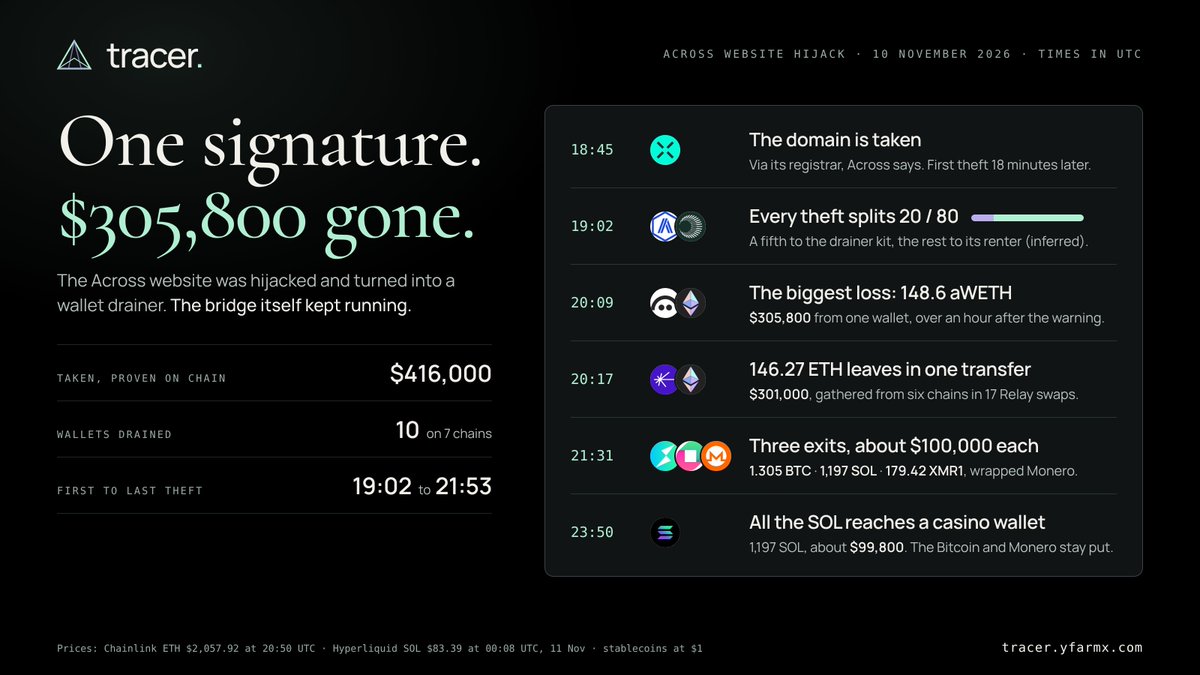
The Across website was hijacked at about 18:45 UTC on 10 November and turned into a wallet drainer. $416,000 was taken from ten wallets in under three hours. One person lost $305,800 with a single signature.
The bridge contracts kept running the whole time. The trap was the website. Here is what happened on chain.
1. The domain was taken
Across says a social engineering attack on its domain registrar gave an attacker control of https://t.co/gq8Txejn50 at about 18:45 UTC. A new security certificate for the domain was logged at 18:46:30 UTC. The first theft landed 18 minutes after the takeover.
2. One signature was enough
The fake site asks you to sign a message, and it looks routine. It is a permit: permission for a stranger's wallet to spend your tokens, with unlimited amount and no expiry. Signing is the only thing the victim does. The drainer submits the signature and pulls the money. The wallet that runs it got its very first funds from Tornado Cash, the mixer, on 2 August.
3. 73 seconds
One user signed on the Plasma chain. At 19:13:43 UTC the attacker's wallet submitted that signature. By 19:14:56 all 7,053 USDT0 ($7,053) had left in seven pulls.
tx 0x2f1eea47673bed95cd9360b5f3064439647554d8f060c9798aa314d978b366cb
4. Every theft splits 20/80
Every time, on all ten wallets drained.
-The 20% wallet: 0x0c7c656126aa62625fdd8051eb69dc14aee8d37b. It has taken a cut from at least 415 thefts and 302 wallets on Ethereum alone since 25 September, most of them far from Across. Its first gas came from the wallet that runs the drains, through a pass-through wallet, so the two share one operator.
-The 80% wallet: 0x2846e69d3298e99eddf2fd8116e952844da11fde. Its first funds came from a KuCoin withdrawal at 19:00:23 UTC. Its first theft landed 2 minutes 34 seconds later.
That is how a rented drainer kit pays out. The kit's owner takes a fifth, and whoever rented it for this job keeps the rest (we suspect).
5. The warning, and the hours after
Across warned users at about 19:05 UTC, three minutes after the first theft of 4 WETH ($8,230).
The biggest loss came more than an hour after the warning. At 20:09 UTC one wallet lost 148.6 aWETH, which is ETH on deposit at Aave, worth $305,800. One signature opened it. The owner revoked the permission 96 seconds after the last pull.
tx 0x2610f11fd3cde7113f83e7137853972ba98d8360b3d91eed6d5807f947a8bd38
The last theft we found landed at 21:53 UTC.
6. Six chains into one pile
Between 19:35 and 20:19 UTC the renter made 17 swaps and bridges through Relay, a cross-chain swap service, turning loot from Plasma, Arbitrum, Base, BNB Chain, Ink and Ethereum into ETH.
At 20:17:59 UTC, 146.27 ETH ($301,000) left the 80% wallet in one transfer.
tx 0x19c5460db37f5cc2bde6f8f644892a5348a1519d2aa97f720091e982134a8ae1
7. Three exits, about $100,000 each
47 ETH went into THORChain at 20:51 UTC and came out as 1.305 BTC.
48.8 ETH went into Chainflip at 21:11 UTC and came out as 1,197 SOL within three minutes.
48.8 ETH was bridged to Arbitrum as 100,364 USDC, sent to Hyperliquid, and by 21:31 UTC had bought 179.42 XMR1, a token that can be redeemed for Monero.
The SOL moved first. At 23:50 and 23:58 UTC all 1,197 SOL (about $99,800) went through a deposit address into a wallet that Solscan labels as the hot wallet of Rainbet, an online casino.
At 00:08 UTC on 11 November the Bitcoin and the Monero were still sitting where they landed. The Monero is still in its wrapped form, where every move shows on chain.
8. The copycats arrive
48 seconds after the 146 ETH moved, a fake token transfer appeared in the wallet's history. It pointed at a lookalike of the address it had just paid, with the same first and last characters. The hope is that someone copies the wrong address.
If you signed anything on https://t.co/gq8Txejn50 on 10 November from about 18:45 UTC: revoke your token approvals, Permit2 included, and move what is left to a fresh wallet. Across says the site is now fully down.
Tracer follows stolen funds on chain: https://t.co/aJatGrQUkg
(2/2)
The swaps from those eight wallets all carry the same label, 'naswap'. That label names the app the swap was sent through:
• Registered on THORChain on 20 April 2026 by the wallet that collects its fees, thor148sahwr5pg44cy0n23zwc723ugy2fptw0m8sau.
• In its whole life, 2,806 swaps and $73.8m have gone through it, from just 40 wallets, in three bursts, and each burst is a theft: $10.4m on 21 and 22 April from wallets on the Kelp DAO exploit trail, $45.4m on 25 to 30 September from Bitget's theft wallets, and $12.4m since 5 November from the Binance thief's wallets. That is 92.5% of everything it has ever carried. The month before this wave, it did nothing at all.
• The September burst came right after the $387.5m Bitget theft. The two biggest users in the app's life, rsiNZr8amajbBCQiWxeis8PJ5fptkGePNz (869 XRP swaps) and 0x4a777646417b0fd34715d2b21d4a132c06aed330 (748 ETH swaps), are both on Bitget's own published list of theft wallets, and so are the next five. Each paid the app a 0.3% cut on top of THORChain's fee. 84% of everything the fee wallet has ever taken in arrived in those five days.
• Now the same label is on the swaps moving Binance's XRP, with the app's cut set to zero on all but eight of them: 709 swaps since 5 November, 482 of them from the thief's own wallets, and about $800 (1,375 RUNE) earned on the lot.
• The fee wallet still holds 100,964 RUNE (about $60,600). The RUNE that set it up on 20 April was bought from one Bitcoin wallet, bc1q3empk84klhz3f3ms74gxyrh2vx78zste47q2f9, and on 22 April its first earnings went back out to that same wallet, 0.16 BTC in seven THORChain payouts. That wallet has made 12 transactions in its life and is empty now.
Check it yourself: search naswap on any THORChain explorer. One swap from each theft, each with the naswap label in its note:
• Kelp DAO, 21 Apr, 57.55 ETH from 0x1c1a82627da9a8a09c8df8078b2a57008be19097: 1DA89D7F922A8A60397B9E02585E1B7D1F208E6EAA5182824C3EAD6D7B14A37B
• Bitget, 29 Sep, 24 ETH from 0x4a777646417b0fd34715d2b21d4a132c06aed330: C5427CECE46102C319446381F06B6B14906E7A7B07D08A641E5022E19EC37298
• Binance, 5 Nov, 115,479 XRP from rwxhn8wpsJraVhZQfxvuQxR4fY5nyJDRLW: 0B8B932703A881D8CD6046C332F8C6A9D286EE9D7510A079B747874F45A90D25
Three thefts, one swap app. The label proves the same app was used each time. Who runs it, and is one group is behind all three?
How the swaps actually run, from rPJws6's 103 transactions today:
• 48 swaps of 30,000 XRP ($35,700 each) and 55 refunds
• 21 swaps went through in full, at about 0.45 BTC each; 18 went through in part; 9 came straight back
• each note sets a minimum price, so when THORChain cannot meet it the XRP is refunded, and the thief sends the same XRP again
• 3.375 BTC ($253,000) arrived in bc1pp65e5kppyl7vu239vlz2xfavr2k4wjrcz0zy4jjgd9wucu5an59scspf2f in 21 payments between 12:42 and 13:02 UTC, and is still sitting there
Every wallet that has sent a naswap swap since 5 November was created and filled by ryB7N: rHZydhi3…, rwxhn8wp…, rUydz7o…, rGC1Pzg…, rPJws6…, r9JN3qjT…, r56ruN… and rh7SXb…. Eight senders, one creator.
Two things to bear in mind if you are following the trace yourself: 16 bot accounts send 10 drops of XRP to every wallet the thief pays, so remove those before you count hops; and a refund looks like a payment from a new wallet, when it is the thief's own XRP coming back.
The full trail map update is on it's way here: https://t.co/S305rAerRk
Binance hack, day 9. The thief is cashing out through THORChain, using a suspicious swap app. $74m has gone through this little known app since April and 97% of it was stolen: Kelp DAO in April, Bitget in September, and since Thursday $16.3m of Binance's XRP, in 30,000 XRP chunks, still going at 13:02 UTC today. Here is the trace: (1/2) 🧵👇
1. Context: On 29 October, from 20:05 UTC, 233,459,920 XRP (about $278m) taken from Binance's hot wallets landed in one brand new wallet, rK21t6nGLy4MNDqhvy3pGwcLFy25qgfzMx.
2. On 2 November, between 03:47 and 04:00 UTC, the thief moved all of it into six new wallets, sending each a 1,000 XRP test payment first. Three of them, rsNoNkb…, rhXtRtp… and raoMrxb…, still hold 113.46m XRP (about $135m) and have never moved since.
3. One wallet does the laundering. Its address is ryB7NESZcttqzRioiD5L6Kf5tFL87ktmx. Two of the six wallets, 40m XRP each, were emptied into it (E01BCF03… on 6 Nov at 06:06 UTC, 6FA5FCC4… on 7 Nov at 02:50 UTC). About 120m XRP (about $143m) has gone through it so far.
4. It creates new wallets and fills them. Example from this morning: at 09:48 UTC it sent 1,866,233 XRP (about $2.2m) to a wallet it had created, rGC1Pzg… (2B808564…). Nine minutes later that wallet sent 1,476,874 XRP to another new one, rPJws6… (735BC1D3…).
5. Those wallets swap the XRP for Bitcoin. Each one sends XRP to THORChain in chunks of 30,000 to 100,000 XRP, with a note attached: "swap this to Bitcoin and pay this Bitcoin address". rPJws6 sent 48 chunks of exactly 30,000 XRP ($35,700 each) in 31 minutes this afternoon, 12:15 to 12:46 UTC. Every note from these wallets carries the same label, 'naswap', which names the app that sent the swap, and sets the app's own cut at zero. THORChain still takes its normal swap fee.
6. The Bitcoin lands in one collecting wallet per sender. Eight collecting wallets have received 65.9 BTC (about $4.9m) so far. The three newest, bc1pp65e5…, bc1p9k4z6… and bc1qp627x…, received 14.55 BTC (about $1.09m) since yesterday.
Bitcoin from the first five collecting wallets was then passed through five more wallets into one gathering wallet, 1JKwWwKrbhnK4DEFco4TdaiTw9d2zwfmSJ. That wallet received 16.04 BTC (about $1.2m) in one evening on 5 November, and nine of its twelve deposits were paid straight out by THORChain.
So the pattern is: make a wallet, fill it, swap in fixed chunks, collect the Bitcoin, move it on. It was still running at 13:02 UTC today.
The large amounts have not been touched. The 19 Bitcoin addresses in the FBI alert still hold all 18,270 BTC (about $1.37bn). The 17,260 ETH in 0x03b0eE5d… is still there too.
Here is the part that changes the picture: the app behind those swaps. 🧵👇