Introducing Onchain Group (OG).
After leaving Coinbase, I spent time reflecting on what was actually worth working on.
My background was as a venture investor — pattern matching, working with founders, and figuring out what’s coming next. What I realized, though, was that the most energizing part wasn’t investing. It was working with teams to define strategy and bring the right transaction into existence, like architecting the Coinbase <> Morpho deal — a new kind of onchain alliance that combined product, capital, and distribution to create an entirely new category and market.
It made me wonder: was this a one-off, or the start of something new?
Having been in crypto for nearly a decade, this is the most dynamic the space has felt. Onchain products are becoming real businesses, tokens are becoming real assets, and regulatory clarity is opening up an entirely new design space — introducing a new class of capital structuring opportunities.
Over the past year, working closely with founders, it became clear that this wasn’t a one-off, but the first of many.
The opportunity design space is just beginning — from tokens turning on fees, to restructurings, to equity-like conversions, to acquisitions and distribution partnerships involving tokens.
Teams are realizing that getting this right is no longer optional. As onchain products mature into real businesses, taking ambitious steps toward the right capital structure becomes a requirement — and the market is beginning to reward those who do it well.
In our conversations with builders, investors, and stakeholders over the past year, it became clear that nobody was exploring this area the right way — with an early-stage mindset, cryptonative intuition, and institutional rigor all at once.
So we started Onchain Group.
OG exists to define and execute the transactions that create new markets and shape this new system.
If crypto is the software upgrade to finance, then capital structure needs to evolve alongside it — requiring ambitious strategy and creative execution.
Using @dakota_xyz for OG @onchaingroup_ has been kind of magical.
No-frills intuitive stablecoin banking: clients pay in stables → wire/ACH into bank accounts seamlessly (and vice versa).
Can genuinely see this becoming my primary bank account over time.
For those confused on Hyperliquid <> USDC:
Past:
> USDC is all of Hyperliquid TVL
> Profit of that USDC is split between Circle and Coinbase 50-50
> Hyperliquid makes no money on that USDC
Future:
> USDC was going to be the main asset anyway
> Both Circle and Coinbase want to claim revenue on the USDC as their share of “on platform”
> Both 2x revenue respectively but make zero profit now - for sake of growth
> Both can now say it’s “their revenue” but pass on most of the yield to Hyperliquid to win deal
> Hyperliquid makes profit on stablecoin yield that it would not have otherwise anyway
Introducing @runneragent, the knowledge work agent that works across all your apps to get real work done
It's simply the best way to stay on top of messages, project management, user feedback, and much more
Runner has become a daily driver for me and I think you'll like it too
Today we're excited to publish ERC 8211, also known as Smart Batching, co-developed by @biconomy and the @ethereum Foundation.
Given all the DeFi drama we've been seeing, as well as growth in AI Agents, Smart Batching radically improves onchain UX and security.
We're going from transactions to programs that augments the entire onchain transaction experience.
For users with no coding experience, you can tell an agent to build a full onchain workflow. User reviews what the agent built, approves workflow by signing once, and it executes without the user or agent handling onchain complexity. This is a no dust, and one signature, multiple txn experience.
This is because agents can express an entire multi-step DeFi strategy as a simple off-chain script — with built-in safety.
In fact, for agents and developers, the experience changes completely. No Solidity required. No contract deployment per flow. No per-strategy audit cycle. Operations are composed entirely in TypeScript, compiled to the standard onchain encoding, signed once, and executed by the EVM.
You or your agent can compose over contracts you trust, such as Aave, Uniswap and practically any arbitrary contract that exists on chain. This matters for agents onchain because its easier for them to produce offchain scripts (rather than writing custom contracts), helping them to finally be expressive in execution.
Intelligence has raced ahead. Execution standards haven't kept up. ERC 8211 solves this!
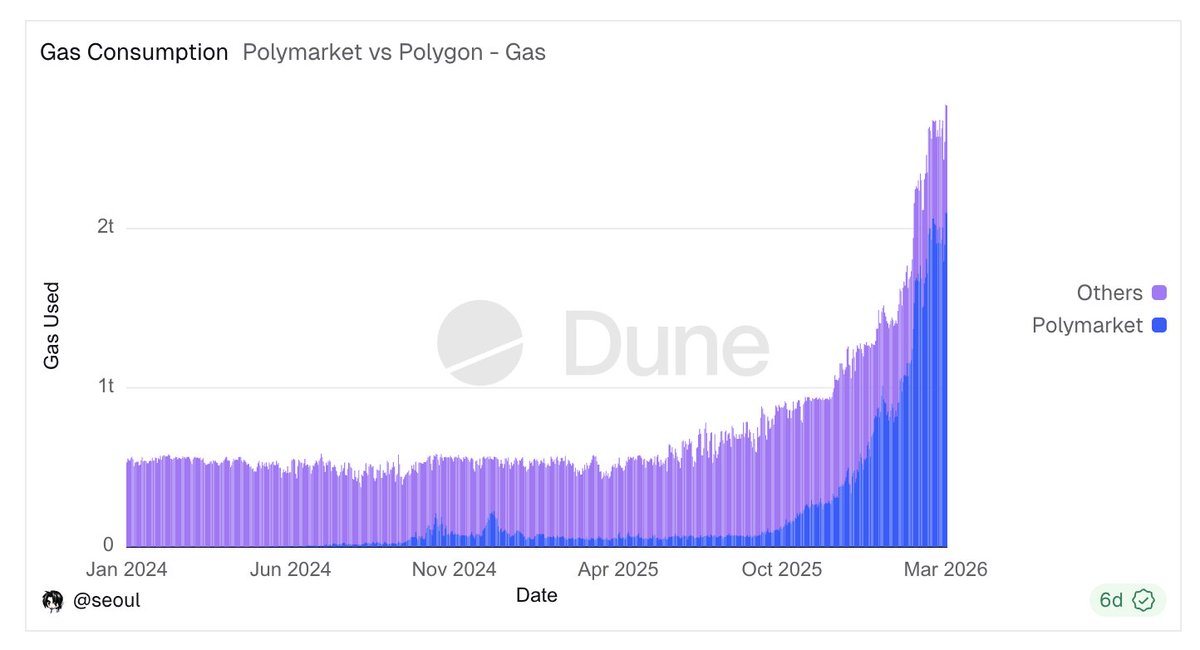
Polymarket generated $10M year-to-date in gas fees for Polygon. $40M annualized. Thats like half of all of Base’s revenue last year.
Prediction - launch own chain, internalize the fees, get creative with flow rebate, user monetization.
seems a crazy chart to me that no one talks about -
Polygon's recent usage is entirely surged by Polymarket, who has claimed to leave the chain in the future...
is this a pivotal moment for Polygon to figure out a deal with Polymarket?
(🎙️interview coming with JW on @indexed_pod soon this week!)
Big launch today by @YI_LON. Ryan was pivotal to many of our biggest token deals at @VectorDAO. Rare ability to reconcile informed optimism of what's possible with technical risks and constraints.
Excited for his next chapter with @onchaingroup_, crypto is lucky to have him.
🗳️ DAOs were supposed to solve governance. So why do founders keep saying they can't run a business through one? @laurashin, @yi_lon, and @theiaresearch on where DAOs actually work, where they fail, and what comes next.
https://t.co/LmiXmjWGCJ
I asked @YI_LON and @TheiaResearch about the
@AcrossProtocol token-to-equity conversion, and Felipe flagged something worth watching: management teams have every incentive to suppress token price before announcing a conversion deal.
They profit from the premium. 👀
https://t.co/jI2CFyd8TN
ICE x OKX deal tea leaves:
- Product: CFTC is opening a path to onshore perps and ICE wants to launch it. OKX has the “know-how” and can help ICE build the product.
- Distribution: Tokenized equities PMF is with international users (see Ondo’s Binance distribution). ICE gets a GTM partnership into OKX userbase.
- Reputation: OKX was fined by DoJ over money laundering last year. By having ICE on the Board, OKX cleans reputation perception and differentiates them from Binance (their largest competitor) while opening a path to U.S. market.
Token IR exists, we just haven’t figured out the right form factor yet.
Public companies:
• report quarterly
• mature businesses
• dedicated IR / CFO
Token projects:
• fundamentals update 24/7 (onchain)
• earlier stage (“pre-Series A/B”)
• founders rarely talk to investors
The result: the market gets constant data but almost no narrative.
Given Aave’s business structuring chapter seems to be resolved, let’s look to the next catalyst in the category, which is…
The Fee Switch for Morpho Blue.
The Vault model is brilliant because it creates competition for liquidity, reshapes risk companies into fund / AUM business models, and regulation prevents front-ends from bundling that activity.
The protocol benefits, but eventually has to monetize, which will directly impact margins for the Vault category.
Watching the protocols navigate this topic is what I’ll pay attention to going fwd.