@agihippo Really interesting sharing. Coming from China, it’s hard to imagine someone saying, “I’m not quite sure how, but I somehow ended up at Tsinghua or Peking University.” 🤣🤣🤣
@agihippo I train at gym with 150+ sgd/session. It’s a totally different than working out by myself. These singaporean little brothers would always push you so hard got me feeling like saitama broke his limiter. It feels great.
Can AI agents autonomously explore, synthesize, and discover knowledge like researchers? 🤖🔬
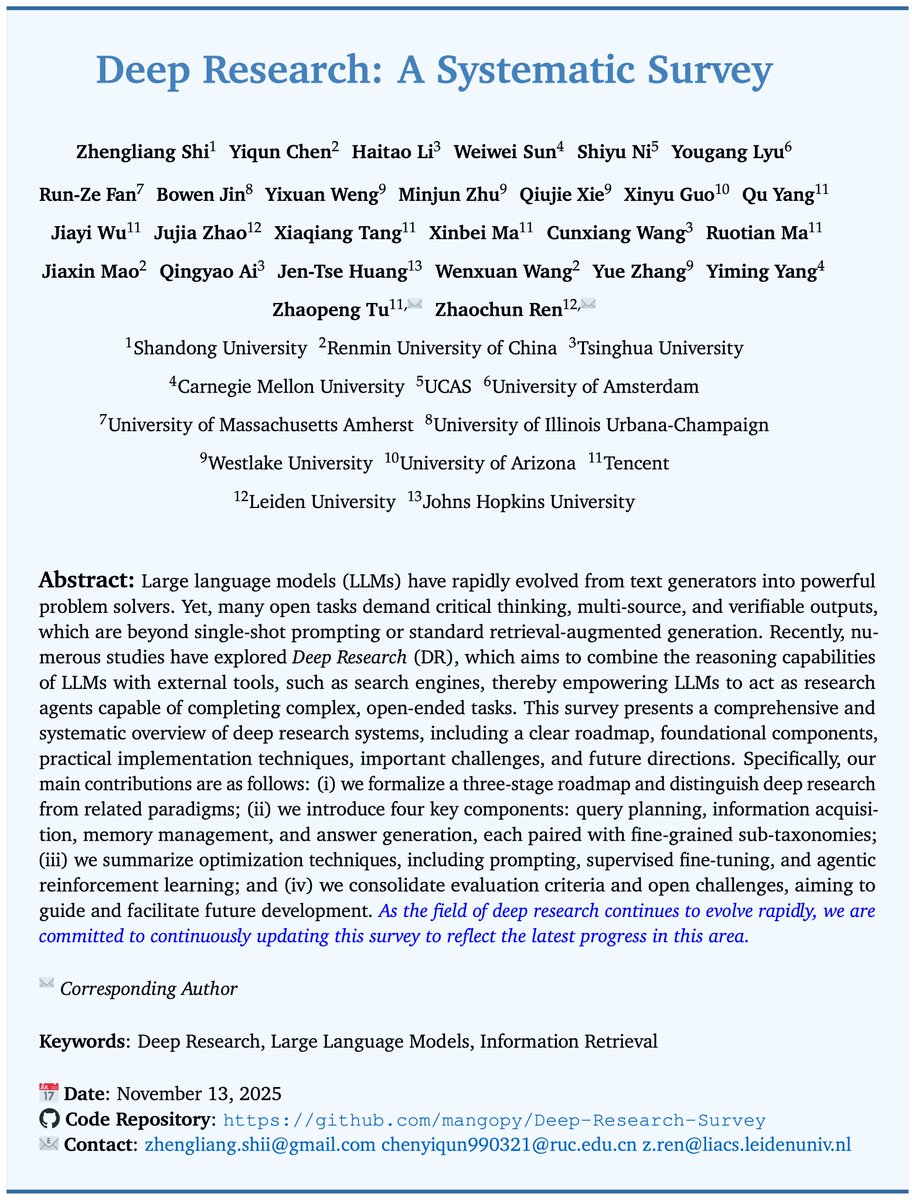
Introducing a comprehensive survey on Deep Research (DR) systems, where LLMs evolve from passive text generators into autonomous agents capable of long-horizon reasoning and verifiable knowledge creation.
🗺️ Three-phase roadmap:
1⃣ Agentic Search → Precise evidence acquisition
2⃣ Integrated Research → Multi-source synthesis & reporting
3⃣ Full-stack AI Scientist → Hypothesis generation & discovery
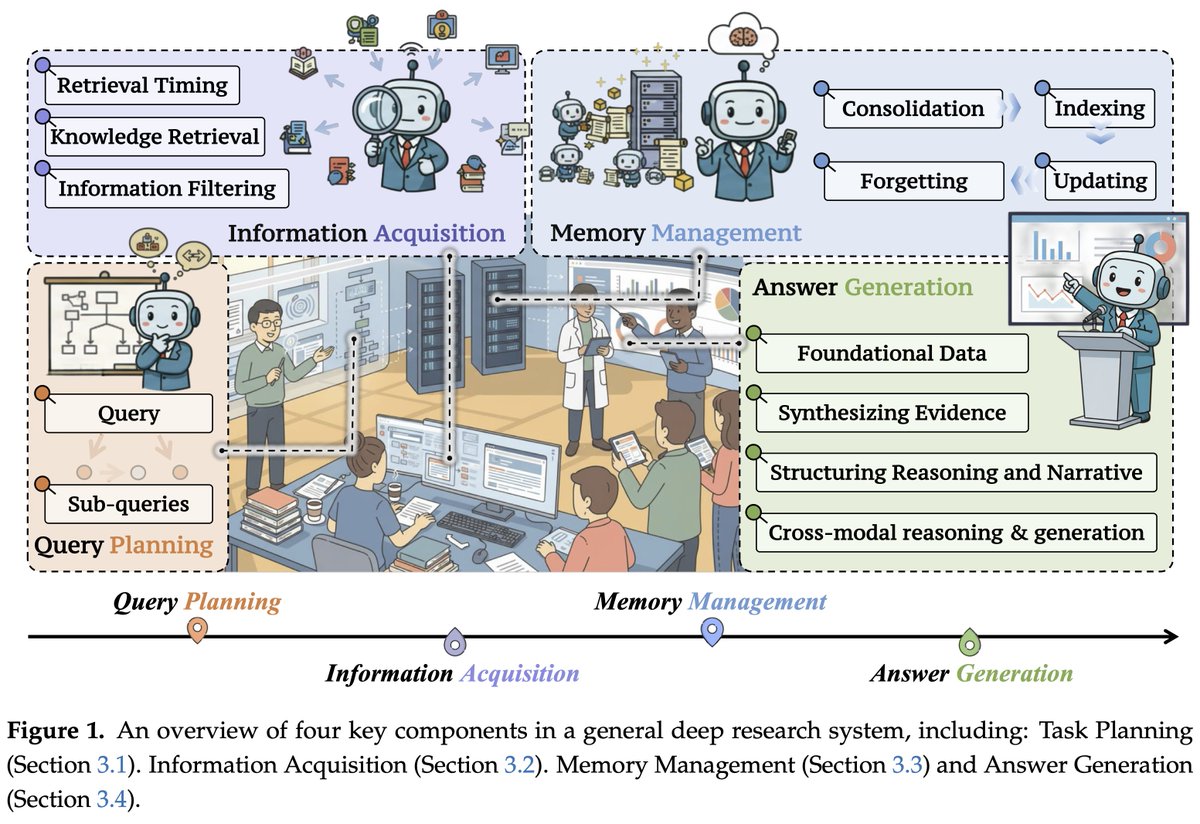
🔧 Four foundational components:
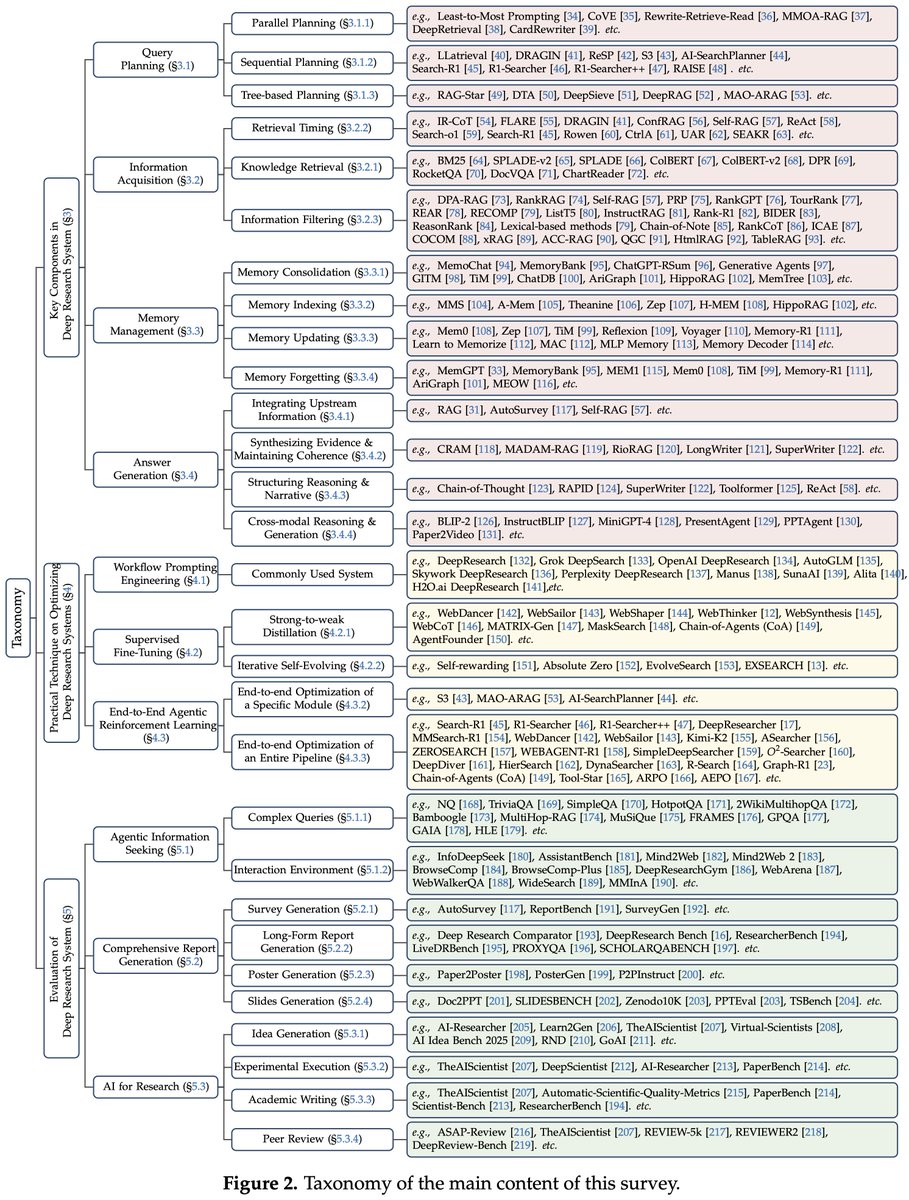
1⃣ Query Planning: Decompose complex questions (parallel, sequential, tree-based).
2⃣ Information Acquisition: Dynamically retrieve from web search, APIs, & multimodal sources.
3⃣ Memory Management: Store, update, and prune context over long horizons.
4⃣ Answer Generation: Synthesize verifiable, cited reports.
🚀 Three optimization paradigms:
1⃣ Workflow Prompting
2⃣ Supervised Fine-Tuning (SFT)
3⃣ End-to-End Agentic Reinforcement Learning (RL)
📊 Key Insight: DR is not just advanced RAG.
Unlike standard RAG, DR enables:
✅ Flexible interaction & tool use beyond static retrieval
✅ Long-horizon planning with autonomous workflows
✅ Reliable, verifiable, and structured outputs
📈 As the field evolves, we are committed to continuously updating this survey to reflect the latest progress!
🧑💻 Project: https://t.co/B7Ssod4kaV
📃 Paper: https://t.co/qnoxyOklki