📄 CoRL 2026 Spotlight: Meta-Ctrl predicts robot plan failures before the LLM task planner writes them. Exact inference, no sampling.
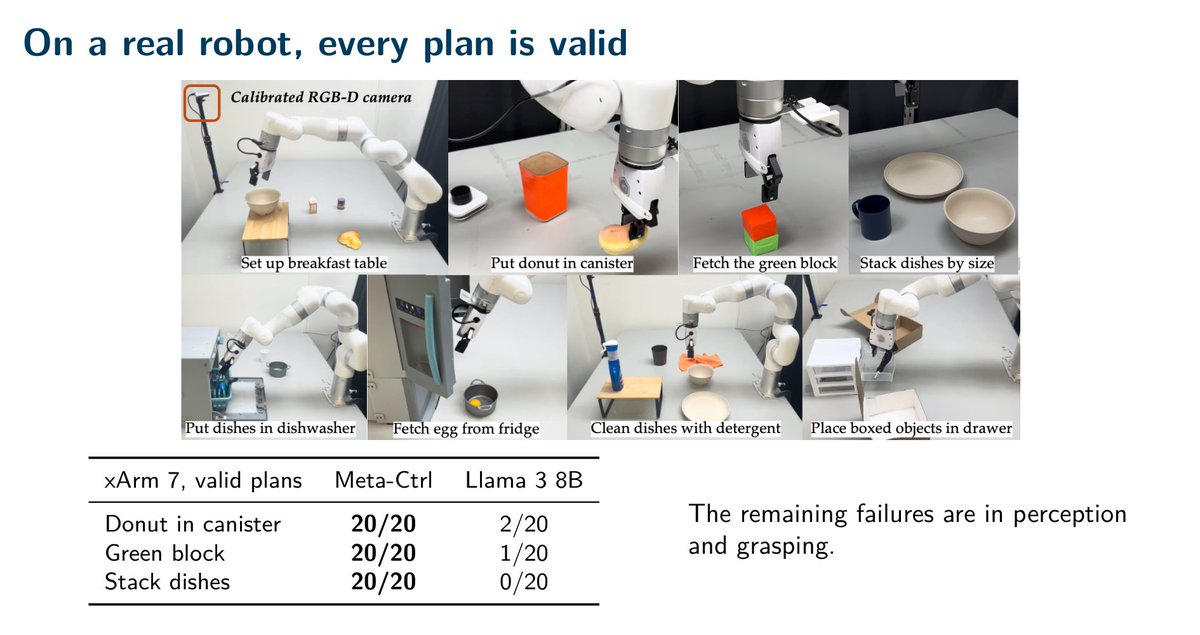
Llama 3 8B beats GPT-5.5 & Claude Opus 4.8 on VirtualHome.
🎤 Talk 8:30 am · 📍 Poster #104, 10:30–12 🧵
📄 CoRL 2026 Spotlight: Meta-Ctrl predicts robot plan failures before the LLM task planner writes them. Exact inference, no sampling.
Llama 3 8B beats GPT-5.5 & Claude Opus 4.8 on VirtualHome.
🎤 Talk 8:30 am · 📍 Poster #104, 10:30–12 🧵
5. Result: small open models top VirtualHome action sequencing (Embodied Agent Interface):
Llama 3 8B: 21 → 90%
gpt-oss-20B: 74 → 91%
Claude Opus 4.8: 88%, GPT-5.5: 73%
On BEHAVIOR, Meta-Ctrl narrows the gap with frontier models.
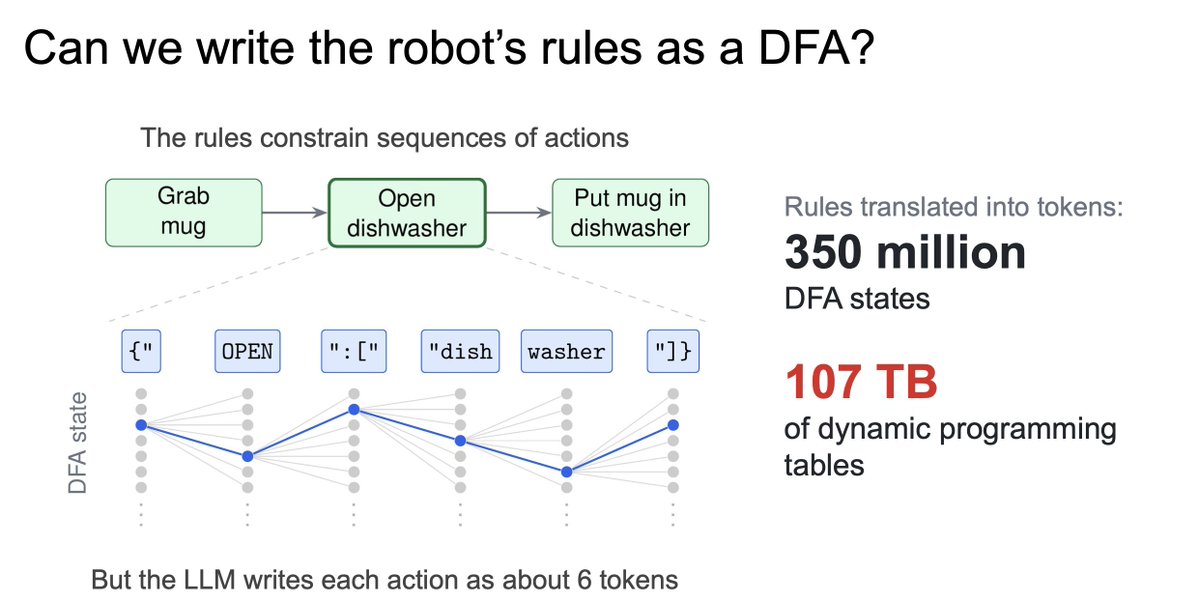
4. That's the framework. Our new piece: robot rules are about actions, but the LLM writes each action as ~6 tokens. One automaton over tokens: 350M states, 107 TB.
Meta-Ctrl reasons at two levels: syntax over tokens, semantics over actions (meta-tokens). 81K states, 3 GB.
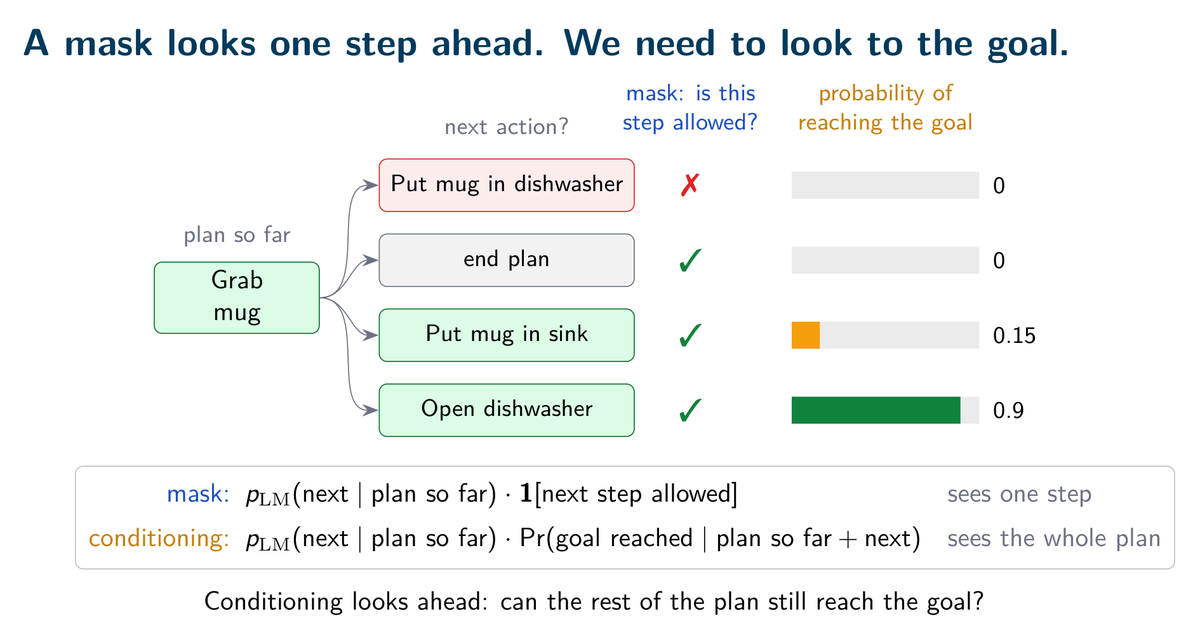
3. Sampling futures is slow: they branch at every step. Ctrl-G instead computes it exactly on an HMM that approximates the LLM, with the rules as an automaton. Zero chance → never written.
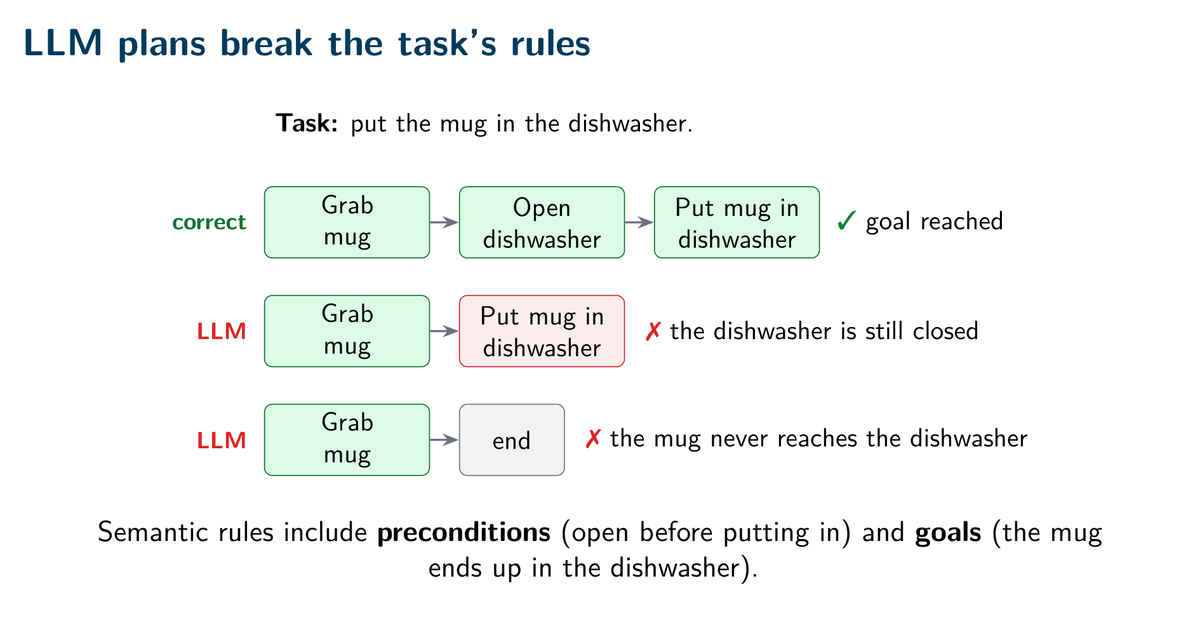
1. Same LLM, same task. On its own, the planner puts the mug in a closed dishwasher and the robot crashes. With Meta-Ctrl, it opens the dishwasher first.
A grammar mask can't catch this: it only checks the next step, not whether the plan can still reach the goal.
Had the pleasure of learning about TRACE by Gwen Yidou-Weng, Benjie Wang, and @guyvdb at ICML!
It view alignment/controlled decoding through a Bayesian lens and derives a simple, principled, and effective new method. I highly recommend reading this paper!
@guyvdb@benjiewang_cs 6. AND TRACE is blazingly fast!
—Seconds of classifier training to adapt to new constraints
—Only +20% inference time over base LM
Wish LM could plan—not just guess the next word?
TRACE lets LM see all endings before each move.
– Global control at inference time
– Tractable lookahead via an HMM LM-proxy
– Linear classifier per constraint
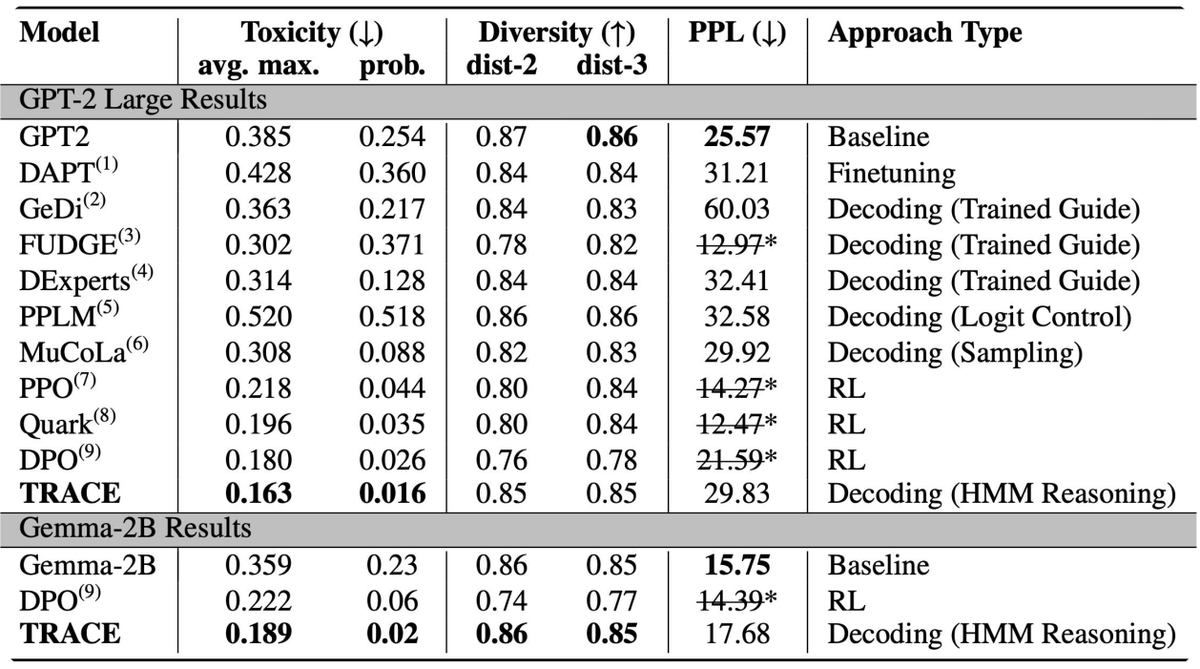
Outperform RL, DPO, FUDGE—at just +20% decoding over base LM.
#ICML2025
@guyvdb@benjiewang_cs 5b. TRACE also adapts flexibly to 76 different personas in seconds.
For example, it can instantly imitate Twilight Sparkle’s tone, much better than prompting baseline.
@guyvdb@benjiewang_cs 5. Results:
Surprisingly, even with this low overhead, TRACE consistently outperforms much more expensive baselines on global control tasks. For example, in detoxification, TRACE outperforms DPO, RL, and FUDGE in quality while maintaining diversity and fluency.
@guyvdb@benjiewang_cs In short, TRACE achieves global control with tractable lookahead.
All you need is a one-time HMM distillation and a log-linear classifier for each constraint.
@guyvdb@benjiewang_cs 4b. How?
—TRACE uses a HMM “LM-surrogate” to efficiently predict p(x>t | x<t, xt): the distribution of all possible futures, given the prompt.
—With these possible futures, we use a simple classifier to estimate if a constraint will be met: p(s | x<t, xt, x>t).
@guyvdb@benjiewang_cs 4a. TRACE approximates p(s | x<t)—the chance that a partial sequence will meet constraints—not by direct modeling, but via probabilistic reasoning.
This decouples tractable prediction from flexible control.
@guyvdb@benjiewang_cs 3. Prev solutions:
Train-time methods (FT/RL):
—Train a model for p(xt | x<t, s)
Inference-time methods:
—Sampling from p(s | x<t, xt) is intractable for long sequences.
—Auxiliary guides approximate p(s | x<t, xt), but aren’t flexible for new constraints.
2. To control outputs, we want p(xt | x<t, s), i.e., every token should consider the end constraint s.
But LLMs natively do p(xt | x<t), wo knowing s.
Here’s the trick:
p(xt | x<t, s) ∝ p(xt | x<t) × p(s | x<t, xt)
This links next-token choice to end constraint satisfaction.
1. Why is LLM control hard?
Autoregressive LLM only “look one token ahead.”
But whether an output matches your style, safety, or format… can only be judged at the end.
This “myopic” generation means you can’t reliably enforce global controls—even with prompts or trained guides.