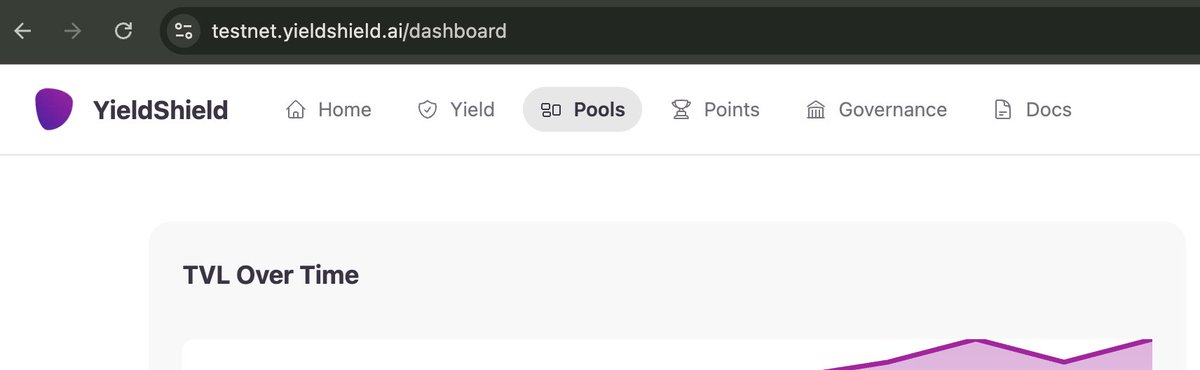
Someone in the YieldShield community took our newly open sourced code and deployed it themselves so anyone can try it out. We have no idea who you are, but thank you 🫶🛡️
Try it here: https://t.co/LSozahT8WI.
Follow the point system to explore what YieldShield can do, and let us know what you think.
Very interesting read. Stablecoins will unlock the next wave of adoption for our industry.
We now have well-established blockchain protocols, stablecoin protocols, and even investing protocols.
What's missing? Insurance. People want reliability to invest safely.
And we are here making it happen.
Participation grows faster when users can rely on structure instead of manual analysis.
Clear outcomes build trust, and trust is what expands the entire space.
Evaluating protocol risk takes time and technical knowledge.
Not everyone wants to do that work for every deposit. Not everyone knows how to do that for every deposit.
@MerlinEgalite This is quite true. But we also need to provide users with tools that make them confident in the system.
A decentralized insurance protocol like YieldShield is key for growth.
There have been several discussions lately in the space of token fundamentals. This is great, but it does not scale to users and scares them away.
Let's build robust systems that protect users, so we can keep onboarding more people to DeFi.
This is unfortunate, and it is good to see the team responding quickly.
Even experienced teams can face exploits. This is systemic risk, not individual failure. It is unrealistic to expect any complex system to operate forever without issues, and we want these teams to keep building the products that move the space forward.
Systemic risk is something users should be protected against. That is what we do at YieldShield.
When users have protection, builders can innovate with confidence, and the entire ecosystem becomes stronger.
At 21:11 UTC on Nov 30, an incident occurred involving the yETH stableswap pool that resulted in the minting of a large amount of yETH. The contract impacted is a custom version of popular stableswap code, unrelated to other Yearn products. Yearn V2/V3 vaults are not at risk.
@adenn_0x@symbioticfi Great post. More and more products coming on-chain should help with this and ultimately make decentralized on-chain insurance more efficient than off-chain insurance.