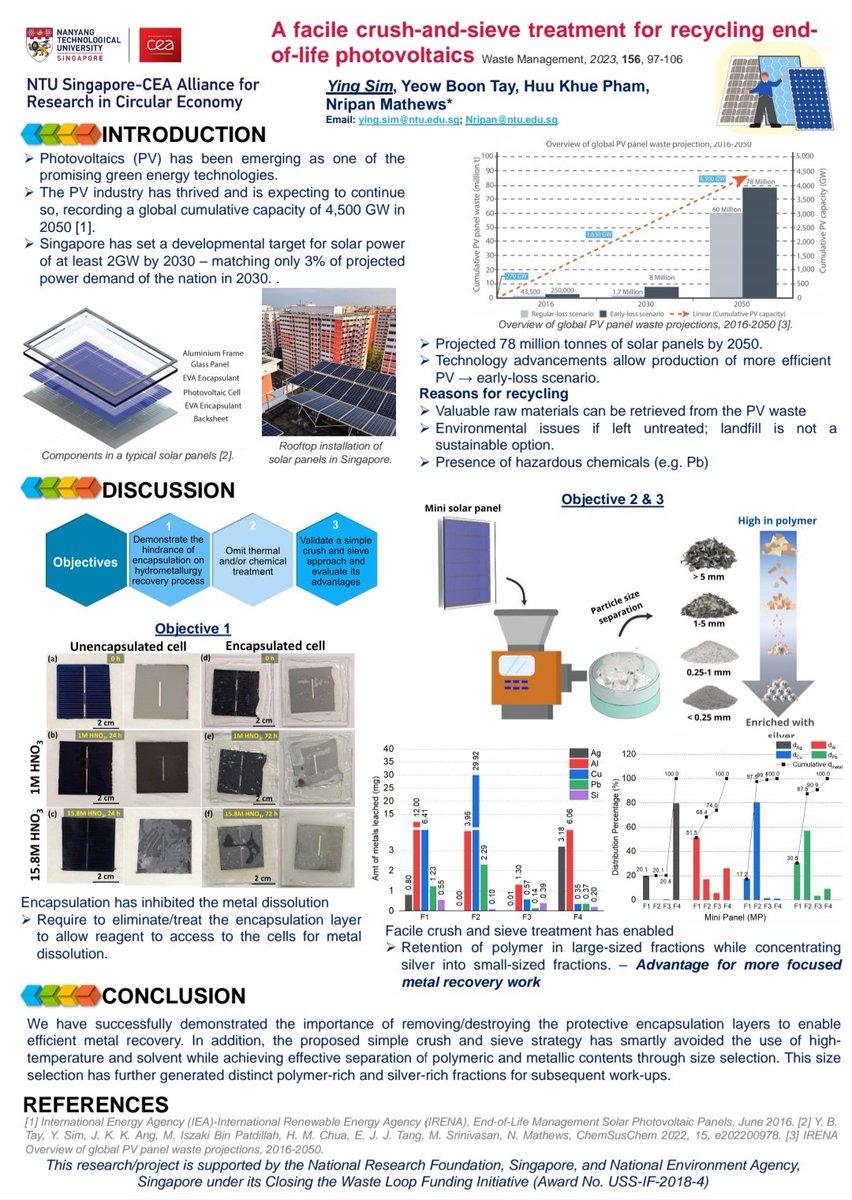
Hi All! I would like to share our team's work on "A facile crush and sieve treatment for recycling end of life photovoltaics". #RSCPoster#RSCEnv
Simple crush and sieve approach enables separation of polymer and metals through size selection.
Read more on our team's work on recovery of Si with solely phosphoric acid and its upcycling application to lithium ion battery anode materials.
This method avoids the use of multiple reagents and high temperature annealing to recover Si!
#NTUsg scientists have devised an efficient method of recovering high-purity silicon from expired solar panels using phosphoric acid. The silicon can be #upcycled into lithium-ion batteries that can power #electricvehicles and more. #NTUsgResearch https://t.co/pNZPCgJcLs
#NTUsg scientists have devised an efficient method of recovering high-purity silicon from expired solar panels using phosphoric acid. The silicon can be #upcycled into lithium-ion batteries that can power #electricvehicles and more. #NTUsgResearch https://t.co/pNZPCgJcLs
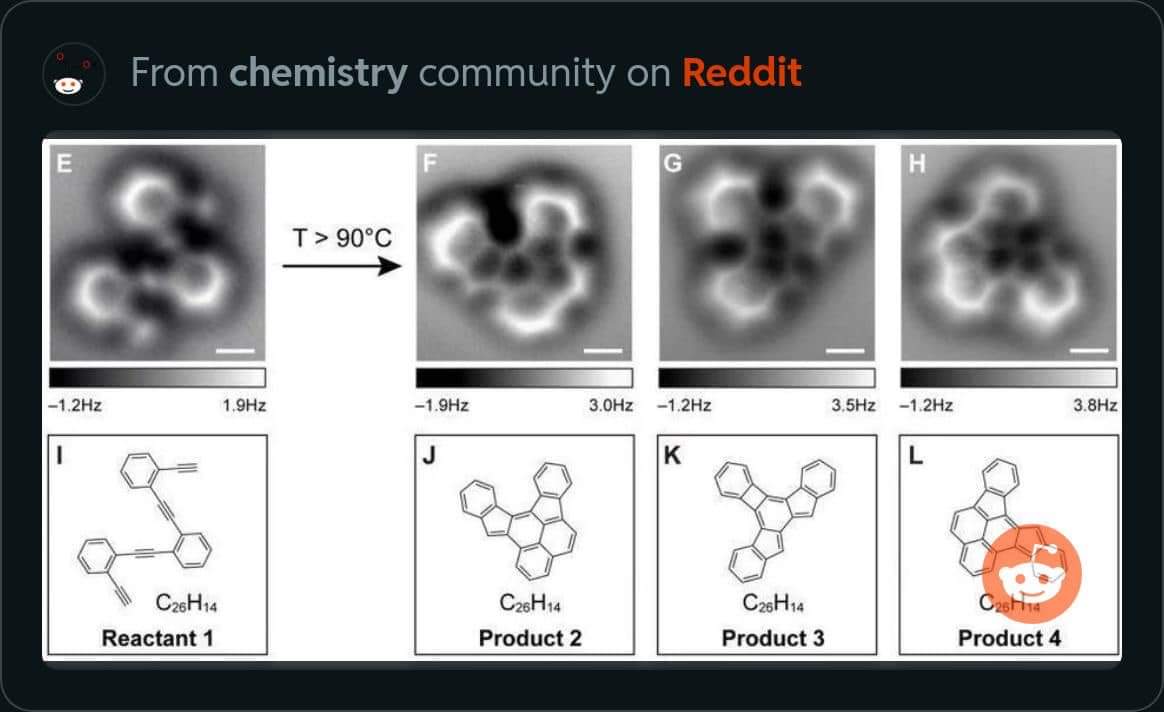
It's so wild that we can "see" molecules now. Humans can do so many amazing things when we're not being miserable monsters to each other. I have hope tho.
🔺Exciting news! Save the date for the upcoming #DEPERO Online Conference on 'Device Physics Characterization and Interpretation in Perovskite and Organic Materials'.
📆3rd-5th October 2023
👉More info and how to submit your oral abstract here:
https://t.co/ZW2SvvV5RE
That's good to know. Never experience this yet since the solvents tend to run out fast back in synthetic lab. Guess it is not just looking at labels and counting bottles from now on.
Pictured: a recently unearthed bottle of isopropanol. Bomb squad is on its way, and the entire organic department has a day off. #peroxides#chemsafety
cc: @SafeChem79 lol
Our team has developed simplified silicon recovery to enable high performance, sustainable lithium-ion batteries. Thank Prof @MrgNripan for the guidance. Congrats @YeowBoonTay1@ankit_823001 !!
https://t.co/F6n3P9BU7U
Our team has developed simplified silicon recovery to enable high performance, sustainable lithium-ion batteries. Thank Prof @MrgNripan for the guidance. Congrats @YeowBoonTay1@ankit_823001 !!
https://t.co/F6n3P9BU7U
Happy to finally see the article online -
Beyond the TPP+ “gold standard”: a new generation mitochondrial delivery vector based on extended PN frameworks
Now published in Chemical Science
https://t.co/NHsEikRRGu
Working on 'Engineering, properties and processes at device interfaces'? Exhibit your work at Conference on Perovskite Thin Film Photovoltaics and Perovskite Photonics and Optoelectronics #NIPHO23
📆15th-16th May 2023 Pavía Italy
👉Submit your abstract:
https://t.co/LloBEezA4t
Hi All! I would like to share our team's work on "A facile crush and sieve treatment for recycling end of life photovoltaics". #RSCPoster#RSCEnv
Simple crush and sieve approach enables separation of polymer and metals through size selection.
Innovative. Interdisciplinary. Problem-solving. Issue 1 of our new gold open-access journal Industrial Chemistry & Materials is out now. Article processing charges are waived until mid-2025. Help advance the application of science and technology: https://t.co/I6YJrI7qTc
@Rachel_E_OBrien Yup! Exactly, Rachel! That's what we are excited about. We are intending to further study on different mesh size to generate more fractions in view to further segregate the metals. 😀
@Rachel_E_OBrien Hi Rachel! Yes, we observed that Al retained majority in F1, Cu and Pb retained largely in F2 while Ag concentrates into F4. For more details, you can read our paper. https://t.co/x8PcrMeAy2
@Anurgdev Hi Ankur! Thankf for your kind comment! For metal wise, we typically digest and use ICP-OES for measurements. On top of that, we also utilise XRF, SEM-EDX and XPS to further analyse the purity of materials recovered.
@AlanAguirreSoto Thanks Alan! We do hope that this simplified approach can replace the thermal treatment to minimise the carbon footprint as well as emission of noxious gaseous by-product from the fluorinated polymer.
@AlanAguirreSoto Hi Alan. Thanks for your kind comment. Our team is currently gathering information for life cycle assessment of this work. Nevertheless, the crushing was done using lab-scale cutting mill Retsch SM200 over 10 mins/cycle. Much lower energy consumption is expected to thermal method
Hi All! I would like to share our team's work on "A facile crush and sieve treatment for recycling end of life photovoltaics". #RSCPoster#RSCEnv
Simple crush and sieve approach enables separation of polymer and metals through size selection.