@initiumnews@malaysiakini@nytimes@tw_reporter_org 🏆 Journalistic Innovation - Award for Excellence - Regional group goes to @erc_earth! Impressive breadth of reporting showing how environmental impacts, crime, and gender issues are linked to the demand for sand! Congratulations! #SOPAwards2024
📰https://t.co/ccPaprbOKY
Proud to present Amy Chen who manages a USD2.4B portfolio as Chief Investment Officer of the Smithsonian institution, the world’s largest museum complex. 8-9am Nov 10 @FringeClub, HK. RSVP https://t.co/GLHj0yOqIF
#philanthropy#endowment#nonprofit
The end of Chinese social media as we know it:
All major platforms (WeChat, Weibo, Baidu, Douyin, Kuaishou, Bilibili) made simultaneous announcements that they will ask users with a least half a million followers to display real IDs to the public
A fabulous interview with Peter Hessler, who talked about growing up pre-digital, generation shifts in China, and how he writes non-fiction. Peter Hessler’s World of Words @SixthTone; https://t.co/4iMopHA75c
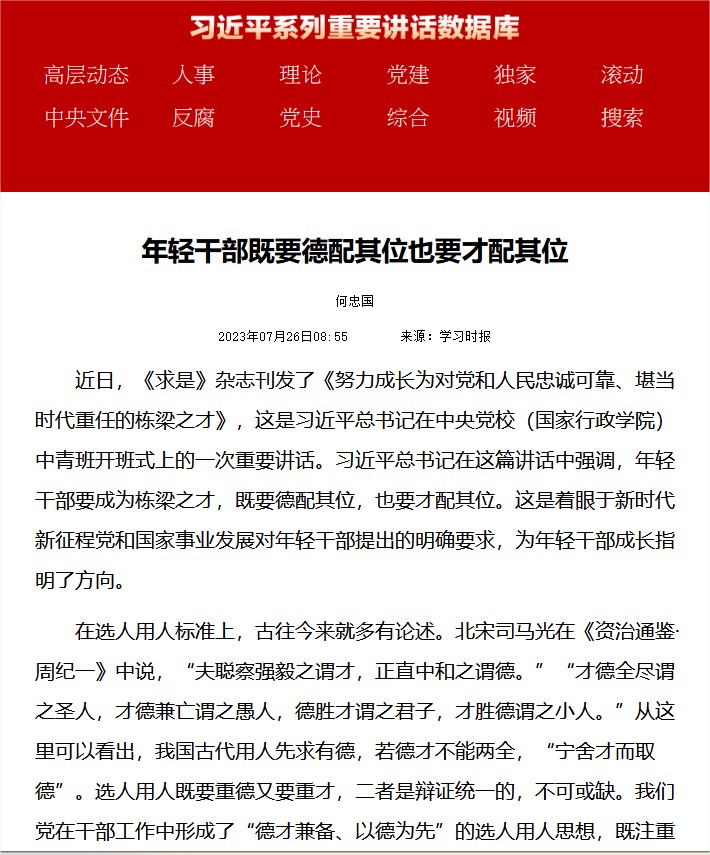
#Chinese media gives us hints re Qin Gang: "Young cadets must have both the #moral fiber and skill-set fit for their positions"
The day after his dismissal as Foreign Minister, CCP's Central Party School's newspaper published this editorial -which recaps a Xi Jinping speech./1🧵
US-China Diplomacy: Make Music to Bring Harmony Amid Global Mayhem - Reflecting on the recent flurry of US-China diplomacy, journalist and author @yingworld underscores the importance of people-to-people exchange #usa#China#uschinarelations
https://t.co/U36ovKnVee
My recent stay in China—all 10 weeks of it, across 6 cities—provided far too many layers of information than can be quickly unpacked on social media, but the overwhelming and obvious impression was one of negative economic sentiments, even pessimism, across the board: tentative spending on behalf of consumers, lack of confidence on behalf of entrepreneurs and investors, general miasma in the financial and legal services sectors, all responding to a perceived lack of fiscal and institutional commitments in government policy, despite positive pro-economy rhetoric being issued for over half a year now.
The general impression among academic observers, which I share, is that the central government still has quite a bit of unused policy firepower (stimulus of all kinds, various institutional commitments it could issue to the tech and real estate sectors, etc.), but has thus far been somewhat hesitant to put its money where its mouth is, literally and figuratively speaking, and private economic sentiments are unlikely to improve until it does. Local governments are fiscally exhausted by this point, and cannot do much on their own. Negative sentiments are, of course, self-reinforcing if not quickly reversed through decisive policy action or external shocks, and therein lies the biggest short-to-medium threat to the Chinese economy. There are, of course, powerful sociopolitical reasons (and also long term moral hazard considerations) for why the central government has been somewhat hesitant to fully jump in, but time seems to be running short before social sentiments sour in a more permanent way.
All in all, while the actual economy is undeniably livelier than it was last year (and how could it not be, given the comparison set), subjective sentiments seem much worse. It was still possible, even last July, for some to write off economic headwinds as situational to the pandemic, but now the pandemic is over, and the long term problems that academics have been harping about for years—demographics, local government finances, real estate bubbles, low consumption, etc.—are no longer avoidable regardless of one’s socioeconomic position. The amount of governmental action (and money) needed to arrest this slide into systemic pessimism seems… quite enormous.
Track three cultural engagement would help mitigate the toxic climate in U.S.-China relations. Nine members of NY Philharmonic, including concertmaster Frank Huang, are now in Shanghai conducting master classes, and presenting two performances.
“Renowned conductor Yu Long, the Shanghai Symphony Orchestra, and the NY Philharmonic announced that their jointly commissioned oratorio, Shanghai! Shanghai! (Émigré) will have world premiere in Shanghai in Nov and will be performed in NY in Feb 2024. https://t.co/QpWMmWhTNO
1/ It has been striking to observe the amount of Kremlinology that has gone into decoding the protocol arrangements for @SecBlinken's visit to Beijing, and also how much of it has lacked context or accuracy. https://t.co/b7aL89EQD0
Many Chinese language talk shows on podcast and YouTube are fiercely anti-CCP. But anti CCP is not necessarily pro democracy. How to tell the difference? By the way they treat Trump and modern GOP. Many of them are also devotees to Trump. They are closet autocrats (minus power).