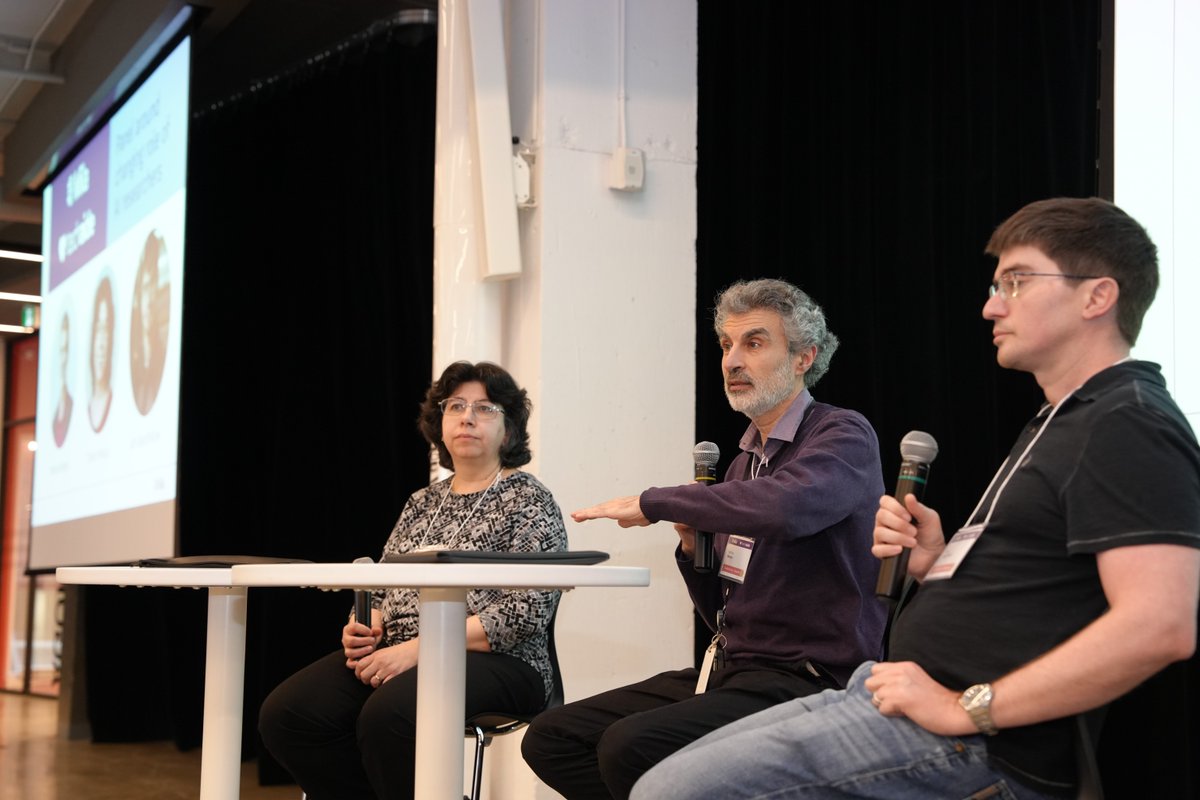
Exciting news! We're thrilled to announce the appointment of Professor @hugo_larochelle as Mila's new Scientific Director! A deep learning pioneer and former head of Google's AI lab in Montreal, Hugo's leadership will be pivotal in advancing AI for the benefit of all. Read the full press release here: https://t.co/K2xdFyr2wW
I’m really sad that my dear friend @FelixHill84 is no longer with us. He had many friends and colleagues all over the world - to try to ensure we reach them, his family have asked to share this webpage for the celebration of his life: https://t.co/1QoyHmAD3p
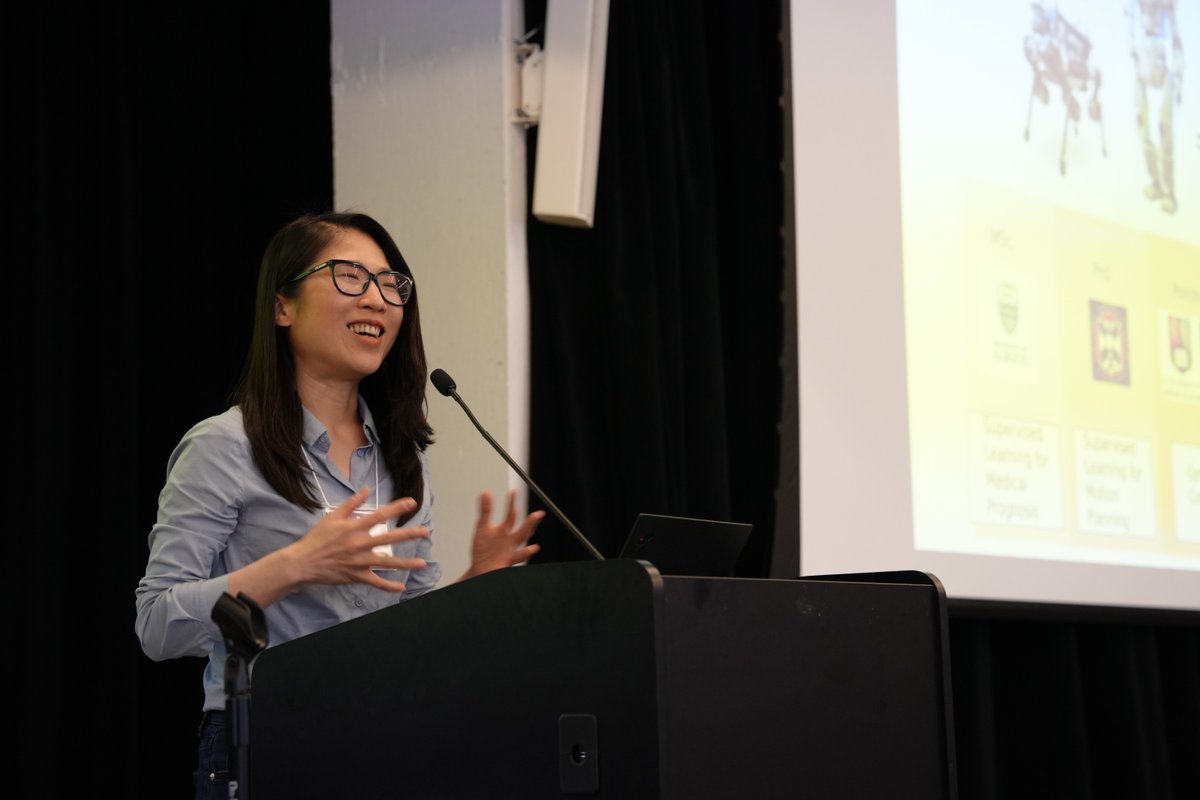
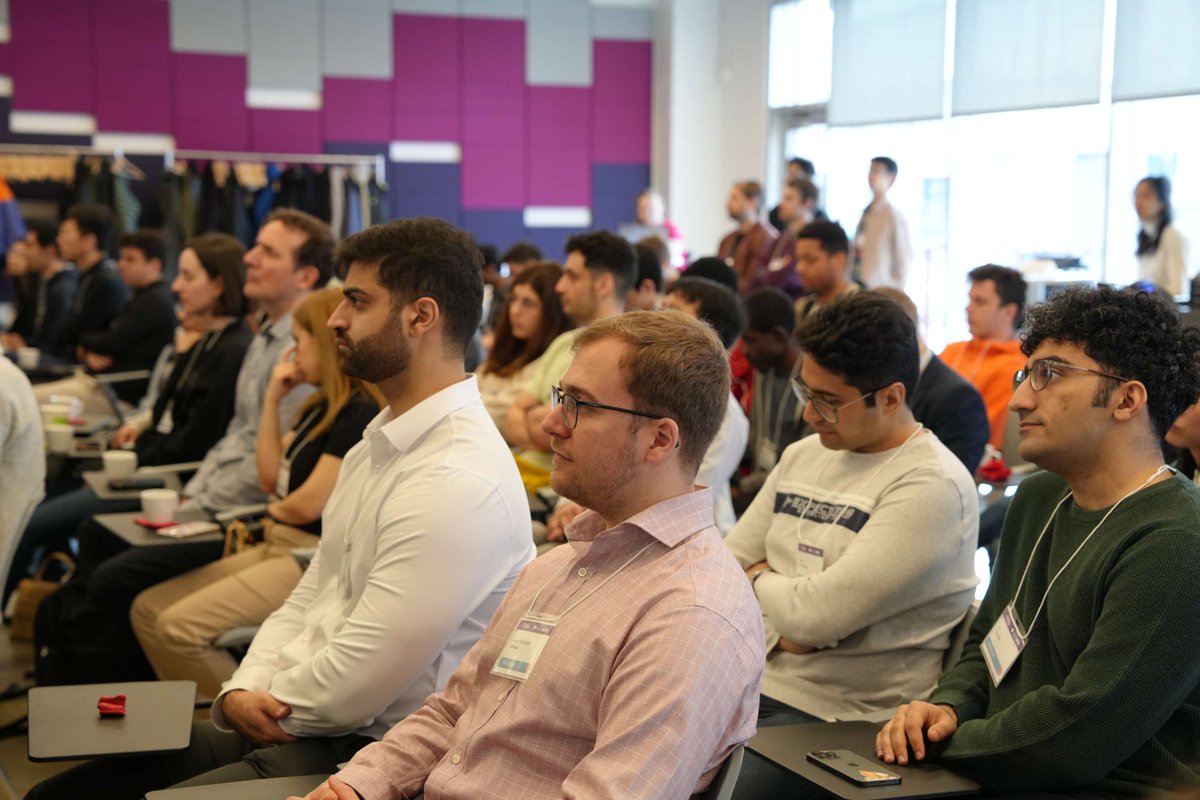
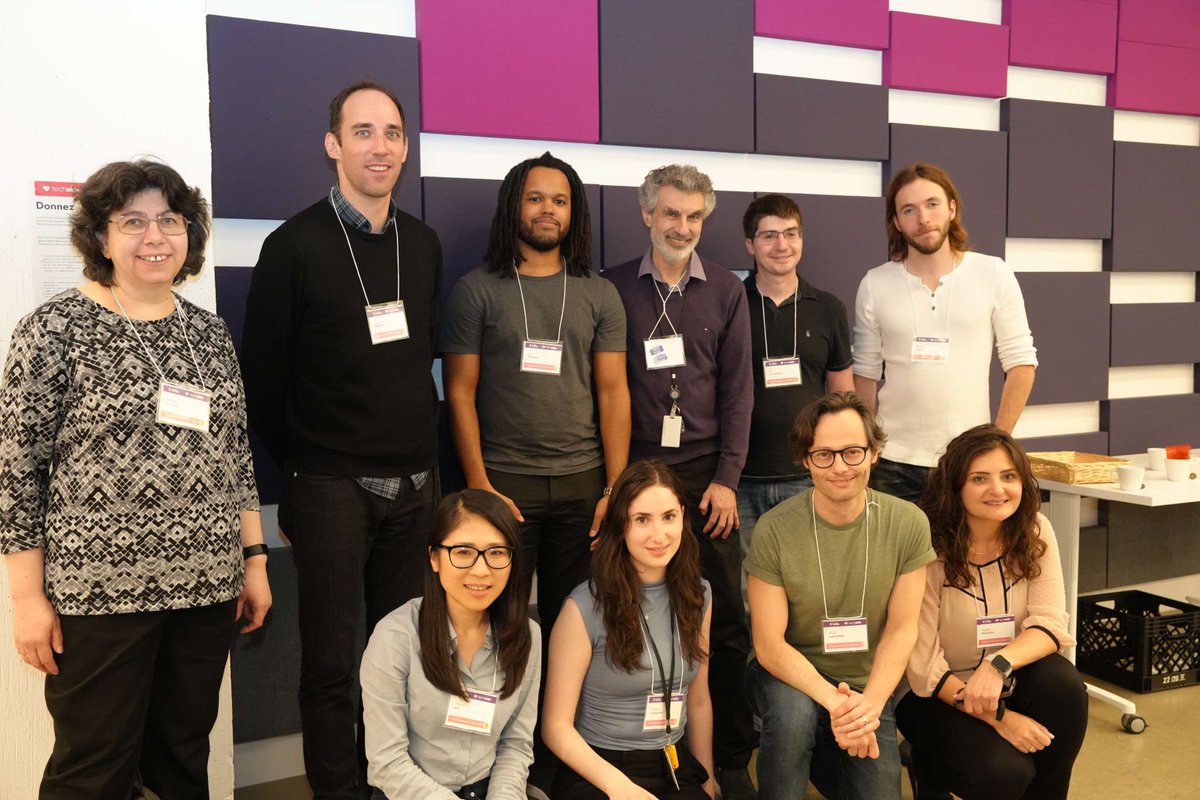
The Mila Techaide event last Friday was a real success! We're thrilled to announce that we raised more than $100k in support of @CentraideMtl. A huge thank you to everyone for your generous donations, and special thanks to all our panellists and speakers. See you next year!
Le 12 avril, lors de l'événement Mila @TechaideMTL, nous aurons le plaisir d'accueillir @goodfellow_ian, chercheur scientifique chez Google DeepMind.
Intéressé⋅e à en savoir plus sur ses projets, tout en soutenant une bonne cause? Inscrivez-vous : https://t.co/zTB4zjDqIZ
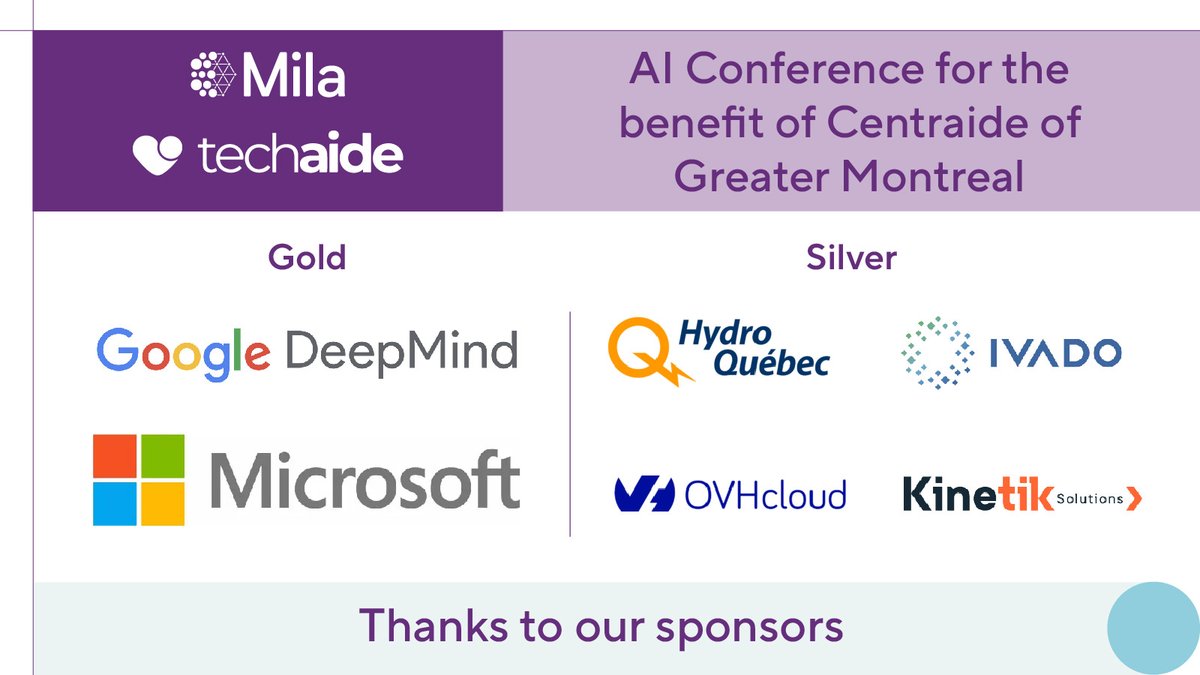
Many thanks to our generous sponsors whose support makes this year's Mila Techaide AI Conference possible: @Microsoft@GoogleDeepMind@hydroquebec@OVHcloud_CA Kinetik Solutions and @IVADO_Qc!
The event is this Friday. Secure your spot – Register now: https://t.co/HAi33c0hS1
📣📣📣 Please don't miss the TechAide AI Conference on April 12! Join us for presentations by Ian Goodfellow, Bruce Schneier, Hsiu-Chin Lin, Ryan Lowe, and Sara Sabour, as well as a panel discussion featuring Yoshua Bengio and Doina Precup.
https://t.co/M3fT6QBNoq
Mila Techaide : rejoignez-nous le 12 avril pour assister aux présentations de Ian Goodfellow, Bruce Schneier, Hsiu-Chin Lin, Ryan Lowe et Sara Sabour, ainsi qu'à une table ronde réunissant Yoshua Bengio et Doina Precup.
Consultez le programme détaillé : https://t.co/cxS3T9ROPQ
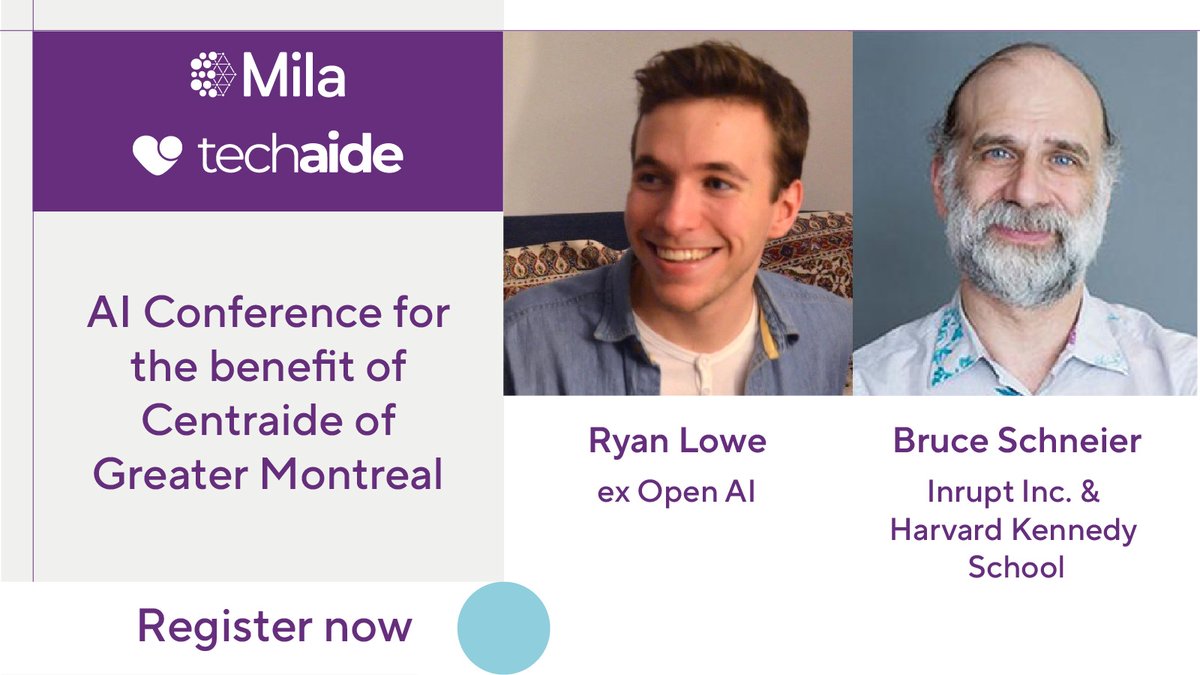
Registration is still open for the Mila @TechaideMTL event on April 12! We're delighted to announce that Ryan Lowe (ex OpenAI) and Bruce Schneier (Harvard Kennedy School and Inrupt) will be joining us as guest speakers.
Details and ticket purchase: https://t.co/ECVBKSQVlq
The Mila @TechaideMTL event is just over a month away, and we’re delighted to announce that @sabour_sara, Research Scientist at Google will be joining us as a guest speaker!
Interested in attending her talk? Buy your ticket now: https://t.co/IUKUT46Nq9
On April 12, as part of the Mila @TechaideMTL event, we'll have the pleasure of welcoming @goodfellow_ian, Research Scientist at Google DeepMind.
Interested in learning more about his projects, while supporting a good cause? Buy your ticket here:
https://t.co/xDkKEpjzsu
I have just recently found out that Aapo Hyvarinen, the inventor of several influential ideas for modern generative AI research, like noise-contrastive estimation, score-matching, and ratio-matching, wrote a book on understanding human suffering with AI: https://t.co/AG6yQuIMoB
📢new paper!📢
we treat learning-from-human-feedback as a density estimation problem.
we show learning a reward model of preferences (e.g. RLHF) is essentially learning user's pref. distrib.
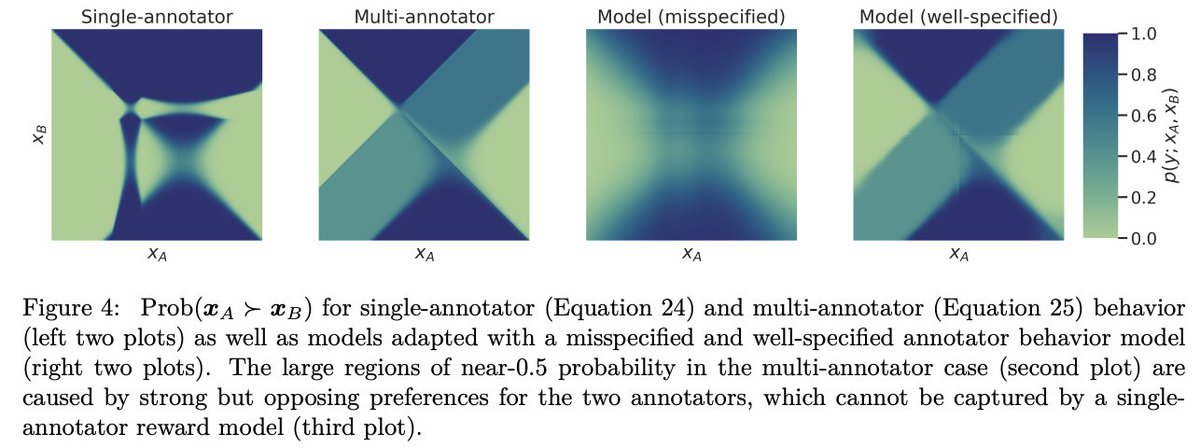
we also discuss difficulties w/ annotator misspecification (see img)
deets in thread! 👇🏾
New paper by my colleagues @_ddjohnson, @pcastr, @hugo_larochelle, @ynd, and me on learning from pairwise human preferences seen through the lens of probabilistic modelling: https://t.co/b6JHqclsdv.
It is really funny how the research landscape evolves in surprising ways. When we were working on or even thinking about running experiments on language modeling between 2013 and 2018, we were being criticized that language modeling is a useless task.
Hyped to share JaxPruner: a concise library for sparsity research.
JaxPruner includes 10+ easy-to-modify baseline algorithms and provides integration with popular libraries like t5x, scenic, dopamine and fedjax. 1/7
Code: https://t.co/tPwCL03xnE
Paper: https://t.co/eedLJj5EVW
Excited to introduce Tied-Augment! A general framework that improves pretraining, finetuning, semi-supervised learning with only a few lines of code, while also enabling data-augmentation to help even few-epoch training.
https://t.co/3bNIPmpVdZ