The only token positioned to bring @RobinhoodCrypto back with a vengeance is $WALLET
Launched straight from core engineers right at the beginning of the chain with fat liquidity & unlimited capabilities.
If Robinhood chain is for the people then Robinhood $WALLET is the reward
Extremely bullish $WALLET relative strength while all of Robinhood chain capitulates as BTC tries to find a bottom.
Bigger onchain liquidity pool than CASHCAT (50m) and almost matching PONS (100m).
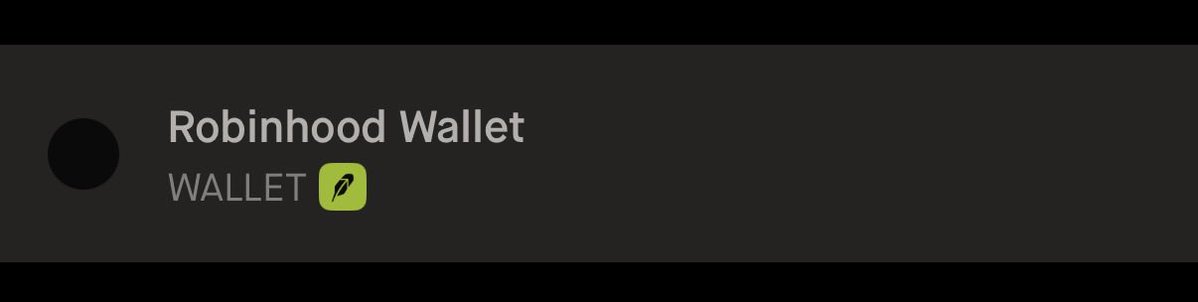
Robinhood wallet app has only one coin with a black logo instead of initials.
If you scroll the youtube comments of this interview its clear that Normies are still hesitant to trust Vlad - to trust robinhood after the whole Gamestop debacle.
Imo, this is part of the reason that they launched $Wallet in stealth - To change the narrative out there that robinhood only cares about the large Hedge funds.
EVERYONE was given an equal chance to accumulate tokens BEFORE they unstealth and the institutional investors pile in.
The robinhood story is about what?
Stealing from the rich and giving to the poor.
Imagine the narrative shift when they print Millionaires with $Wallet
Its getting hard to find a winner. This is definitely not the season. Feels like another one is close thou. During this time I'm fine tuning my skills ... working on improving the BOSS and considering when to add more $WALLET
Yeah I know I dig into legit tech ones, find scams and all. But $WALLET just still has real lore and when Robinhood chain starts running again.. its a safe bet.
(1/6) Weekly $WALLET update | Oct 31-Nov 6 | Only NEW findings/protocols/integrations
Newly verified lending, debt servicing and managed liquidity, plus one market preparation.
Token: 0x0339f5459fc690ac85f1782e15782a151b4a9e1b
(1/8) 🧵Weekly $WALLET update | Oct 24-31 | Only NEW findings
Seven updates: an index holding WALLET, LP-share staking, platform support, an Earn reopening and more.
Newly verified use/support
Token: 0x0339f5459fc690ac85f1782e15782a151b4a9e1b
Connect the dots
Morpho is a lending platform. Its own Robinhood Chain data shows $WALLET as a supplied loan asset.
That means $WALLET has actually been put into Morpho’s lending system, where assets can be supplied for lending.
So this is a direct $WALLET → Morpho connection, not just $WALLET using the same blockchain or router.
And what’s $WALLET’s connection to Stock Tokens?
Wallet 0x2147 is a Stock Token / trading-infrastructure account on Robinhood Chain
0x214753A212C0b3d6fa2445a50FE92E0B196b6434 = Robinhood Stock Tokens / RobinHoodSettler / trading & liquidity infrastructure
0x2147 later interacted with official Robinhood Stock Tokens, RobinHoodSettler, and Uniswap liquidity infrastructure
0xF718 funded 0x2147 before public mainnet
The same 0xF718 also funded aa33, which later deployed $WALLET
0x2147 matters because it connects 0xF718 directly to Robinhood-specific infrastructure AND $WALLET
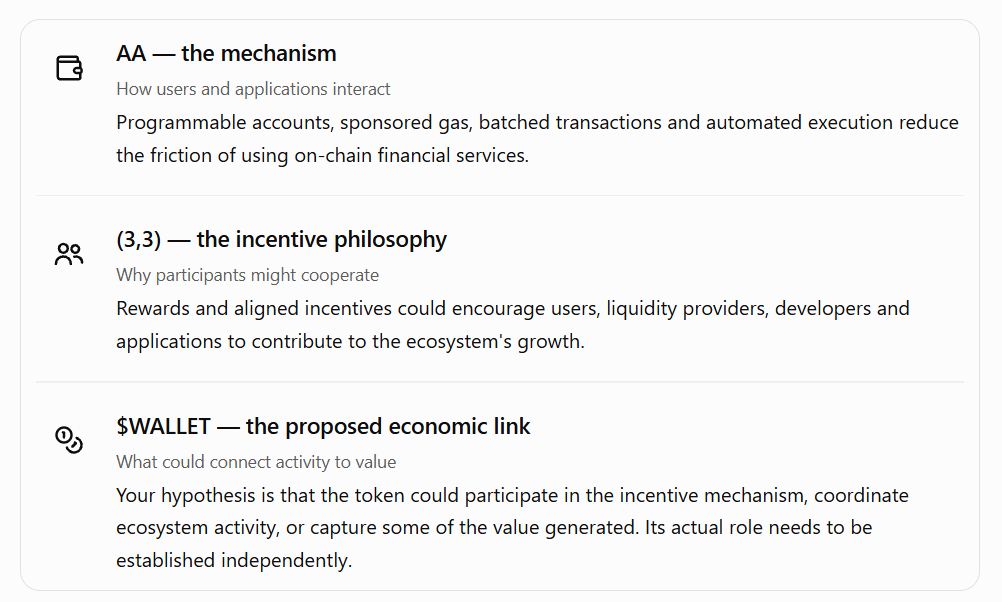
The Robinhood Chain flywheel thesis: AA + (3,3)
DEEPDIVE.
@RobinhoodCrypto could be building more than a blockchain for tokenized stocks. It could be working on a programmable financial distribution network in which wallets control the user experience, incentives coordinate participation, and $WALLET potentially connects the economic activity.
The central idea is that these components are complementary. AA can make participation easier; incentives can make participation worthwhile; and a token could, if designed for that role, help coordinate those incentives.
The flywheel only becomes economically meaningful if each stage reinforces the next.
To understand why this flywheel could matter, start with the business Robinhood is trying to build.
Tokenizing a stock is only one part of the opportunity. The bigger opportunity is controlling the infrastructure through which people discover, access, hold, trade and use financial assets.
Robinhood Chain is designed as an Ethereum-compatible Layer 2 for tokenized real-world assets, including equities and ETFs. Its official documentation describes an open network on which developers can deploy applications and users can interact with on-chain assets.
2. AA: turn the wallet into a programmable financial interface.
Traditional crypto wallets often expose users to the underlying mechanics of blockchain transactions.
A user may have to obtain ETH for gas, approve a token, execute a swap and then sign another transaction to complete a task.
Every additional step creates friction.
Account Abstraction changes what a wallet can do. ERC-4337 supports smart-account features such as gas sponsorship, transaction batching and programmable authorization.
This is illustrative: actual steps depend on the application, wallet configuration, token approvals and sponsor policies.
Why does it matter economically?
- Fewer steps can improve conversion from attempted transactions to completed transactions.
- Sponsored gas can let a new user transact before acquiring ETH.
- Session keys and programmable permissions can support approved automated activity.
- Batching can make complex interactions feel like a single operation.
AA does not automatically generate demand. It makes it easier to act on existing demand and creates more possibilities for applications to offer useful experiences.
AA is the mechanism that makes the participation layer programmable.
3. Programmable participation
Now imagine that the wallet is not just a place to store assets. It becomes the entry point to an ecosystem of financial applications.
A user could potentially interact with a decentralized exchange, provide liquidity, use an eligible lending protocol or authorize an automated strategy.
A smart account could be configured to execute certain permitted actions without requiring a fresh manual signature for every step.
That opens up a much broader design space. It would be a complete rebranding to the goal they're aiming for.
For example, a hypothetical application could offer:
- A gas subsidy for a user's first eligible swap.
- A reward for maintaining liquidity in a particular market.
- A fee discount for using a partner application.
- An incentive for completing a series of legitimate transactions.
- A reward for providing useful liquidity during a new market's launch.
These are examples of mechanisms an ecosystem could implement.
- Loyalty incentives.
The critical transition is from rewarding ownership alone to rewarding useful participation.
A wallet could become the point where identity, permissions, transaction execution and incentives meet.
That creates the conditions for a flywheel.
4. (3,3) enters the picture
Can a network and an ecosystem make it individually attractive for participants to take actions that also make the network more useful?
3,3 is a cooperative equilibrium
It represents a desired state where:
- Users have a reason to stay active.
- Developers have a reason to build.
- Liquidity providers have a reason to supply capital.
- Applications have a reason to integrate.
The ecosystem becomes more useful as these contributions accumulate.
The ideal is not that everyone simply buys a token and refuses to sell it. It is that participants benefit from helping create something that other participants genuinely want to use.
That is a potentially powerful design principle for a financial distribution network.
The deeper possibility: Robinhood Chain as an incentive-driven, tokenized financial distribution layer connecting users, developers, AI agents, and liquidity providers in a self-reinforcing economic flywheel.
Remember that time when @RobinhoodApp retweeted $WALLET bull @JJcycles with a wall full of $WALLET bullposting, while following 33 accounts (since mid September, after months of sitting at 32)?
Probably nothing.
The deeper version of the Wallet tokenization thesis is that @RobinhoodApp might be building two interconnected things: a tokenized distribution network for financial assets, and an economic flywheel with the same asset that makes that network increasingly valuable.
1. First, understand what Robinhood is
actually competing for
The tokenization race isn't simply a competition to put stocks on a blockchain.
Imagine several companies can offer tokenized exposure to the same stock. The underlying asset may be identical, but the customer experience surrounding it can differ enormously.
Which platform gives users access to the most assets?
Where is liquidity deepest?
Which wallet makes trading easiest?
Which platform offers the best execution, pricing, and incentives?
Where do users keep returning because their other financial activities are already integrated?
These are distribution questions.
Robinhood's strategic opportunity is to connect traditional financial products with blockchain infrastructure and deliver them through an interface people already know. If it succeeds, Robinhood Wallet could become more than a crypto wallet. It could become an access point between conventional financial markets and on-chain markets.
That matters because the company that controls distribution can influence where users trade, which assets they discover, and which infrastructure captures transaction activity.
And the more integrated the ecosystem becomes, the harder it may be for competitors to persuade users to leave.
2. Why the flywheel concept is important.
A flywheel is a business model in which one successful activity helps strengthen another, creating a cycle of growth.
The classic example is a platform that attracts users, which attracts developers and businesses, which improves the product, which attracts even more users.
Like a closed loop of demand inside an ecosystem.
This is consistent with Robinhood's publicly stated direction. Its July 2026 announcement described Robinhood Chain as infrastructure for tokenized stocks and DeFi, with integrations including Uniswap and Chainlink.
However, a flywheel can work perfectly well at the company level without any associated cryptocurrency. The question is whether Robinhood could extend its business flywheel into a separate token economy.
That's where the theory begins.
3. What if Robinhood tokenized the wallet economy itself?
First, we need to separate two ideas that sound similar but are fundamentally different.
$WALLET could theoretically be an incentive, utility, or transaction-related asset within the wallet ecosystem. Its value would depend on the actual rules governing its use and demand.
This would not mean the wallet app itself had been tokenized.
And also a token representing economic rights in the wallet business
Robinhood could theoretically issue the asset also with defined rights to certain revenue, distributions, or another economic interest. For example dividends.
That is a much more ambitious structure, involving questions of corporate ownership, contractual rights, securities regulation, and how the economic benefits would be funded.
4. Asset distribution.
Suppose Robinhood wants to reward users for trading tokenized stocks and other assets through its wallet.
It could use a system similar to Coinbase's newly announced program, where eligible swap activity determines rebates. But instead of paying all rewards in USDC, Robinhood could theoretically use a separate asset.
If Robinhood simply awards newly issued $WALLET to traders, those users may immediately sell their rewards. Distribution alone does not guarantee price appreciation.
If users must acquire or retain $WALLET to access meaningful benefits, the token could have a stronger demand mechanism. If an actual program purchases tokens from the market, that could add another source of demand.
And if holders receive a contractual claim on revenue like dividends, the valuation framework changes fundamentally.